68° and Clear
Image
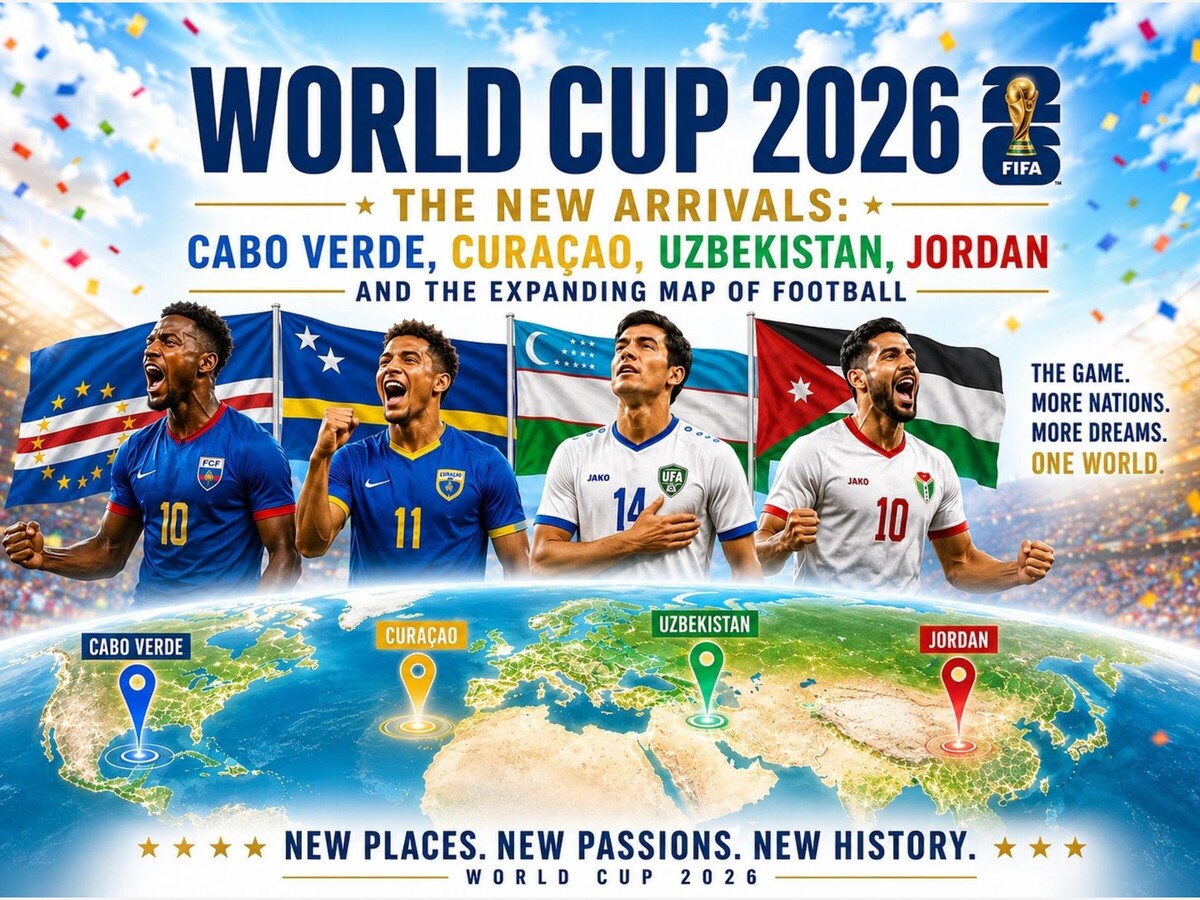



The questions are understandable. World Cups have always revolved around giants. The sport's greatest tournament naturally gravitates toward nations with the deepest histories, the largest supporter bases, the most recognizable stars, and the heaviest expectations. Yet every World Cup also contains another story, a quieter story that often receives less attention before kickoff but becomes increasingly important once the tournament begins. It is the story of arrival. It is the story of nations that have spent decades watching from the outside, the story of football cultures that developed far from the traditional centers of power, and the story of countries that once viewed qualification as a distant aspiration but now find themselves standing on the same stage as Brazil, Germany, Argentina, France, and England.
The expanded 48 team format of the 2026 World Cup has generated significant debate. Critics have questioned whether expansion risks diluting quality or weakening competition, while supporters argue that the larger field better reflects the modern realities of a global sport played and followed by billions. Both arguments contain elements of truth, but the qualification stories of Cabo Verde, Curaçao, Uzbekistan, and Jordan reveal something deeper. These nations are not merely beneficiaries of expansion; they are evidence of football's transformation. Their presence demonstrates how dramatically the global game has evolved over the past three decades.
The football world of 2026 is not the football world of 1990, and it is not even the football world of 2010. The sport's developmental infrastructure has expanded, coaching knowledge has spread, sports science has become global, and player pathways have diversified. Crucially, diaspora communities have strengthened connections between nations and talent pools. The result is a World Cup field that increasingly reflects football's actual global footprint. For the first time in history, nations that once existed at the margins of international football now arrive carrying realistic ambitions, tactical sophistication, and a growing belief that qualification is not the endpoint of their journey but the beginning. Their stories matter because they help explain where football is heading, and where football is heading may ultimately matter as much as who lifts the trophy in July.
For much of World Cup history, international football operated within a relatively stable hierarchy. The same powers qualified repeatedly, the same regions dominated tournament narratives, and the same countries supplied the overwhelming majority of champions. There were exceptions, of course, as every tournament produced surprises and every generation created a few memorable underdog stories. But the overall structure remained remarkably consistent, and the sport's center of gravity remained concentrated in Western Europe and South America.
That concentration shaped expectations. Supporters in emerging football nations often entered qualification campaigns with hope but limited realistic expectation. Qualification itself became the achievement, and simply reaching the World Cup represented success. What has changed over the last two decades is not merely access; it is capability. More countries now possess the tools necessary to compete. Youth academies exist in places where they once did not, coaches receive international training, players move across continents at younger ages, and technology allows tactical ideas to travel instantly. When sports science is no longer confined to elite European clubs, competitive balance eventually follows.
The arrival of the 2026 newcomers reflects that reality. Each followed a different path and each built success through different methods, but all four illustrate the same broader truth: football is becoming more geographically distributed than at any point in its history.
Few qualification stories in modern football are more remarkable than Cabo Verde's. A small island nation off the coast of West Africa, Cabo Verde possesses a population of just over 500,000 people, a demographic that would fit comfortably inside many major metropolitan areas around the world. By traditional football logic, that population size should create severe limitations because smaller countries generally face smaller talent pools, and smaller talent pools often translate into reduced competitiveness. Yet football has never been governed entirely by demographics. Culture matters, organization matters, and vision matters. In Cabo Verde's case, the country's vast diaspora became one of its greatest football assets.
The Cape Verdean story is, in many ways, a story about migration. Generations of Cape Verdeans established communities in Portugal, the Netherlands, France, Luxembourg, and other parts of Europe. These communities maintained strong cultural and familial connections to their homeland. As football became increasingly globalized, those connections began producing opportunities. Young players with Cape Verdean heritage entered European academies, received elite coaching, developed inside sophisticated football environments, and increasingly chose to represent Cabo Verde internationally.
This did not happen automatically. Under the guidance of the national federation, strategic pathways were created and vital relationships had to be built. Players had to be convinced that representing the Blue Sharks was not simply an emotional decision but a highly competitive one. That work took years, but the payoff is now visible under the tactical leadership of head coach Bubista.
The modern Cabo Verde national team no longer resembles the type of small nation that merely hopes to survive qualification campaigns. Featuring elite defensive talents like Logan Costa, veteran winger Ryan Mendes, and rising attackers like Dailon Livramento, the team possesses structure, technical quality, and international experience. Most importantly, they carry a growing sense of legitimacy, topping their qualifying group with definitive performances like their 3-0 victory over Eswatini.
The significance of qualification extends beyond football itself. For a nation often overlooked in global conversations, the World Cup offers visibility on an extraordinary scale. Millions of viewers who may never have heard of Cabo Verde will now encounter its flag, its players, and its story when they debut on the global stage in Atlanta. That visibility carries cultural significance because football has long functioned as one of the world's most powerful forms of national introduction. For Cabo Verde, 2026 represents exactly that opportunity.
The qualification of Curaçao tells a different story, but it is no less important as a catalyst for a broader Caribbean football renaissance. For decades, Caribbean football occupied a difficult position within the international landscape. The region produced extraordinary athletes, passionate supporters, and rich sporting cultures, yet translating those assets into sustained football success proved challenging. Infrastructure gaps persisted, domestic leagues struggled for resources, competition for sporting attention remained intense, and many talented athletes pursued other opportunities.
The emergence of Curaçao reflects how those dynamics have begun to change, driven extensively by a modernized approach to international recruitment and a unique connection to Dutch football. Under a highly organized football federation, players developed in the Netherlands increasingly became eligible to represent Curaçao. That connection expanded the available talent pool dramatically, creating a vital bridge between Caribbean football culture and elite European football development systems.
The modern Curaçao national team benefits from both sides of this hybrid identity. The squad features a sophisticated core of players with top tier professional experience, anchoring their 2026 qualification campaign with prominent talents like Tahith Chong, Leandro Bacuna, and veteran goalkeeper Eloy Room. These players arrive with high level tactical education and exposure to intense competition, yet they also carry the energy and pride associated with representing a small island nation on the global stage.
This combination has transformed expectations. Curaçao is not arriving at the World Cup simply to participate; the country arrives believing it belongs. That shift in mentality is one of the most important developments in international football. Historically, many smaller nations entered major tournaments burdened by inferiority, respecting opponents before matches even began. Modern football increasingly rejects that mindset.
Teams like Curaçao have grown up watching Morocco reach a World Cup semifinal, watching Croatia reach multiple finals and semifinals, and watching Japan defeat Germany and Spain. They have seen smaller football nations challenge established powers, and the lesson is obvious: reputation alone does not determine results. Organization, preparation, and execution matter more than ever, and Curaçao's historic qualification stands as a direct reflection of that evolution.
If Cabo Verde represents diaspora success and Curaçao represents Caribbean transformation, Uzbekistan represents something different: the ultimate triumph of long term national investment. For years, Central Asia remained largely absent from elite football discussions. The region produced occasional talent but struggled to establish a sustained international presence. That reality began changing as countries invested more aggressively in development, and Uzbekistan emerged as one of the most ambitious examples.
The country's football authorities spent years building a robust infrastructure from the ground up. Academies expanded, youth development improved, the domestic Uzbekistan Super League strengthened, and international exposure increased. None of these changes generated immediate results, because they rarely do. Football development is an institutional, long term project where generations must be trained, systems must mature, and knowledge must accumulate. Uzbekistan's qualification, navigating the rigorous Asian football landscape to finish as a dominant force in the final rounds, demonstrates what can happen when that process remains consistent.
Now managed by Italian legend Fabio Cannavaro, the White Wolves possess a tactically disciplined squad built around generation defining talents. At the back, young Manchester City defender Abdukodir Khusanov provides world class security, while all time leading scorer Eldor Shomurodov anchors the attack. Their historic breakthrough was finally sealed in a tense, final round clash against the United Arab Emirates, where a brilliant clean sheet by goalkeeper Utkir Yusupov secured the definitive point.
The achievement matters far beyond the country's borders. For much of football history, Central Asia existed outside the sport's main narrative, but qualification changes that reality entirely. The region now possesses a premier representative on football's biggest stage. That visibility has the potential to inspire future investment, participation, and ambition across neighboring countries, creating the exact ripple effects that World Cups are known for. Children watch, governments notice, sponsors invest, and clubs expand. The consequences extend far beyond a single tournament. For Uzbekistan, qualification represents both a culmination and a beginning. The country has reached the World Cup, and now it must determine what comes next.
Perhaps no newcomer enters the 2026 tournament carrying a more emotionally resonant story than Jordan. Known affectionately by generations of faithful supporters as Al Nashama, Jordan's football journey has been defined by persistence. The country spent years hovering near breakthrough moments where qualification often appeared possible, or even probable, yet it remained elusive. Near misses accumulated, disappointments lingered, and progress felt tangible but incomplete.
That history makes the eventual breakthrough under Moroccan manager Jamal Sellami significantly more meaningful. The supporters understand exactly how difficult qualification can be because they remember the campaigns that ended just short, the opportunities missed, and the moments that slipped away. As a result of that collective memory, this success feels deeply earned.
The turning point for Jordanian football was forged during their historic, thrilling run to the 2023 Asian Cup Final, which proved to the players and the nation that they could go toe to toe with the continent's established titans. That momentum carried directly into the World Cup qualifiers, where they secured their historic ticket to North America by finishing second in their group, punctuated by a definitive victory over Oman.
The heartbeat of this historic squad is winger Musa Al-Taamari, whose trailblazing success as a standout in France's Ligue 1 has inspired a completely fearless mentality across the entire roster. Alongside the defensive stability of Yazan Al-Arab and the balanced midfield play of Noor Al-Rawabdeh, Jordan brings a deeply unified squad to North America.
Jordan's arrival at the World Cup carries a significance that extends far beyond sport. National teams often function as mirrors of collective identity, providing shared experiences, shared emotions, and shared memories. For countries without extensive World Cup histories, qualification can become a defining national milestone. Jordan now joins that category, celebrating an achievement that belongs not only to the players and coaches but to generations of supporters who continued believing despite repeated setbacks. That emotional investment will travel with the team across North America, and while experience may favor more established nations, profound emotion should never be underestimated in tournament football.
The newcomers collectively offer something incredibly valuable to the 2026 World Cup: perspective. Football's established powers often operate under enormous, crushing institutional pressure. Every single match is analyzed relentlessly, and anything short of a deep tournament run can feel like a devastating national failure. The newcomers experience the tournament differently because their presence itself represents history.
That reality creates an immense sense of competitive freedom, and freedom can be dangerous. Teams playing without fear often become highly difficult opponents. They approach matches with fewer psychological burdens, choosing to embrace opportunity rather than buckling under the weight of expectation.
History contains numerous examples of this phenomenon, from Senegal in 2002 and Costa Rica in 2014 to Morocco's historic run in 2022. Unexpected success rarely emerges from nowhere; it usually begins with a nation arriving at the tournament carrying a quiet confidence that outsiders failed to recognize. The newcomers of 2026 understand this context perfectly. They have watched previous underdogs reshape tournaments, they know monumental surprises are possible, and they arrive determined to create their own.
The arrival of Cabo Verde, Curaçao, Uzbekistan, and Jordan reveals something fundamental about the modern game: football's future is becoming broader than its past. The traditional powers remain powerful. Argentina remains Argentina, Brazil remains Brazil, and France remains France. History still matters, infrastructure still matters, and depth still matters. But access to elite football knowledge, advanced development systems, and international opportunity has expanded dramatically, breaking through old borders.
That expansion is changing who gets to participate, who gets to dream, and who gets to believe. The 2026 World Cup will feature giants, it will feature champions, and it will feature global stars. But it will also feature nations making history simply by being there, and that matters immensely. Because every established football power was once an outsider, every grand tradition began somewhere, and every football culture started with a first appearance.
The newcomers of 2026 now begin writing those chapters for themselves. Some may struggle, some may surprise, and one may become the tournament's breakout story. History offers no guarantees, only opportunity. What is certain is that football's map continues expanding. The sport belongs to more countries than ever before, more supporters than ever before, and more dreams than ever before.
Perhaps that is the most important story of World Cup 2026 before a single ball has been kicked. The tournament is not merely growing; it is becoming more representative of the game the world actually plays. And that may prove to be one of its most enduring legacies.
MinneapoliMedia | Community. Culture. Civic Life.


Sunny, with a high of 94 and low of 67 degrees. Sunny during the morning, clear overnight.