63° and Moderate rain at times
Image
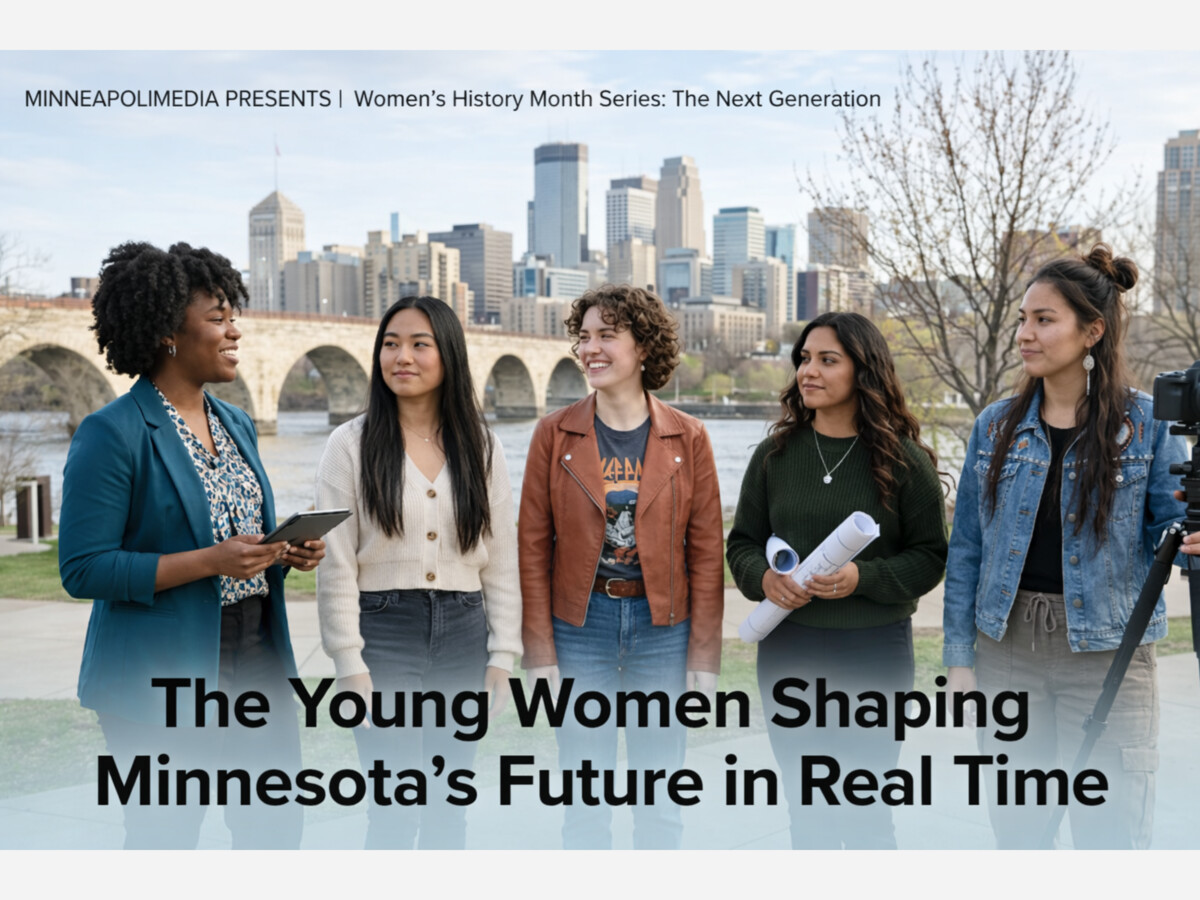
Illustration By MinneapoliMedia



On a cold afternoon in Minneapolis, a college student sits at a table inside a campus building, laptop open, phone within reach, toggling between messages.
One thread is about a mentorship program she helped organize for high school students. Another is a group chat coordinating transportation for a community event that evening. A third is a running list of resources for students navigating housing instability.
She is not elected.
She does not hold a formal title.
There is no press release attached to her work.
But by the end of the day, dozens of people will have been connected to something they needed.
Across Minnesota, scenes like this are no longer unusual.
They are becoming the pattern.
Young women are building systems in real time, often while still moving through the very institutions they are working to improve.
In Saint Paul, a young organizer working with a neighborhood-based nonprofit finishes her shift and transitions directly into a planning meeting with other volunteers. The focus is on expanding a weekend food distribution program that began as a small effort during a period of increased need and has since grown into a consistent operation serving multiple families.
There is no formal announcement marking her as a leader.
There is no defined moment when leadership began.
It emerged through responsibility.
She showed up consistently.
She took on more coordination.
She became someone others relied on.
This is how much of this generation is operating.
Leadership is not assigned.
It is assumed through action.
The work these young women are doing is shaped by the conditions around them.
Across Minnesota, they are navigating rising housing costs, increasing student debt, and a job market that continues to shift. At the same time, they are engaging directly with disparities that remain visible in education, healthcare, and economic opportunity.
In Brooklyn Park, a young professional balances a full-time job with organizing weekend workshops focused on financial literacy for younger students. The sessions cover budgeting, credit, and pathways into higher education.
Her motivation is direct.
“These are things I had to figure out on my own,” she explains. “If we can make that easier for someone else, we should.”
Her work is not theoretical.
It is corrective.
In North Minneapolis, a small group gathers in a community space on a weeknight to discuss mental health resources. The conversation is open, direct, and grounded in lived experience.
The session is led by a young African American woman who started the group after recognizing a gap in accessible, culturally relevant mental health support within her community.
She is not a licensed clinician.
But she understands the barriers.
She coordinates guest speakers, connects participants to available services, and maintains a space where people can speak openly without fear of stigma.
This work exists at the intersection of community need and system limitation.
It reflects a broader pattern.
African American young women across Minnesota are identifying where systems fall short and building responses that are immediate, practical, and rooted in trust.
They are not waiting for institutional solutions.
They are creating parallel ones.
At the University of Minnesota, student-led organizations continue to expand their reach, addressing issues ranging from academic support to cultural representation. Many of these efforts are led by young women who are balancing coursework with organizational leadership.
In one case, a student group focused on supporting first-generation college students has grown from a small peer network into a structured program offering mentorship, workshops, and resource navigation.
The work is both internal and external.
It operates within the university while also addressing gaps that the institution itself does not fully cover.
This dual approach is becoming common.
Young women are not choosing between working inside systems or outside them.
They are doing both.
In Minneapolis and surrounding areas, young women are also entering entrepreneurship earlier.
Some are launching small businesses while still in school. Others are building service-based companies that respond directly to community needs.
A young entrepreneur running a home-based catering business explains it simply:
“I didn’t see an opportunity, so I created one.”
Her business provides income, but it also creates connection. Many of her clients are within her own community, and her work often extends beyond transactions into relationships.
Entrepreneurship, in this context, is not only economic.
It is relational.
What distinguishes this generation is not only what they are building, but how quickly they are building it.
Digital tools allow them to organize in hours what once took weeks. Events are planned through group chats. Resources are shared instantly. Networks form across cities without physical meetings.
This speed increases impact.
It also increases responsibility.
Information must be accurate.
Coordination must be consistent.
Engagement must be sustained.
Even so, the ability to act quickly has changed what is possible.
The work comes with pressure.
Many of these young women are managing:
often at the same time.
They are expected to perform, contribute, and lead while still establishing their own stability.
In some cases, they are building support systems for others before fully securing those systems for themselves.
And still, the work continues.
The results of this work are not hypothetical.
Programs are operating.
Communities are being served.
Networks are expanding.
Conversations are shifting.
These are measurable outcomes.
They reflect leadership that is already in place.
The question is no longer whether this generation is capable.
The record is already visible.
The question is whether institutions, policymakers, and established leaders are prepared to recognize and support what is already happening.
Support can take many forms:
Without that support, the work will continue.
But its reach will be limited.
The phrase “next generation” suggests something that has not yet arrived.
Across Minnesota, that is no longer accurate.
The leadership is already here.
It is happening in classrooms, community spaces, small businesses, and digital networks.
It is happening in ways that are practical, sustained, and measurable.
It is shaping the state now.
Minnesota has long been shaped by women who stepped forward when systems were incomplete.
That pattern has not ended.
It has continued through a new generation that understands both the history it inherits and the conditions it must navigate.
They are not waiting for the future.
They are building it.
And in doing so, they are ensuring that Minnesota’s next chapter is already underway.
MinneapoliMedia
Community. Culture. Civic Life.



Sunny, with a high of 80 and low of 57 degrees. Sunny during the morning, clear overnight.