66° and Overcast
Image
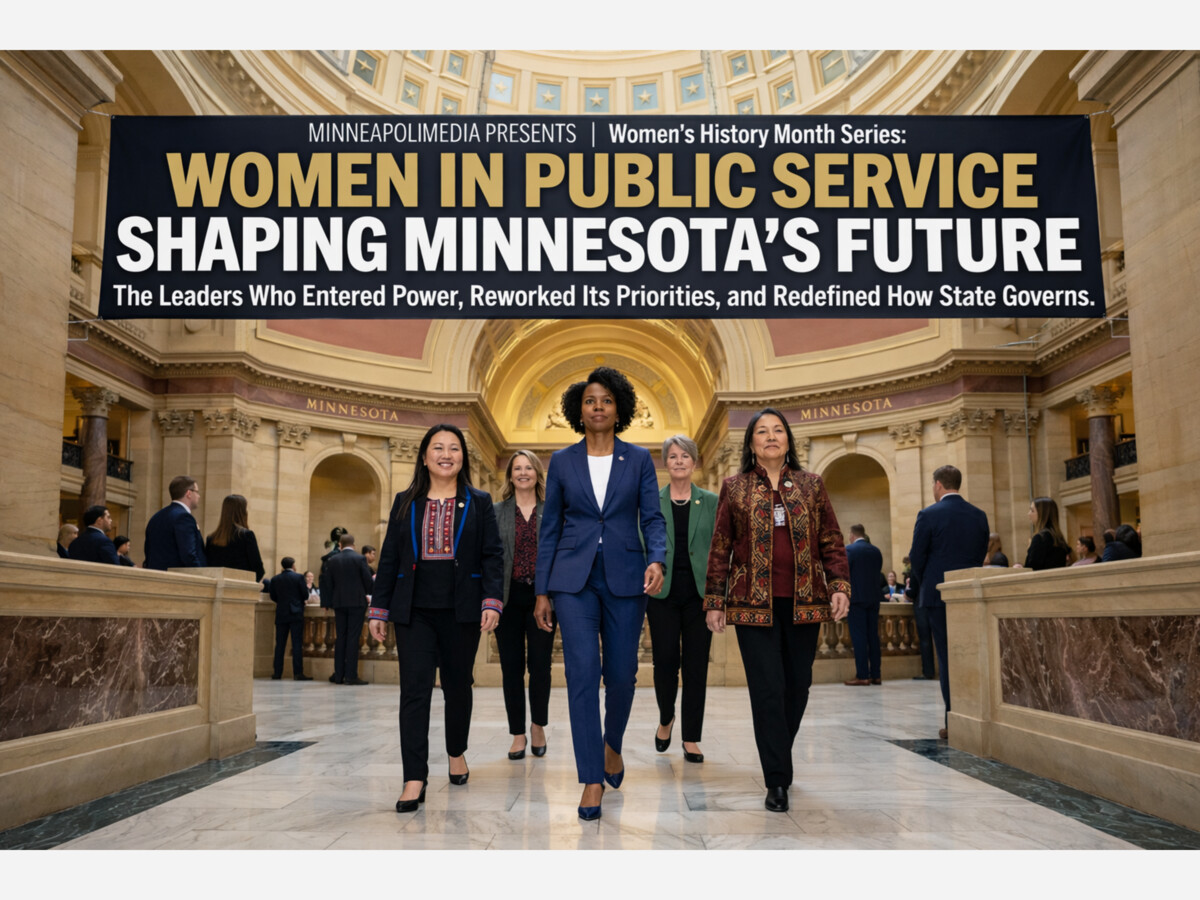
Illustration By MinneapoliMedia



Public service in Minnesota is often described through structure.
The Legislature meets in St. Paul to debate and pass laws. City councils vote on budgets, zoning decisions, and local ordinances. County boards oversee services that affect public health, transportation, and housing. State agencies administer programs that reach into nearly every aspect of daily life.
From a distance, these systems appear stable and procedural. They suggest continuity and order.
But institutions do not explain how they came to function as they do.
They reflect the people who have shaped them over time.
In Minnesota, the evolution of public service cannot be understood without examining the role women have played in entering systems that were not built to include them and then altering how those systems operate.
Their contributions did not simply increase representation.
They changed priorities, expanded access, and reshaped the relationship between government and the communities it serves.
For much of Minnesota’s early history, access to public office followed clearly defined boundaries.
Leadership positions were concentrated within a narrow segment of the population. Women were largely excluded from formal decision-making roles, even as they contributed extensively to civic life through community organizing, education, and social support systems.
The absence of women in elected office did not reflect a lack of capacity.
It reflected structural barriers.
When women began to enter public service in greater numbers, they did so within systems that had already been established without their participation. Policies, procedures, and expectations were already in place.
Gaining access to these systems required persistence.
Influencing them required strategy.
The appointment of Muriel Humphrey in 1978 is often cited as a milestone in Minnesota’s political history.
Her appointment to the United States Senate followed the death of her husband, Senator Hubert Humphrey, but her role carried significance beyond succession.
She entered a space that had historically excluded women and contributed to a broader shift in how leadership was understood at both the state and national levels.
Her presence did not resolve issues of representation.
It made them more visible.
It marked a transition from exclusion toward inclusion, while also underscoring how much work remained.
Long before representation expanded within elected office, women in Minnesota were influencing policy through organizing, advocacy, and sustained civic engagement.
Nellie Stone Johnson provides a clear example.
Johnson’s work in labor organizing connected employment conditions to public policy. She was involved in efforts that contributed to fair employment legislation, demonstrating that policy is often the result of sustained advocacy rather than isolated legislative action.
Her work illustrates a broader reality.
Public service does not begin when an individual takes office.
It often begins when individuals identify systemic issues and organize to address them.
By the time policies are debated in legislative chambers, much of the groundwork has already been laid.
When Sharon Sayles Belton was elected mayor in 1994, she became both the first woman and the first African American to lead the city.
Her election reflected changes in representation, but it also marked a shift in how executive leadership was exercised.
Her administration engaged directly with issues such as economic development, public safety, and community engagement during a period when cities across the country were confronting structural challenges.
Leadership at this level is not only about occupying a position.
It is about determining priorities, allocating resources, and setting the tone for how institutions respond to the communities they serve.
Representation at the executive level changes those decisions.
While elected officials often receive the most attention, public service in Minnesota operates through a wide network of roles that extend beyond elected office.
Women serve in state agencies, city departments, and county offices where policies are implemented on a daily basis.
They manage housing programs, oversee public health initiatives, coordinate transportation services, and assist residents navigating complex systems.
This work is administrative, operational, and direct.
It determines whether policies are effective in practice.
It determines whether services are accessible.
It determines whether individuals receive the support they need.
Public service, in this sense, is not limited to decision-making.
It includes execution.
Today, women in Minnesota hold positions across all levels of public service.
They serve in the Minnesota Legislature, participate in city and county governance, and lead divisions within state agencies.
Through ongoing engagement with legislators and public officials, a pattern has become clear.
Many leaders are grounding their work in direct community experience.
They are bringing local concerns into policy discussions, emphasizing practical outcomes, and maintaining ongoing communication with the people they represent.
In legislative discussions, leaders such as Huldah Momanyi-Hiltsley have focused on community development and infrastructure that reflects the needs of growing and diverse populations.
Her work highlights the importance of aligning policy with local conditions rather than applying broad solutions without adjustment.
Similarly, Kari Rehrauer has emphasized responsiveness to constituents and the importance of addressing issues that affect families directly, including economic stability and access to services.
These approaches illustrate a shift in how policy is developed.
It is increasingly informed by direct engagement rather than distance.
Despite progress in representation and policy development, Minnesota’s public systems continue to face challenges.
Disparities remain in education outcomes, healthcare access, housing stability, and economic opportunity.
Public service operates within these constraints.
Leaders must navigate existing systems while working to improve them.
This requires balancing immediate needs with long-term policy goals.
It also requires an understanding of how structural limitations affect outcomes.
African American women in Minnesota continue to play a significant role in holding public systems accountable.
They advocate for policy changes that address measurable disparities. They bring attention to gaps in service delivery. They work within institutions while also engaging with community-based organizations to ensure that concerns are addressed.
This work often involves sustained engagement rather than singular actions.
It requires persistence and coordination.
It reflects a long-standing pattern in which African American women have contributed to expanding access and strengthening accountability within public systems.
One of the most consistent contributions women have made to public service in Minnesota is the ability to connect policy development with implementation.
Policies are often written in formal settings.
Their impact is realized through application.
Women working in public service frequently operate at this intersection.
They translate policy into practice. They identify where adjustments are needed. They ensure that systems remain responsive to the people they serve.
This function is essential to effective governance.
Without it, policy remains theoretical.
The continued development of public service in Minnesota depends on how leadership is supported.
Access to resources, mentorship, and institutional backing influences how effectively leaders can operate within existing systems and expand their impact.
Support structures determine whether progress is sustained.
They influence whether new approaches can be implemented and whether existing systems can adapt to changing conditions.
Minnesota’s public institutions did not become more inclusive through a single event or decision.
They evolved through sustained effort.
Women have been central to that process.
They entered systems that did not initially include them.
They influenced policy development.
They strengthened accountability.
They expanded access to leadership.
Their contributions changed how public service functions in the state.
That change is ongoing.
It continues to shape how Minnesota governs itself and how it responds to the needs of its residents.
The record is clear.
Public service in Minnesota is not defined only by its structures.
It is defined by the people who continue to shape them.
MinneapoliMedia
Community. Culture. Civic Life.



Patchy rain nearby, with a high of 66 and low of 53 degrees. Overcast in the morning, partly cloudy in the afternoon, clear in the evening, patchy rain nearby overnight.