63° and Moderate rain at times
Image



BLAINE, MN
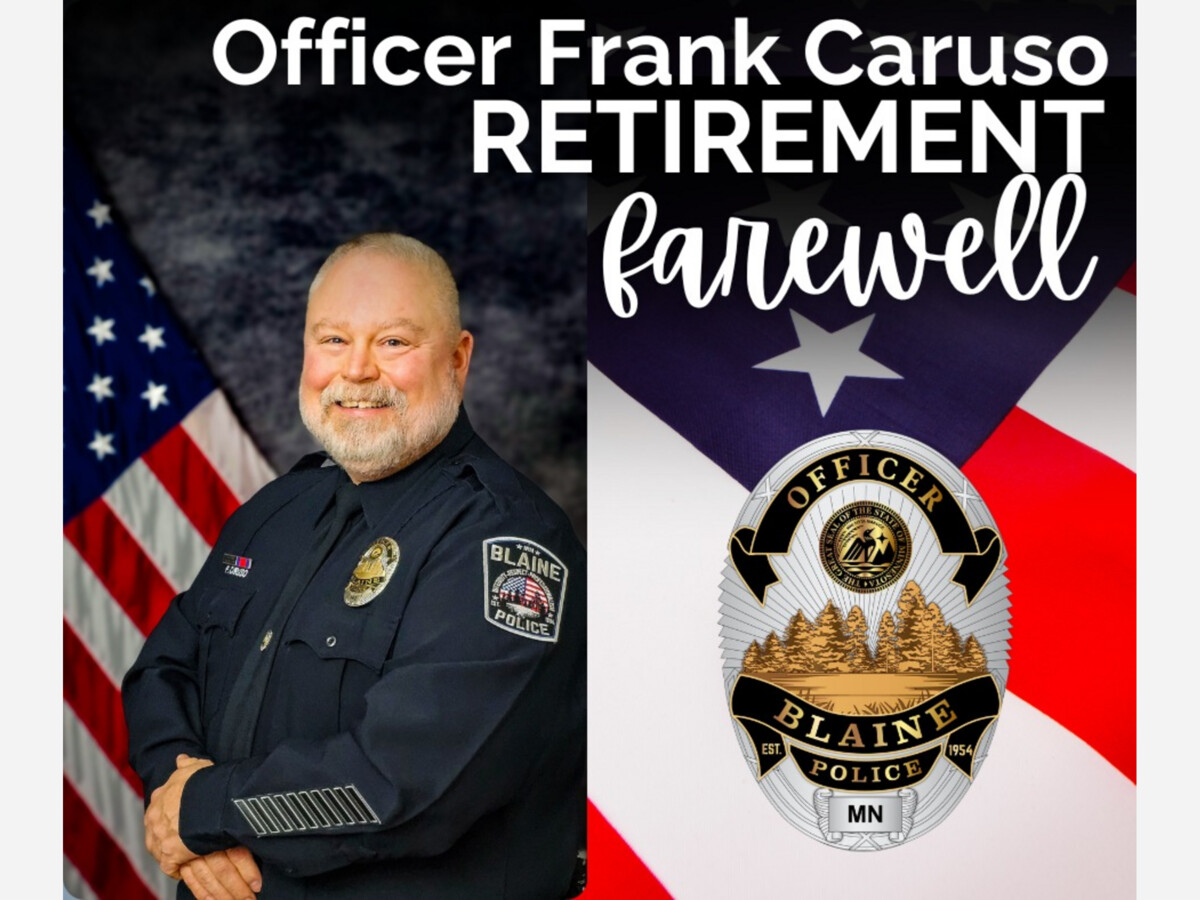
After more than three decades in law enforcement, including 25 years with the Blaine Police Department, Officer Frank Caruso officially retired on March 24, closing a career that helped shape not only a department, but generations of officers trained under his watch.
His retirement marks the end of a 33-year tenure in Minnesota policing, one defined by a rare combination of technical mastery, instructional leadership, and sustained community presence.
Within the Blaine Police Department, Caruso was not simply a veteran officer. He became part of the institution’s internal foundation, a “trainer of trainers” whose influence extended far beyond his own patrol assignments.
Caruso’s path into policing began in 1993 with the St. Paul Police Department, where he entered one of the state’s most active urban policing environments. That early experience exposed him to high-volume calls, complex public safety challenges, and the demands of city-based law enforcement.
He later served with the Minnesota State Fair Police Department, where policing takes on a different scale and intensity, requiring coordination across large crowds and high-profile events. His time with the Wright County Sheriff’s Office added a county-level dimension, broadening his experience across jurisdictions and operational structures.
In 2001, Caruso joined the Blaine Police Department. What followed was a 25-year tenure that would define his professional legacy.
Over time, he evolved from patrol officer into one of the department’s most relied-upon mentors and instructors, helping to institutionalize training practices that continue to shape the agency today.
Caruso’s most enduring contribution to the Blaine Police Department lies in training, an area where his influence became both structural and generational.
He held instructional roles across nearly every critical domain of modern policing, including Use of Force Instructor, Firearms Instructor, Field Training Officer, Patrol Rifle Instructor, and Active Shooter Instructor.
In these roles, Caruso was responsible not only for teaching skills, but for reinforcing judgment, decision-making, and discipline under pressure. His work ensured that officers met and maintained Minnesota’s evolving standards for safety, accountability, and tactical response.
As a lead firearms and use-of-force instructor, he played a central role in preparing officers for the most consequential moments in policing, where decisions must be made in seconds and carry lasting consequences.
His involvement in active shooter training placed him at the forefront of one of the most demanding areas of modern law enforcement. These trainings require officers to respond rapidly in high-risk, high-stress scenarios, often with limited information and immediate threat to life.
Perhaps most significantly, Caruso served as a Field Training Officer, mentoring new recruits through the structured, multi-phase field training process that bridges academy instruction and independent patrol. This period is widely regarded as the most formative stage in an officer’s career.
Colleagues describe his impact as cumulative and enduring. Officers trained by Caruso now serve across the department in patrol, specialized assignments, and leadership roles, carrying forward the standards he helped instill.
While his internal role defined much of his professional legacy, Caruso maintained a consistent presence in the community, reinforcing the department’s connection to the residents it serves.
He participated in the Blaine Police Department’s Citizens Academy, helping residents better understand law enforcement practices and decision-making. He was also active in school safety patrol education, working directly with students on issues of traffic safety and civic awareness.
Through programs like Heroes and Helpers, he engaged with children and families during the holiday season, emphasizing a model of policing rooted in accessibility and relationship-building. His participation in the Polar Plunge further reflected a commitment to community-based initiatives, supporting programs tied to Special Olympics and local engagement.
These efforts placed Caruso in roles where enforcement was not the focus. Instead, they highlighted a quieter but equally important dimension of policing, one centered on trust, familiarity, and visibility.
Over the course of his career, Caruso received two Department Commendations and the Medal of Valor, the highest honor awarded by the Blaine Police Department.
The Medal of Valor is reserved for acts involving significant personal risk in the face of danger. While specific incidents are not detailed in the department’s public summary, the award signals a moment, or moments, where Caruso’s actions extended beyond expected duty under extraordinary circumstances.
These recognitions reflect both performance and character, acknowledging a career that combined technical competence with demonstrated courage.
Caruso’s retirement comes at a time when police departments across Minnesota and the country are navigating generational turnover, evolving training standards, and heightened public expectations around accountability and community engagement.
Within that broader context, his departure represents more than the retirement of a single officer. It marks the transition of a figure whose influence is embedded in the daily operations of the department.
His legacy is not confined to years served or titles held. It is visible in the tactical readiness of officers he trained, in the instructional frameworks he helped build, and in the professional culture he contributed to shaping.
For the Blaine Police Department, that legacy will continue long after March 24.
For the community, it leaves the imprint of a familiar presence, one that for more than two decades operated at the intersection of public safety, mentorship, and civic life.
Officer Frank Caruso retires not only as a veteran of 33 years, but as a figure whose work helped define how a department prepares, responds, and connects.
MinneapoliMedia
Community. Culture. Civic Life.



Sunny, with a high of 80 and low of 57 degrees. Sunny during the morning, clear overnight.