63° and Moderate rain at times
Image
Vikings Logo: Courtesy: eBay



Filed on Wednesday, March 25, 2026, the proposal outlines a multi-site, statewide approach anchored at U.S. Bank Stadium, with complementary programming extending to TCO Performance Center and other regional venues.
A Statewide Stage, Not a Single Venue
At the center of the bid is a deliberate reframing of the draft from a stadium event into what organizers describe as a “Minnesota celebration.”
U.S. Bank Stadium would host the primary draft theater and the NFL Draft Experience, the league’s interactive fan festival that has grown into a central attraction of the three-day event. But the proposal extends well beyond downtown Minneapolis.
At the Vikings’ headquarters in Eagan, officials envision a second hub of activity. The TCO Performance Center would likely host the NFL’s red carpet arrivals, youth football clinics, and flag football tournaments, transforming the facility into a national showcase for the sport’s next generation.
The emphasis on flag football is not incidental. The sport is scheduled to make its Olympic debut at the 2028 Summer Olympics in Los Angeles, just months after the 2028 draft, aligning Minnesota’s proposal with the NFL’s broader developmental strategy.
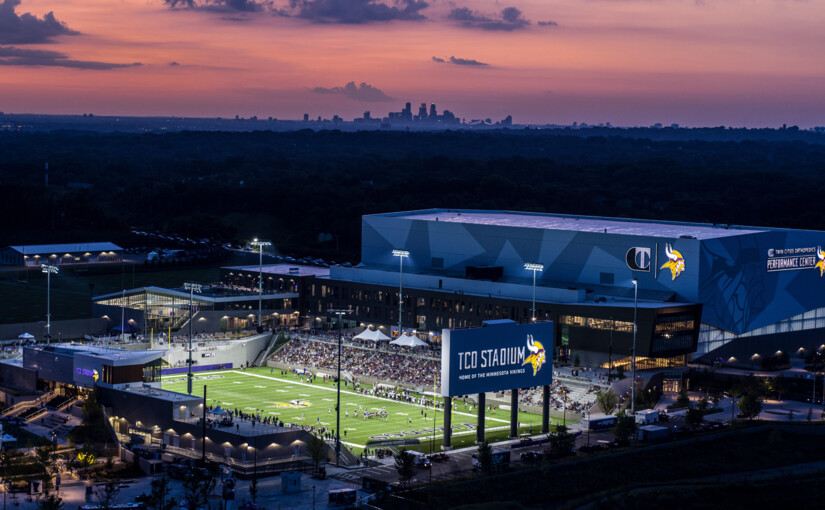 Vikings stadium. Courtesy: Vikings
The bid is rooted in precedent. Minnesota’s successful hosting of Super Bowl LII remains a cornerstone of its case, demonstrating the region’s ability to manage large-scale, globally watched events under complex logistical conditions.
Recent drafts underscore the economic stakes:
For Minnesota, the implications extend beyond a three-day influx of visitors. The draft has become a national broadcast platform, a tourism driver, and a long-tail branding opportunity for host regions seeking to position themselves on a global stage.
Wendy Blackshaw, president and CEO of Minnesota Sports and Events, has framed the bid as part of a broader strategy to secure “world-class” events that deliver both economic return and long-term visibility.
The NFL’s selection process typically unfolds roughly two years ahead of the event, placing the 2028 decision window in the near term. The league has already awarded the 2027 draft to Washington, D.C., with plans centered around the National Mall.
The current roadmap:
Minneapolis is expected to face competition from other markets, including Buffalo, which has signaled interest in leveraging its new stadium opening as part of a future bid.
Still, Minnesota’s candidacy carries a unique narrative advantage. If selected, it would complete a modern hosting cycle across the NFC North: Chicago (2015–2016), Detroit (2024), Green Bay (2025), and potentially Minneapolis in 2028.
Behind the scenes, the Vikings have made clear that this is not a symbolic bid. Team leadership, including Executive Vice President Lester Bagley, has emphasized that the organization is “vested and invested,” committing financial resources, staffing, and operational support to strengthen Minnesota’s proposal.
The infrastructure case is equally central. U.S. Bank Stadium offers a climate-controlled venue capable of anchoring the draft’s main stage, while the TCO Performance Center provides a purpose-built secondary site tailored for fan engagement and football programming.
Together, the two sites form a dual-campus model that aligns with the NFL’s evolving preference for host cities capable of delivering both scale and flexibility.
What Minnesota has submitted is not merely a request to host an event. It is a statement about place, capacity, and ambition.
The modern NFL Draft is no longer confined to podium announcements and televised selections. It has become a civic performance, a convergence of sport, culture, and economic strategy. Cities that host it are not just staging a league function. They are presenting themselves to the country.
Minnesota’s argument is that it is ready, again, to do just that.
A decision from the NFL is expected in the coming months. Whether the league ultimately selects Minneapolis or another contender, the bid itself reflects a broader truth: the competition to host the draft has become as consequential, and as revealing, as the event it seeks to secure.
Community. Culture. Civic Life.

Sunny, with a high of 80 and low of 57 degrees. Sunny during the morning, clear overnight.