63° and Moderate rain at times
Image
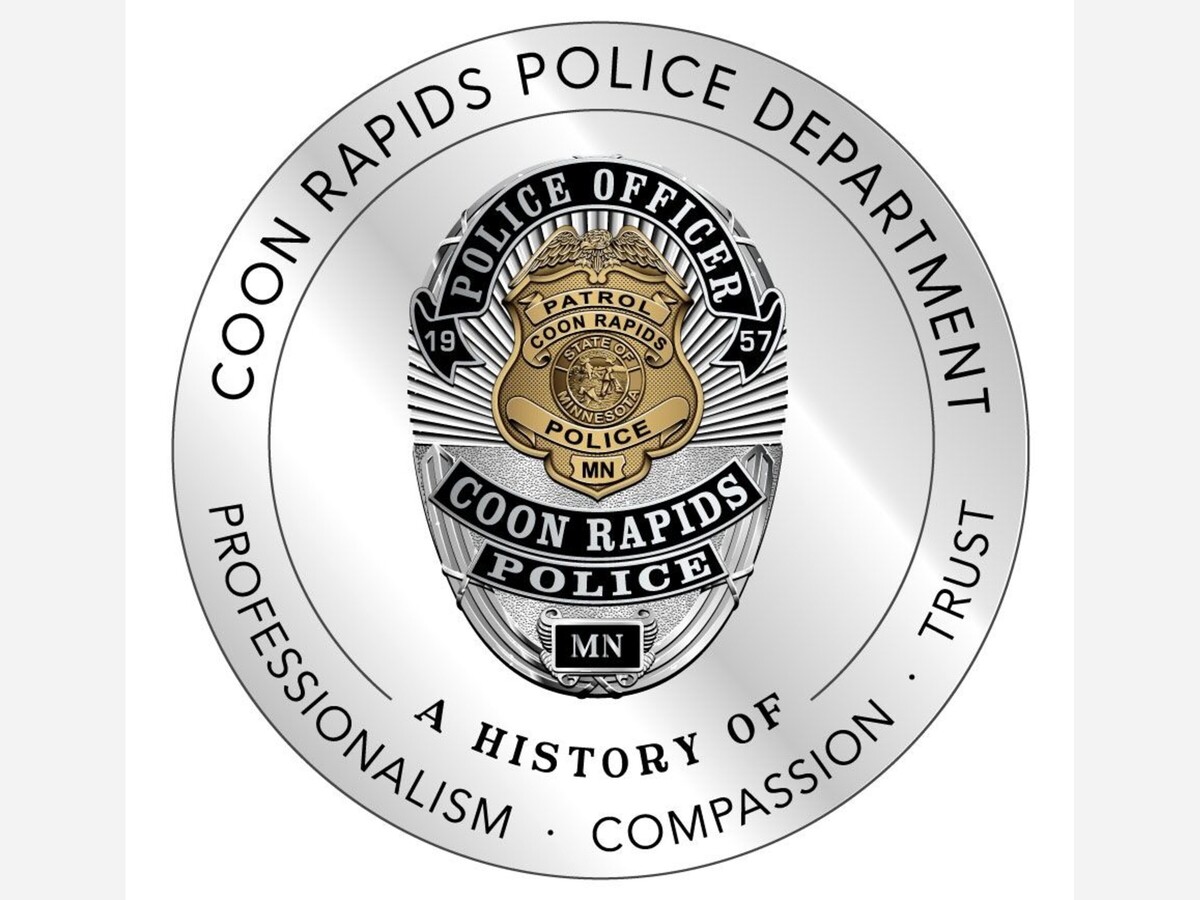



A recent Women’s History Month reflection from the Coon Rapids Police Department gestures toward that history, recognizing the women who have served with “dedication, resilience, and commitment.” Behind that message lies more than a century of evolution, beginning in constrained roles and extending to leadership at the highest levels of law enforcement across the state.
What follows is not simply a timeline of milestones. It is a record of persistence, structural change, and the steady expansion of what policing in Minnesota has allowed women to be.
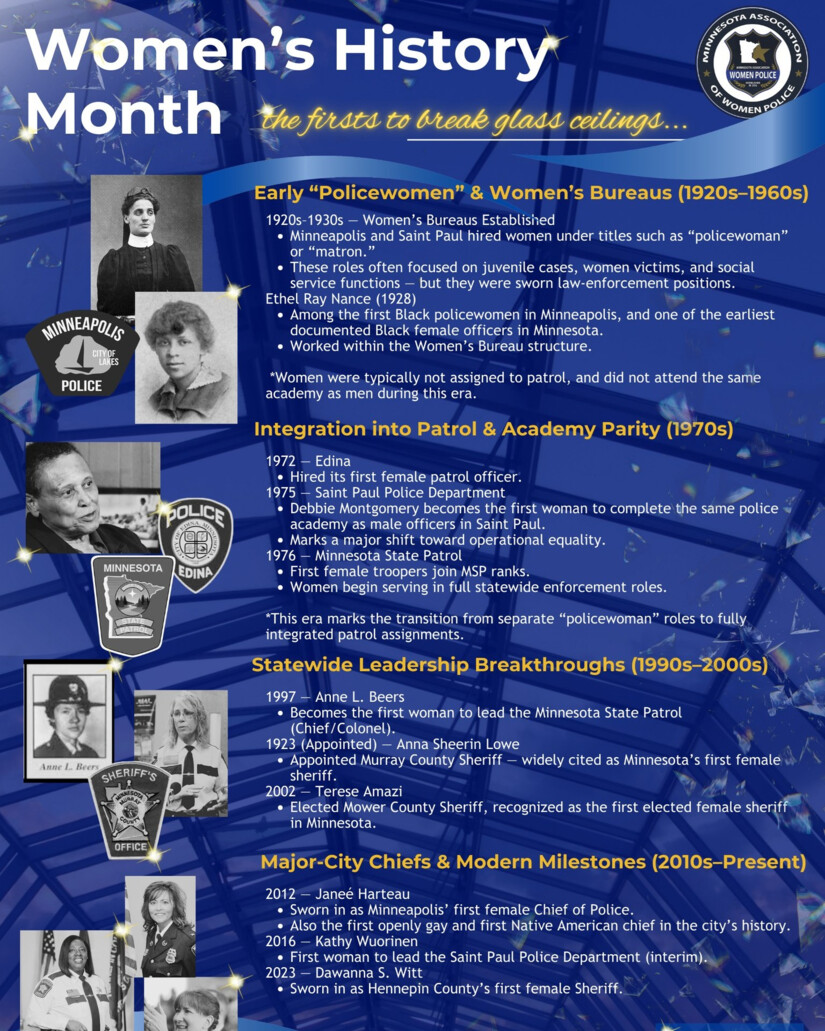 Photo credit: Minnesota Association of Women Police
The entry of women into Minnesota policing dates back to the late 19th century, when cities such as Minneapolis began employing police matrons. One of the earliest documented figures, Louise Paine, was serving in that capacity by 1889.
Her work, preserved through departmental records, focused on what the system then defined as “care” rather than enforcement. She handled cases involving lost children, women in distress, and individuals described at the time as “insane,” reflecting a model that positioned women as extensions of social welfare inside police structures.
By the 1920s and 1930s, that role had evolved into more formalized Women’s Bureaus in both Minneapolis and Saint Paul. Women hired into these units were sworn officers, but their authority remained circumscribed. They were largely excluded from patrol, trained separately from men, and assigned to cases involving juveniles and women.
Yet within those constraints, important precedents were set.
In 1928, Ethel Ray Nance joined the Minneapolis Police Department, becoming one of the earliest documented African American female officers in Minnesota and among the first in the nation. Her role within the Women’s Bureau placed her at the intersection of race, gender, and public service at a time when few institutions recognized any of the three.
Parallel developments were unfolding in county law enforcement. In April 1922, Sadie Munroe was appointed sheriff of Lyon County, widely recognized as the first female sheriff in Minnesota. A year later, in 1923, Anna Sheerin Lowe was appointed sheriff of Murray County, stepping into the role during Prohibition and overseeing enforcement actions against bootlegging operations.
These early appointments were often tied to circumstance, including the deaths of husbands who previously held office, but they nonetheless established a foothold for women in positions of authority long before such leadership was normalized.
For decades, women in policing remained structurally separated from core law enforcement functions. That began to change in the 1970s, a period shaped by civil rights legislation, workplace equity mandates, and broader cultural shifts.
In 1972, Edina hired its first female patrol officer, marking one of the earliest moves in Minnesota toward integrating women into frontline policing roles.
The shift accelerated in 1975 when Debbie Montgomery joined the Saint Paul Police Department. She became the first woman to complete the same police academy training as male officers in the department, a milestone that carried both symbolic and operational weight.
Montgomery’s early experience underscored the barriers that remained. Departments lacked basic infrastructure for women, including properly fitted uniforms and locker room facilities. She would later recall the difficulty of working in oversized equipment designed for men, an issue that was as practical as it was emblematic.
Despite those conditions, Montgomery built a career that extended far beyond her initial breakthrough. She rose to the rank of Senior Commander in Saint Paul and later served as Assistant Commissioner for the Minnesota Department of Public Safety, helping shape policy at the state level.
At the same time, statewide policing institutions were undergoing their own transformation.
In 1976, the Minnesota State Patrol admitted its first cohort of female troopers. Among them were Anne Beers, Sue Hackett, and Ruth Wittner, who became known as the agency’s “first three.” Their entry marked the end of formal exclusion at the state patrol level and opened the door for women to serve across Minnesota’s highway enforcement system.
These changes collectively signaled a decisive break from the Women’s Bureau era. Women were no longer confined to specialized roles. They were entering the same training pipelines, performing the same duties, and being evaluated against the same standards as their male counterparts.
By the 1990s and early 2000s, the question facing Minnesota policing had shifted. It was no longer whether women could serve. It was whether they would lead.
In 1997, Anne L. Beers, one of the State Patrol’s first female troopers, became Chief of the Minnesota State Patrol, holding the rank of Colonel. Her appointment was not only a state milestone but also a national one, placing her among the first women to lead a statewide law enforcement agency in the United States.
County leadership followed its own trajectory.
In 2002, Terese Amazi was elected sheriff of Mower County, becoming the first woman elected, rather than appointed, to a county sheriff position in Minnesota. The distinction mattered. It reflected not only institutional acceptance but also public trust expressed through the ballot.
At the state level, additional breakthroughs reinforced the expanding scope of women’s leadership.
Linda Finney became the first woman and the first person of color to serve as Superintendent of the Minnesota Bureau of Criminal Apprehension in 2004, overseeing one of the state’s most critical investigative agencies.
In 2011, Ramona Dohman was appointed Commissioner of the Minnesota Department of Public Safety, becoming the first woman to lead the department responsible for statewide law enforcement coordination, emergency management, and homeland security functions.
These appointments marked a structural shift. Women were no longer entering policing through limited roles and working upward against resistance. They were being selected, elected, and entrusted with directing the system itself.
The past decade has brought some of the most visible leadership milestones in Minnesota policing.
In 2012, Janeé Harteau was sworn in as Minneapolis’ first female Chief of Police. Her appointment represented multiple historic firsts, including being the first Native American and first openly gay chief in the city’s history. Leading one of Minnesota’s most prominent departments, her tenure reflected both progress in representation and the increasing complexity of modern policing.
In Saint Paul, Kathy Wuorinen became the first woman to lead the department, serving as interim chief in 2016. Her leadership underscored the growing depth of experienced women within command ranks.
More recently, Dawanna S. Witt was elected sheriff of Hennepin County, becoming the first woman to hold that office in the state’s most populous county. Her election reflects a broader trend in which women are not only appointed to leadership roles but are also securing them through direct voter support.
Today, women serve in every dimension of policing across Minnesota, from patrol and investigations to executive leadership and statewide command.
Yet the story remains unfinished.
Women continue to be underrepresented in law enforcement nationally, particularly in leadership roles. The progress seen in Minnesota reflects sustained institutional change, but also ongoing effort by those entering a profession still shaped by its history.
What distinguishes Minnesota’s trajectory is the continuity between generations. The matrons of the 19th century, the policewomen of the early 20th century, the integration pioneers of the 1970s, and the leaders of today are part of the same arc.
Each group expanded the boundaries of the profession, often without recognition at the time.
The Coon Rapids Police Department’s Women’s History Month message honors that legacy in a few carefully chosen lines. It acknowledges the women who paved the way, those serving today, and those who will follow.
But the deeper history reveals something more enduring.
Progress in policing has not been inevitable. It has been built through persistence, often in environments that resisted change. The women who entered these spaces did not simply adapt to the system. They altered it.
That legacy now carries forward in every department across Minnesota, including in communities like Coon Rapids, where recognition is paired with responsibility.
The next chapter of this history will not be written by milestones alone, but by how institutions continue to evolve, who they choose to include, and how they define service in the years ahead.
MinneapoliMedia
Community. Culture. Civic Life.



Sunny, with a high of 80 and low of 57 degrees. Sunny during the morning, clear overnight.