63° and Moderate rain at times
Image



In Blaine, the response no longer ends with containment.
It continues with care.
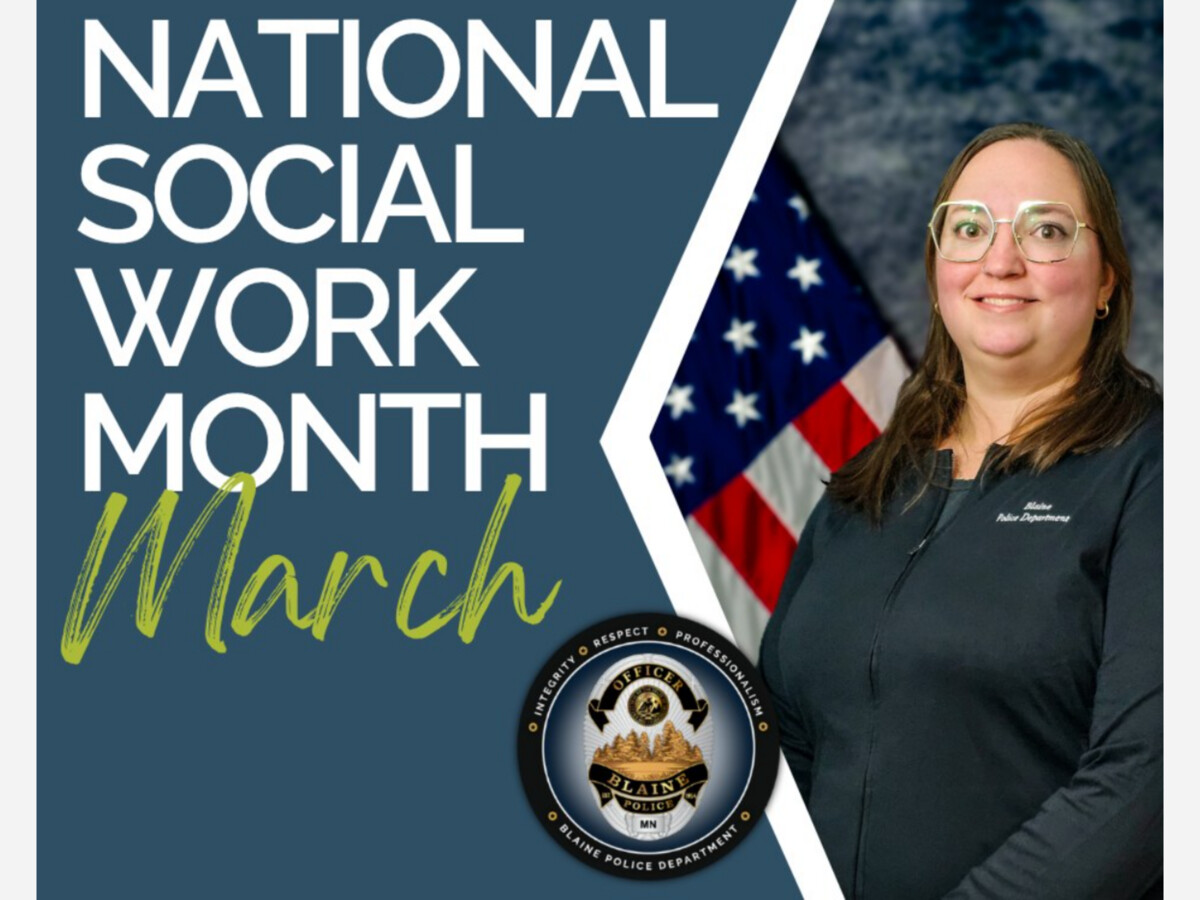
As part of National Social Work Month, the Blaine Police Department has placed a public spotlight on its Mental Health Coordinator, Kelsey Keil, whose role reflects a broader transformation taking place inside law enforcement agencies across Minnesota and the nation. Her work represents a shift away from a singular enforcement model toward a dual approach that blends public safety with public health.
Keil operates within what is known as an “embedded social work” model, working alongside officers while maintaining a distinct, specialized function. When officers secure a scene, she steps into the space that follows, where stabilization, assessment, and human connection become the priority.
Her responsibilities extend beyond the immediate moment.
She provides crisis intervention at the scene, but more critically, she carries the response forward. In the days and weeks after an incident, Keil conducts follow-up outreach, ensuring individuals are connected to appropriate mental health providers, housing resources, or chemical dependency services. In many cases, she serves as the bridge between the Blaine Police Department and broader systems within Anoka County, guiding residents through processes that can often feel fragmented or inaccessible.
That continuity is the distinction.
Where traditional policing models often conclude once a scene is cleared, Keil’s work is designed to prevent the next call from happening.
The Blaine Police Department’s model is part of a growing movement across the Twin Cities metropolitan area and beyond. Law enforcement agencies are increasingly integrating clinicians, social workers, and mental health professionals directly into their operations, recognizing that a substantial portion of emergency calls are tied to behavioral health, not criminal activity.
According to the Substance Abuse and Mental Health Services Administration, millions of Americans experience mental health crises each year, many of which result in emergency response. Historically, police officers have been the default responders, often without the clinical tools necessary to address underlying conditions.
Embedded social work changes that equation.
It introduces specialized expertise into the response itself, allowing for de-escalation strategies rooted in behavioral health training and communication techniques that differ from traditional law enforcement methods. It also allows officers to return to patrol more quickly, improving overall departmental efficiency while ensuring individuals receive targeted support.
The contrast between models is increasingly clear:
At its core, the model is designed to reduce repeat calls, often referred to within policing as the “revolving door” of crisis response.
Observed each March, National Social Work Month recognizes the more than 700,000 social workers across the United States who operate in hospitals, schools, community organizations, and increasingly, police departments. The initiative, supported by the National Association of Social Workers, has in recent years emphasized the “incredible impact” of social workers in systems that intersect with public safety.
Within law enforcement, that impact is both immediate and systemic.
The National Association of Social Workers has long advocated for co-responder and embedded models, pointing to their ability to divert individuals away from the criminal justice system and toward appropriate healthcare pathways. These approaches also reduce the likelihood of escalation during volatile encounters and allow agencies to address root causes such as untreated trauma, housing instability, and substance use disorders.
In Blaine, those national principles take shape in the day-to-day work of a single coordinator moving between crisis scenes, follow-up visits, and coordination with county services.
Blaine, one of the fastest-growing cities in Anoka County, has experienced an increase in calls for service that reflect broader demographic and social pressures. As populations grow, so too does the complexity of needs presented to first responders.
Mental health-related calls are among the most challenging.
They require time, patience, and a level of specialization that traditional policing alone is not structured to provide. By embedding a role like Keil’s within the department, Blaine is adapting to that reality, reframing certain emergency calls not as incidents to be resolved, but as entry points into longer-term care.
That distinction carries consequences.
It changes how individuals experience their most vulnerable moments. It alters how officers engage with the public. And over time, it reshapes the relationship between law enforcement and the community it serves.
Inside the Blaine Police Department, officials describe Keil’s work not as an addition, but as an essential component of modern policing. Her presence allows officers to approach complex situations with greater context, reduces reliance on enforcement in non-criminal cases, and builds pathways toward stability that extend beyond a single encounter.
For residents, the impact is often quieter but no less significant.
It is found in the follow-up call that comes days later. In the connection to a counselor or support program that might otherwise have gone unknown. In the absence of a repeat crisis.
As departments across Minnesota continue to evaluate how best to respond to evolving community needs, models like Blaine’s are increasingly seen not as experimental, but foundational.
They represent a recognition that public safety cannot be separated from public health.
And that in many cases, the most effective response is not measured by how quickly a situation is controlled, but by whether it returns at all.
In honoring Kelsey Keil during National Social Work Month, the Blaine Police Department is acknowledging more than individual service. It is affirming a direction, one that places understanding alongside enforcement, and care alongside response.
A direction that is steadily redefining what it means to keep a community safe.
MinneapoliMedia
Community. Culture. Civic Life.



Sunny, with a high of 80 and low of 57 degrees. Sunny during the morning, clear overnight.