63° and Moderate rain at times
Image
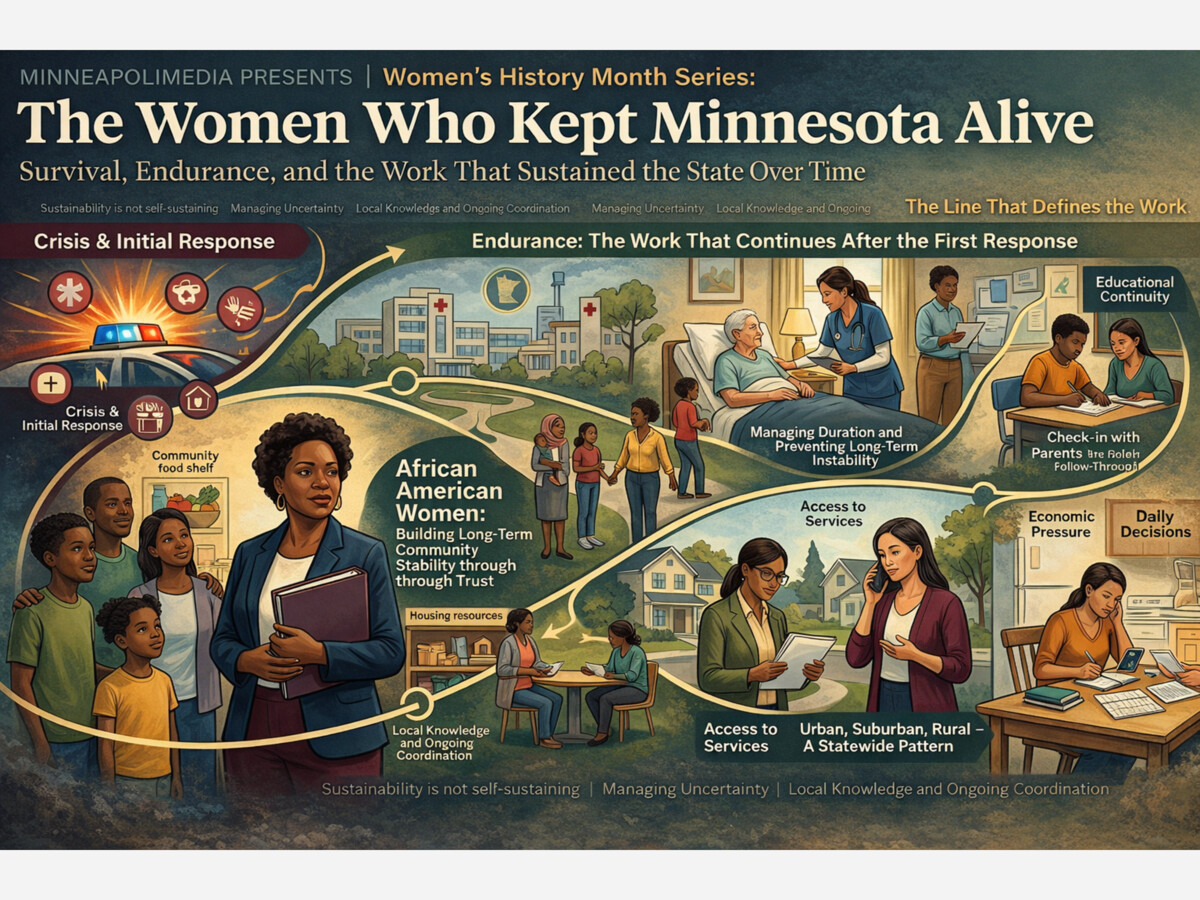
Illustration By MinneapoliMedia



Minnesota is often described through its stability.
Its institutions function. Public systems continue to operate through changing conditions. Schools open each day. Hospitals provide care. Government agencies maintain services. Businesses adapt to economic shifts. From a distance, this continuity can appear built into the structure of the state itself.
But stability is not self-sustaining.
It depends on sustained effort, particularly during periods when conditions place pressure on systems and communities alike. Across Minnesota, that effort has often taken place outside formal recognition. It has been carried forward through daily decisions, ongoing coordination, and the ability to maintain continuity when circumstances make that work more difficult.
Women have been central to that process.
Their role is not limited to moments of visible crisis. It extends into the longer periods that follow, when the immediate urgency has passed but conditions have not fully improved. It is in these periods that stability is most vulnerable, and where sustained effort becomes essential.
Crisis produces immediate response. It generates urgency and draws attention to the need for action. Systems activate, resources are mobilized, and communities respond.
Endurance operates differently. It begins after the initial response has taken place. It requires maintaining effort over time, often without clear timelines for resolution and without the visibility that accompanies emergency response.
In Minnesota, many of the conditions that affect households and communities do not resolve quickly. Economic pressure, access to care, housing stability, and educational continuity often require ongoing attention. These are not short-term disruptions. They are conditions that unfold over extended periods.
Endurance, in this context, is not an abstract concept. It is a series of practical actions repeated over time to maintain stability.
When a household experiences disruption, the first response may come quickly. Support may be provided, connections may be made, and immediate needs may be addressed.
What follows is less visible.
Bills continue to arrive. Employment may remain uncertain. Access to services may be inconsistent. The initial intervention stabilizes the situation, but it does not resolve it.
This is where sustained effort becomes necessary.
Across Minnesota, women continue the work after the first response has passed. They monitor conditions, adjust plans, and coordinate ongoing support. They ensure that progress made during the initial response is not lost during the longer period of recovery.
This work requires attention over time. It requires managing uncertainty and responding to changes as they occur.
This pattern is not limited to a single type of community.
It appears across Minnesota.
In urban areas, where cost of living places continuous pressure on households. In suburban communities, where access to services may vary depending on location and resources. In rural areas, where distance and availability of services affect response times and access.
The conditions differ.
The need for sustained effort does not.
Women across these environments organize support, maintain communication, and ensure that households and communities remain functional despite ongoing challenges.
This consistency across different contexts indicates that the work is structural rather than situational.
African American women in Minnesota have played a critical role in sustaining long-term stability, particularly in communities where disparities in access to resources are well documented.
Their work often involves navigating systems that do not consistently meet community needs. It requires both immediate response and ongoing coordination to ensure that support remains available over time.
This includes maintaining access to food, housing support, educational resources, and healthcare connections. It also includes advocacy, where systemic issues are identified and addressed through sustained engagement.
Unlike short-term interventions, this work is continuous. It does not begin and end with a single event. It requires maintaining networks, updating information, and ensuring that individuals remain connected to available resources.
Trust is central to this process. Effective coordination depends on relationships that have been built over time. Individuals rely on sources that have demonstrated consistency and reliability.
African American women have built that trust through sustained involvement, creating systems of support that operate alongside formal structures.
Public systems in Minnesota are designed to respond to need, but they operate within defined parameters. They require eligibility criteria, processing timelines, and resource allocation.
These elements are necessary for scale and consistency.
However, they also create delays.
Even when systems function effectively, there is a period between identifying a need and delivering a response. During that period, stability depends on sustained effort at the community level.
Women operate within this space.
They maintain continuity while systems process applications, distribute resources, and implement solutions. They ensure that individuals are not left without support during these intervals.
This relationship between systems and sustained effort is not incidental. It is a core component of how stability is maintained.
Endurance requires managing duration.
Unlike crisis response, which is often defined by urgency and immediacy, sustained effort must account for uncertainty. Conditions may change. Timelines may shift. Resources may fluctuate.
Women managing this work must adjust continuously.
They reassess needs, update plans, and maintain coordination over extended periods. This requires both organization and flexibility. It also requires the ability to continue working without clear indicators of when conditions will improve.
This type of work is demanding.
It requires consistency in the absence of immediate resolution.
One of the most important functions of sustained effort is preventing temporary disruptions from becoming long-term instability.
A short-term loss of income can lead to housing instability if not addressed. Gaps in access to care can result in more serious health outcomes. Interruptions in education can affect long-term academic progress.
By maintaining continuity, women help prevent these outcomes.
They ensure that temporary challenges remain temporary.
This function is critical to the overall stability of communities.
Initial response addresses immediate need.
Endurance depends on follow-through.
Women often remain engaged after initial support is provided. They check whether resources have been accessed. They assist with additional steps. They adjust support as conditions change.
This follow-through ensures that response leads to resolution.
Without it, initial efforts may not produce lasting outcomes.
Sustained effort is informed by local knowledge.
Women working within communities maintain awareness of changing conditions. They understand which households require continued support and which resources are available.
This knowledge allows for efficient coordination.
It reduces duplication of effort and ensures that support is directed where it is most needed.
It also enables prioritization, which is essential when multiple needs exist simultaneously.
Minnesota’s ability to function over time is often attributed to its institutional design.
While institutions play a critical role, they do not operate in isolation.
Sustained stability depends on continuous effort at the community level.
Women have been central to that effort.
They maintain the conditions that allow systems to function effectively. They provide continuity during periods when systems are adjusting. They ensure that individuals remain connected to necessary support.
This work is not always visible in formal documentation.
It does not appear consistently in reports or data.
However, it is reflected in outcomes.
Communities remain intact.
Households maintain stability.
Individuals continue to access support over time.
These outcomes are the result of sustained effort.
They are the result of endurance.
There is a point at which crisis begins.
There is a point at which systems respond.
Between those points, and extending beyond them, there is a period that requires sustained effort.
Across Minnesota, women have consistently carried that effort.
They continue when immediate response has passed.
They maintain stability when conditions remain uncertain.
They ensure that progress is not lost over time.
Minnesota continues to function not only because of its systems, but because of the people who sustain those systems over time.
Women have been central to that sustained effort.
They ensure that disruption does not become long-term instability.
They maintain continuity during extended periods of difficulty.
They provide the ongoing work that allows recovery to take place.
That work continues.
And it remains one of the defining elements of how Minnesota endures.
MinneapoliMedia | Community. Culture. Civic Life.



Sunny, with a high of 80 and low of 57 degrees. Sunny during the morning, clear overnight.