60° and Clear
Image
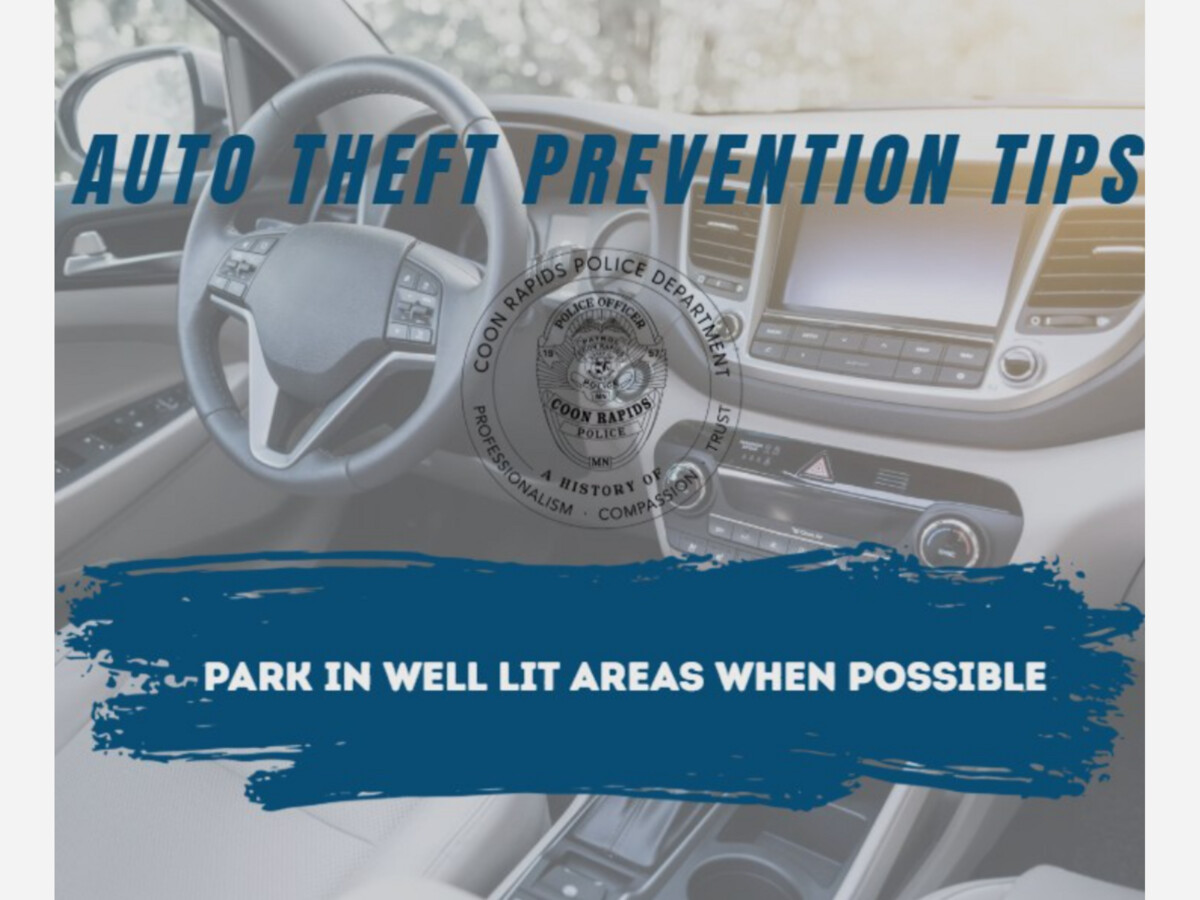



But according to the Coon Rapids Police Department, where and how that vehicle is left behind can quietly determine whether it becomes a target.
In a recent safety advisory, the department urged residents to prioritize one of the most overlooked but effective crime prevention strategies available: parking in well-lit areas.
“Parking in well-lit areas can deter thieves from targeting your vehicle,” the department noted, distilling a broader body of criminological research into a single, practical reminder.
Across law enforcement and public safety research, visibility is consistently identified as one of the strongest deterrents to opportunistic crime. Guidance from the National Highway Traffic Safety Administration and crime data compiled by the Federal Bureau of Investigation reinforce a central finding: most vehicle thefts are not highly sophisticated operations. They are crimes of opportunity.
Darkness, in that equation, becomes an accomplice.
Poorly lit streets, isolated parking lots, and shadowed residential areas offer concealment. They allow individuals to move between vehicles, check door handles, peer through windows, and, in some cases, break in, all with reduced risk of being seen or interrupted.
Lighting disrupts that equation.
A vehicle parked under a streetlamp or near a building entrance does more than improve visibility for its owner. It increases what criminologists refer to as “perceived risk,” a critical psychological factor that influences whether a potential offender proceeds or walks away. When visibility rises, uncertainty follows. When uncertainty rises, many crimes simply do not occur.
Vehicle theft continues to affect communities across Minnesota and the United States, often following predictable patterns. Incidents frequently occur overnight, in residential driveways, apartment complexes, and public parking areas where vehicles are left unattended for extended periods.
In many of these cases, the theft is not pre-planned. It is discovered.
An unlocked door. A visible backpack. A vehicle left running to warm up during winter months.
Each detail becomes an invitation.
The Coon Rapids Police Department’s advisory reflects this reality. Prevention, officials emphasize, is not only about responding to crime after it occurs. It is about reducing the opportunities for it to happen at all.
While lighting is a foundational step, law enforcement officials stress that it works best when combined with consistent personal habits.
The department is encouraging residents to follow a straightforward but effective framework often used in crime prevention messaging:
Secure the perimeter.
Always lock doors and close windows, even during brief stops. Many thefts occur in seconds, often when a vehicle is left unsecured “just for a moment.”
Remove or conceal valuables.
Items left in plain view, including electronics, bags, or wallets, can draw attention. If belongings must remain in the vehicle, placing them in the trunk before arriving at a destination reduces visibility and risk.
Never leave keys or a running vehicle unattended.
So-called “warm-up thefts,” in which vehicles are left running during colder months, remain a persistent issue in Minnesota. A running vehicle without a driver is one of the easiest opportunities for theft.
Together, these measures reinforce the same principle as lighting: reduce opportunity, increase effort, and raise the likelihood of detection.
Beyond individual actions, the department is underscoring the importance of collective vigilance.
Suspicious behavior often follows recognizable patterns. Individuals moving from car to car, checking door handles, looking into windows, or lingering in parking areas without a clear purpose can signal potential criminal activity in progress.
In those moments, timing matters.
Residents are urged to call 911 immediately if they observe suspicious activity. Providing clear descriptions of individuals, vehicles, and behavior allows officers to respond quickly and, in many cases, intervene before a crime occurs.
Crime prevention rarely arrives in dramatic gestures. More often, it is built through small, repeated decisions made in ordinary moments.
Choosing a well-lit parking space. Locking a door. Taking a bag inside instead of leaving it behind.
Individually, these actions may feel minor. Collectively, they reshape the environment in which crime either finds opportunity or fails to take hold.
In Coon Rapids, the message from law enforcement is clear.
Safety, in many cases, begins not with reaction, but with awareness.
And sometimes, it starts simply by stepping into the light.
MinneapoliMedia | Community. Culture. Civic Life.



Patchy rain nearby, with a high of 80 and low of 58 degrees. Sunny for the morning, thundery outbreaks in nearby during the afternoon, partly cloudy for the evening, clear overnight.