60° and Clear
Image
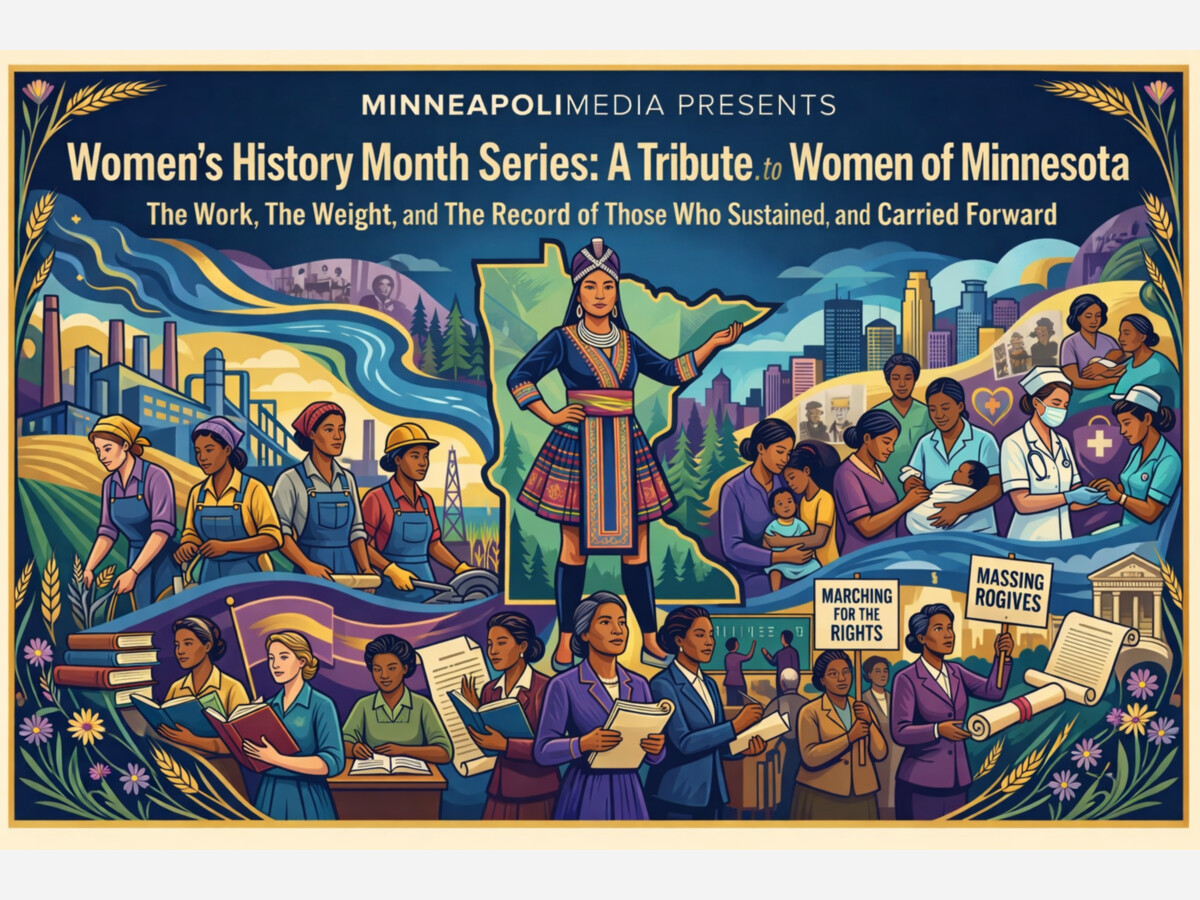
Illustration By MinneapoliMedia



Minnesota is often described through its institutions.
Its schools, healthcare systems, public agencies, and economic structures are used to explain how the state functions. These systems are visible. They are documented, measured, and evaluated. They provide a framework for understanding how services are delivered and how communities are supported.
But institutions do not operate independently of the people who sustain them.
Behind the structure is continuous effort. It exists in daily decisions, in coordination that is not always visible, and in work that is carried forward without formal recognition. This effort does not begin or end with policy. It exists at the level where systems meet real conditions.
Across Minnesota, women have been central to that effort.
Throughout this series, the role of women has been examined across multiple areas of public life.
In education, women have supported continuity by ensuring that students remain engaged even when systems are under pressure. They have identified gaps early, coordinated support, and maintained connections between households and schools.
In healthcare, women have provided care that extends beyond formal systems. They have monitored conditions, navigated access, and ensured that individuals receive attention when delays occur.
In the economy, women have maintained stability at the household level. They have adjusted to changing conditions, managed resources, and created pathways for income and support when formal structures have not fully met demand.
In public service and community leadership, women have organized responses, connected individuals to resources, and ensured that information moves where it is needed.
These roles are distinct, but they are connected.
They form a structure of support that operates alongside formal systems.
What distinguishes this work is not visibility.
It is continuity.
Systems are designed to respond to need, but they operate within defined processes. They require time to assess, allocate, and implement. During that time, stability depends on ongoing effort at the community level.
Women have carried that effort.
They maintain continuity when systems are adjusting. They ensure that households remain stable while processes are completed. They provide coordination that prevents disruption from expanding.
This function is not temporary.
It is ongoing.
Minnesota’s public systems are often evaluated based on performance indicators.
These indicators measure output and efficiency. They provide a way to assess how systems function at scale.
However, they do not fully capture how those systems are experienced.
At the household level, stability is defined by different factors. Access to care, consistency of income, availability of support, and clarity of information all affect how individuals experience the state’s systems.
Women operating within households and communities interpret these conditions in real time.
They identify where systems are functioning effectively and where gaps remain. They adjust accordingly, ensuring that individuals are able to navigate those systems.
This role connects structure to experience.
The work of maintaining stability does not end when a challenge is identified or even when an initial response is made.
Many of the conditions that affect communities extend over time.
Economic pressure may persist. Access to services may fluctuate. Recovery from disruption may take longer than expected.
During these periods, sustained effort becomes necessary.
Women continue to monitor conditions, adjust plans, and coordinate support. They ensure that progress is not lost and that individuals remain connected to resources.
This endurance is not always visible, but it is essential to maintaining stability.
In addition to responding to current conditions, women have played a role in preparing for future challenges.
They observe patterns in cost, access, and demand. They recognize when conditions are shifting and begin organizing responses in advance.
This preparation reduces the impact of future disruption.
Communities that are prepared are better able to respond when change occurs. Networks are already in place. Information is accessible. Coordination can begin without delay.
This work positions communities for what comes next.
African American women in Minnesota have carried a significant share of this work, particularly in communities where disparities in access and outcomes require ongoing attention.
Their work often involves navigating systems that do not consistently meet community needs. They coordinate support, share information, and advocate for adjustments that improve access.
They build networks that allow communities to function even when formal structures fall short.
This work requires sustained engagement.
It is based on relationships that allow for coordination and trust.
It reflects a commitment to maintaining stability over time.
Minnesota’s ability to function is often attributed to its systems.
But systems alone do not account for how stability is maintained.
Stability is sustained through practice.
Through daily decisions.
Through ongoing coordination.
Through work that continues even when it is not visible.
Women have been central to that practice.
They ensure that systems remain connected to the people they are designed to serve.
As this series concludes, it is necessary to recognize the conditions under which this work continues.
Minnesota is not defined by a single reality.
It contains multiple conditions at once.
It is a state where systems operate and where gaps remain. Where communities are supported and where individuals continue to face risk. Where progress exists alongside unresolved challenges.
These conditions are not theoretical.
They are present.
In January 2026, Renee Good, a Minneapolis resident, was killed during a federal enforcement operation. The circumstances surrounding her death have prompted legal action and ongoing questions regarding transparency and accountability.
In November 2025, Amber Czech, a 20-year-old welder from Hutchinson, Minnesota, was killed at her workplace in Cokato after reporting harassment multiple times without effective intervention.
During that same period, civil rights attorney Nekima Levy Armstrong was arrested while protesting federal enforcement actions, and journalist Georgia Fort was detained while documenting those events.
These events are part of Minnesota’s current record.
They reflect conditions in which women continue to act, organize, document, and, in some cases, experience direct consequence.
They also reflect the limits of systems when response does not occur in time or does not occur at all.
Minnesota does not exist in a single condition.
It is a place where leadership, care, and coordination operate alongside gaps, failures, and unresolved challenges.
Women have built systems of support.
They have sustained communities over time.
They have prepared for future conditions.
At the same time, they have navigated environments where risks remain.
These realities exist together.
The work described throughout this series is not confined to a specific period.
It continues.
Women across Minnesota continue to organize, sustain, and prepare. They continue to connect individuals to resources, maintain stability, and ensure that communities function.
This work does not depend on recognition.
It depends on necessity.
This series has documented a range of contributions.
It has examined how women have shaped systems, sustained communities, and responded to changing conditions.
As a record, it reflects both what has been built and what continues to be carried.
It also reflects the conditions under which that work occurs.
Minnesota’s story is not singular.
It is defined by multiple realities that exist at the same time.
Understanding that complexity is essential to understanding the state itself.
Women have played a central role in building, sustaining, and carrying Minnesota forward.
They have done so through work that is visible and work that is not. Through response and through preparation. Through leadership that is formal and leadership that operates outside formal recognition.
Their contributions are part of the state’s structure.
They are also part of its ongoing reality.
This is not a conclusion.
It is a record.
MinneapoliMedia | Community. Culture. Civic Life.



Patchy rain nearby, with a high of 80 and low of 58 degrees. Sunny for the morning, thundery outbreaks in nearby during the afternoon, partly cloudy for the evening, clear overnight.