59° and Partly Cloudy



Image
The effort represents an investment of roughly $1.5 billion, placing it in line with the scale of recent years while underscoring the state’s ongoing challenge: maintaining an aging transportation system while preparing for future demands in safety, population growth, and economic mobility.
At the center of the announcement was Commissioner Nancy Daubenberger, who framed the season not simply as construction, but as long-term stewardship of a system that underpins daily life.
“These projects will help people get around more easily, improve safety, create smoother roads, and strengthen connections across Minnesota,” Daubenberger said.
Minnesota’s transportation network, like much of the nation’s, is confronting the accumulated weight of decades of use. Bridges built for earlier traffic volumes now carry heavier freight loads. Highways designed for smaller populations face daily congestion. Rural corridors remain essential lifelines for agriculture, manufacturing, and regional economies.
The 2026 construction season reflects a coordinated attempt to respond to those pressures at scale.
More than 200 road and bridge projects form the backbone of the effort. Alongside them, 51 additional projects extend beyond highways, targeting airports, water ports, railroad crossings, and transit systems. Together, they signal MnDOT’s continued shift toward a multimodal strategy that recognizes transportation as an interconnected system rather than a collection of isolated roads.
While orange cones and lane closures will define the public experience of the coming months, a significant portion of the work is happening outside the traditional highway system.
The 51 multimodal projects include:
Many of these projects are supported through targeted funding streams such as the Minnesota Rail Service Improvement Program and the Port Development Assistance Program, reflecting a layered approach to infrastructure funding.
In 2026, MnDOT is also implementing a notable regulatory shift at railroad crossings. The agency is moving to prohibit the silencing of crossing bells, even in designated quiet zones, in an effort to improve safety for pedestrians, particularly individuals with low vision who rely on audible signals.
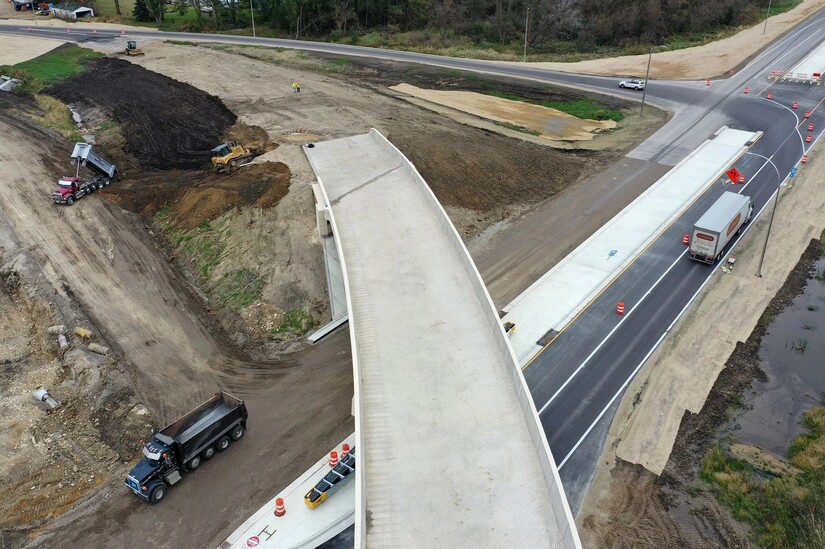
In the Twin Cities metro, where traffic density and infrastructure strain are most visible, several major projects will define the season.
In Blaine, Highway 65 enters the early phase of a four-year transformation. The project will replace signalized intersections with grade-separated interchanges, a shift designed to reduce congestion and significantly lower crash rates along one of the region’s busiest corridors.
In St. Paul, Interstate 35E will see the replacement of an aging bridge over Shepard Road near downtown, addressing both structural concerns and long-term traffic reliability.
Highway 280, a key connector between Minneapolis and St. Paul, will undergo extensive resurfacing through St. Paul, Roseville, and Lauderdale, paired with bridge and ramp repairs aimed at extending the corridor’s lifespan.
To the west, Highway 12 through Wayzata and Minnetonka will be fully reconstructed, replacing deteriorating concrete pavement and introducing updated safety features.
At the same time, several high-profile projects are reaching completion. Work is concluding on Interstate 94 in St. Paul, including improvements to the John Ireland Boulevard bridge. Interstate 35W in Burnsville and the Interstate 394 and Interstate 94 interchange in Minneapolis are also nearing the end of multi-year construction cycles.
Beyond the metro, the 2026 construction season carries equal weight.
In Moorhead, crews are completing the 11th Street underpass, a three-year effort that separates vehicle traffic from BNSF rail lines, reducing delays and improving safety.
On Interstate 94 between Albertville and Monticello, the long-anticipated “gap” project is nearing completion, expanding the corridor to three lanes in each direction and addressing one of the region’s most persistent bottlenecks.
In Brainerd, Highway 210 enters a two-year reconstruction phase that includes upgrades to the Mississippi River bridge, a critical crossing for both local and regional traffic.
Bemidji will see the start of a multi-year safety project on Highway 197, featuring new roundabouts and enhanced pedestrian infrastructure.
In Duluth, Highway 61 along London Road will undergo resurfacing and intersection improvements, targeting both safety and traffic flow along a key lakeside corridor.
Taken together, these projects reflect a deliberate effort to ensure that infrastructure investment is not confined to the metro, but distributed across the full geography of the state.
As construction activity accelerates, MnDOT is again emphasizing the human stakes inside work zones.
Between 2019 and 2024, Minnesota recorded approximately 13,000 work zone crashes, resulting in 15 fatalities and more than 4,200 injuries. Most of those harmed were drivers and passengers, not construction workers, underscoring the shared risk present in every active work zone.
For 2026, enforcement and public messaging are being intensified:
The message is direct. Slow down. Stay alert. Respect the space where people are working.
Beyond its physical footprint, the construction season carries significant economic weight.
Large-scale infrastructure projects support thousands of jobs across construction, engineering, materials production, and logistics. For contractors and local governments, the consistency of MnDOT’s annual program provides stability in an industry often shaped by uncertainty.
Despite ongoing concerns about material costs and supply chains, project bids for 2026 have remained largely in line with expectations, allowing MnDOT to maintain its planned scope without significant reductions.
For residents, the coming months will bring the familiar realities of Minnesota’s construction season: lane closures, detours, slower commutes, and shifting traffic patterns.
MnDOT is encouraging drivers to plan ahead using the state’s 511 system, which provides real-time updates, traffic cameras, and detour mapping across all active construction zones.
Yet beneath the inconvenience lies a longer timeline.
What is being built in 2026 will shape how Minnesota functions for decades. Safer intersections. Stronger bridges. More reliable corridors. Expanded transit options. Systems designed not only to meet today’s needs, but to anticipate tomorrow’s demands.
The orange cones, as visible as they are, represent only the surface.
What lies beneath is a sustained effort to rebuild the infrastructure that carries a state forward.
MinneapoliMedia | Community. Culture. Civic Life.



Sunny, with a high of 65 and low of 46 degrees. Overcast during the morning, sunny for the afternoon, clear during the evening, cloudy overnight.