Image



The Minnesota Vikings entered the 2026 NFL Draft with a clear understanding of what had been missing from their roster. The issue was not effort or scheme. It was structural. It centered on the defensive line, where control of the game is often established and where Minnesota, despite strong overall results, did not consistently impose its will.
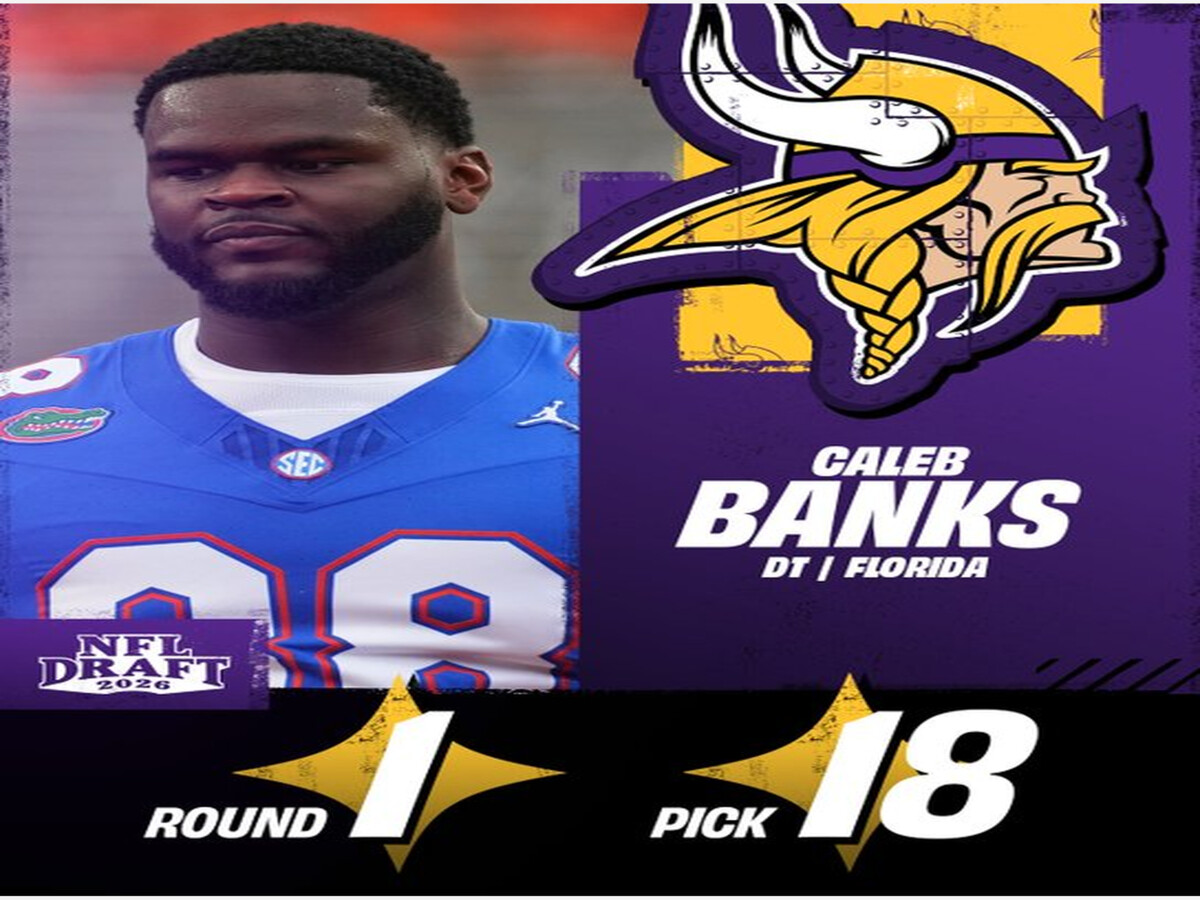
By selecting Caleb Banks with the No. 18 overall pick, the organization made a deliberate decision to address that weakness with one of the most physically gifted players in the draft class. It also accepted a level of risk that several teams in that range were unwilling to take.
This decision reflects more than draft strategy. It reflects how the Vikings evaluated their roster, identified their limitations, and chose to respond.
Minnesota’s defense in 2025 was effective by several conventional measures. It generated pressure, created turnovers, and kept the team competitive in games where the offense struggled to maintain consistency.
A closer evaluation shows a more complex picture. The defense relied heavily on scheme, timing, and coordinated execution. Under defensive coordinator Brian Flores, the Vikings used movement across the defensive front, disguised pressures, and post-snap adjustments designed to disrupt opposing quarterbacks.
That approach produced results. It also required consistent execution across all levels of the defense. When that execution broke down, the limitations of the defensive front became more visible.
One of the most persistent issues was the lack of a consistently dominant interior presence.
Interior defensive line play has taken on increased importance across the league. Offenses are structured to manage edge pressure through quick passing concepts and interior protection adjustments. Pressure generated from the interior can disrupt those structures more directly by limiting a quarterback’s ability to step into throws.
Minnesota did generate pressure, but much of it came through scheme rather than consistent interior disruption from individual players. That distinction influenced how opposing offenses approached protection and play design.
The departures of Javon Hargrave and Jonathan Allen during the offseason intensified that concern. Both players had been expected to contribute to interior stability. Their exits, influenced by roster and financial considerations, left Minnesota without a clearly established anchor in the middle of the defensive line.
Players such as Jalen Redmond provided effort and developmental upside. The unit, however, did not consistently command double teams or collapse the pocket from the interior.
The effects of interior inconsistency were particularly noticeable in run defense. Minnesota frequently used slanting and lateral movement at the snap to create disruption. While effective at times, that approach can create vulnerabilities if not executed precisely.
When defensive linemen move out of their initial alignments, cutback lanes can emerge. Opposing offenses were able at times to take advantage of those openings, sustaining drives and maintaining balance.
At the center of this issue was the challenge of consistently maintaining gap control at the interior. Two-gap responsibilities require a defensive lineman to engage blockers, control contact, and remain positioned to defend multiple rushing lanes.
Minnesota did not consistently execute that at a high level across the interior.
This is the context in which Caleb Banks was evaluated.
Banks entered the draft as one of the most physically distinctive defensive linemen in the class. At 6-foot-6 and approximately 327 pounds, with a wingspan measured at over seven feet, he presents a rare physical profile for the position.
Length can allow a defender to engage blockers early, extend through contact, and influence multiple areas of a play. Banks also shows movement ability that is notable for his size, including initial quickness and closing range.
His 2024 season at the University of Florida offered the clearest example of his potential production, including 21 tackles, seven tackles for loss, and 4.5 sacks. Beyond the statistics, evaluators noted his ability to generate interior disruption and affect the pocket.
At the same time, his evaluation included questions about availability.
Banks’ final collegiate season was significantly impacted by injuries to his left foot.
He sustained an injury late in the 2024 season and experienced additional issues during 2025, including a more serious fracture that required surgery and limited his availability.
During the pre-draft process, he experienced another setback involving the same foot, leading to a second surgical procedure in March 2026.
Repeated injuries to the same area introduce uncertainty in projection. Medical evaluations can assess recovery progress and expected timelines, but long-term durability remains a variable that can only be resolved over time.
Banks indicated in pre-draft communication that he expects to be cleared for football activity in early June 2026, which would align with participation in training camp if recovery proceeds as expected.
When the Vikings made their selection at No. 18, they had multiple viable paths available.
They could have selected a player with fewer medical questions and a more stable projection. They could have traded back to add draft capital. Instead, they selected a player whose evaluation included both high-end traits and elevated risk.
That decision suggests a willingness to prioritize long-term upside at a position of need, even with uncertainty attached.
Within Brian Flores’ system, Banks projects as a versatile defensive lineman capable of aligning in multiple techniques.
His size and length suggest he could contribute in roles that require anchoring against the run, while his movement ability offers potential value as an interior pass rusher in sub-package situations.
Flexibility along the defensive front is a key component of the Vikings’ scheme. Players who can align in multiple positions without requiring substitutions allow for greater variation in pressure design and coverage disguise.
Banks’ profile aligns with those requirements, if he develops as projected.
Interior defensive line performance can influence linebacker efficiency. When linemen occupy blockers and maintain gap discipline, linebackers are able to read and react with fewer obstructions.
When interior play is inconsistent, linebackers are more frequently required to navigate congestion, which can delay reaction time and affect positioning.
For players such as Ivan Pace Jr., improved interior stability could contribute to more consistent second-level play.
Minnesota’s defensive performance must also be considered in relation to the offense. During the 2025 season, the offense experienced inconsistency, including turnovers that affected field position and game flow.
Those factors placed additional demands on the defense, including shorter fields and extended time on the field in certain situations.
While improving the defensive line does not resolve offensive issues, it can help create greater stability under those conditions.
The Vikings entered the offseason with a roster that included a number of experienced players, while also facing the need to incorporate younger talent capable of contributing over a longer timeline.
The selection of Banks reflects an effort to add a player with developmental upside who could become part of a longer-term defensive core.
The evaluation of this selection ultimately centers on availability.
Banks’ physical traits and projected role suggest the potential to become a significant contributor along the defensive front. At the same time, his injury history introduces a level of uncertainty that cannot be fully resolved at the time of the draft.
If he remains available and develops as expected, the selection could address one of Minnesota’s most persistent structural issues. If injuries continue to limit his availability, that issue may remain.
The Minnesota Vikings used the No. 18 overall pick to address a clearly identified need with a player whose profile includes both high-end potential and measurable risk.
The decision reflects a broader organizational approach that prioritizes impact at critical positions, even when that approach involves uncertainty.
The outcome of that decision will be determined over time, shaped by performance, development, and durability.
In selecting Caleb Banks, the Vikings committed to a direction.
How that decision is ultimately evaluated will depend on whether that investment translates into consistent presence and production on the field.
MinneapoliMedia | Community. Culture. Civic Life.


Sunny, with a high of 91 and low of 59 degrees. Fog in the morning, sunny in the afternoon, clear overnight.