Image
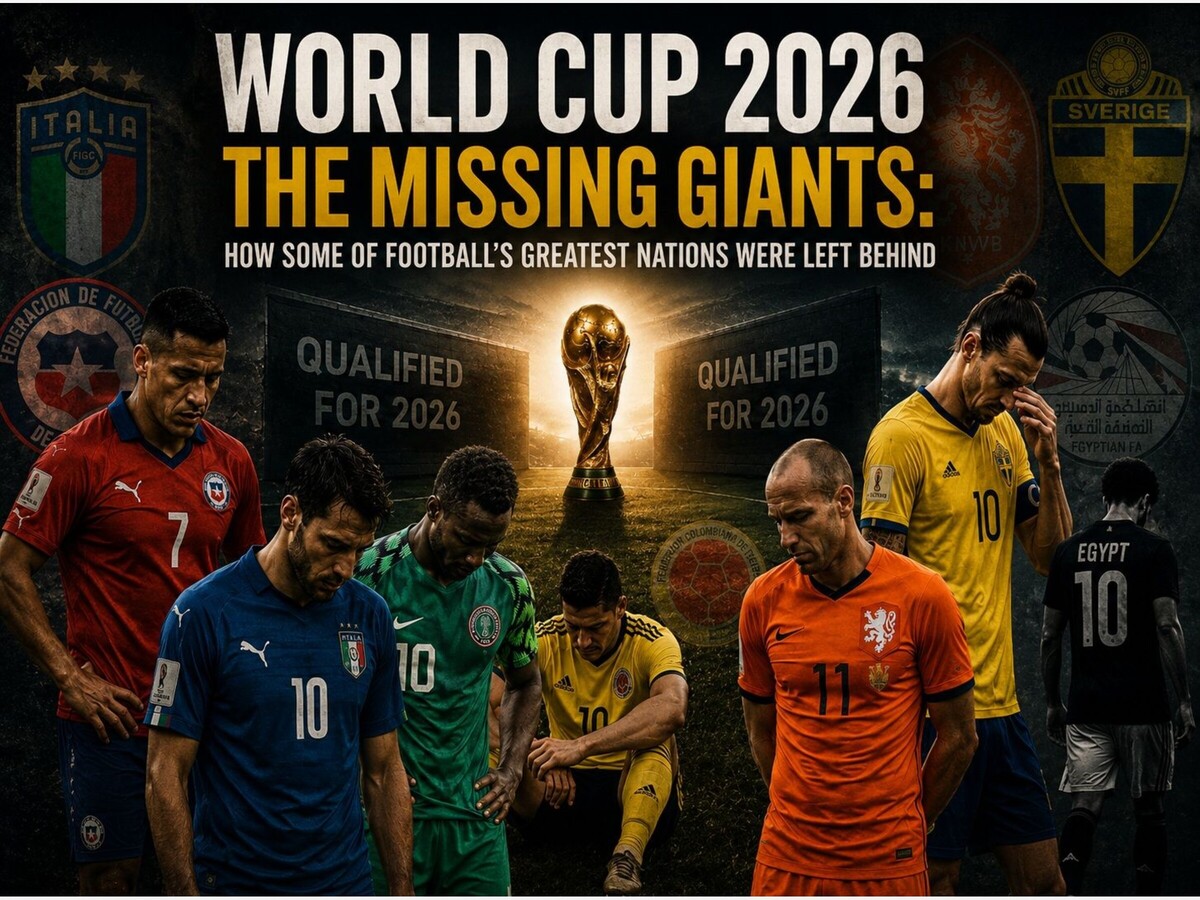



As the final qualification campaigns closed and the full field for the 2026 FIFA World Cup settled into place, the global football conversation immediately turned toward the nations that had arrived.
The hosts.
The favorites.
The emerging powers.
The dark horses.
The returning challengers.
But every World Cup carries another story beneath the visible one.
A quieter story.
A harsher story.
The story of absence.
Because while the 2026 tournament will introduce new nations, expand the competition to 48 teams, and project itself as the largest World Cup in history, it will do so without several of the most historically significant football countries in the modern game.
The absences are not minor.
The tournament will proceed without Italy, one of the most decorated football nations ever assembled.
Without Nigeria, one of Africa’s most influential football powers.
Without Cameroon, a nation whose World Cup history helped reshape perceptions of African football.
Without Chile, whose golden generation once conquered South America itself.
Without Poland, a nation that spent years trying to build around one of the modern game’s greatest strikers.
Without Denmark, one of Europe’s most stable and structurally disciplined football systems.
These absences matter because World Cups are not merely competitions.
They are historical gatherings.
The tournament functions as football’s collective memory bank. Nations do not simply participate in it. They build identities through repeated appearance. Generations of supporters organize emotional history around qualification cycles, tournament nights, victories, collapses, and recurring national narratives.
That is why absence cuts differently in football than in many other sports.
When major nations fail to qualify repeatedly, the damage is not confined to one campaign. It begins to alter identity itself.
And that is precisely what makes the 2026 World Cup qualification cycle so revealing.
Because this is no longer a story about isolated failure.
It is a story about structural instability inside global football’s old order.
No absence defines the 2026 field more dramatically than Italy’s.
There was a time when the idea itself would have sounded absurd.
Italy was not merely successful in international football. Italy was foundational to modern tournament football culture. Four World Cup titles established the country as one of the game’s central powers. Italian tactical philosophy influenced football across continents and generations.
For decades, Italy represented competitive control.
Tournament management.
Defensive organization.
Emotional resilience under pressure.
Italian football once projected certainty.
Now it projects anxiety.
The failure to qualify for the 2018 World Cup shocked the sport because it violated assumptions that had existed for generations. Italy missing two consecutive tournaments after also failing to qualify for 2022 transformed shock into crisis.
Now comes 2026.
A third absence.
At this point, the conversation changes fundamentally.
Three consecutive qualification failures can no longer be treated as coincidence, transitional instability, or temporary underperformance.
They indicate systemic deterioration.
This is the difficult truth confronting Italian football.
The issue is not passion. Italy remains deeply football-obsessed. Serie A continues producing tactically sophisticated club environments. Italian supporters remain emotionally invested at extraordinary levels.
The problem is that the structures supporting the national team no longer consistently generate elite international performance.
Several failures overlap.
One of the most persistent concerns surrounding Italy’s decline has been the development and integration of younger players.
Italian football historically prioritized tactical discipline and defensive maturity. These qualities once gave Italy enormous advantages in tournament football. But modern football evolved faster than some of Italy’s developmental assumptions.
While other countries accelerated:
Italy often appeared caught between identities.
Not fully modernized.
Not fully traditional.
This created developmental tension.
Young Italian players frequently emerged technically intelligent but lacking the dynamic attacking confidence increasingly required at the highest international level.
The problem became especially visible in attacking areas.
Italy continued producing tactically competent defenders and midfielders, but the consistent production of elite, game-breaking attacking players slowed dramatically compared to previous eras.
That imbalance narrowed Italy’s margin for error.
Repeated qualification failure creates cumulative psychological consequences.
This may be the most underestimated aspect of Italy’s current situation.
Historically, Italy entered qualification campaigns carrying confidence derived from decades of tournament success. Even during uneven campaigns, there remained an underlying national belief that Italy would ultimately stabilize itself.
That emotional reserve has now weakened.
Modern Italian players increasingly carry the burden of recent absence rather than the confidence of historical success.
This changes qualification dynamics.
Pressure arrives earlier.
Mistakes become emotionally heavier.
Conservative decision-making increases.
Tactical fear expands.
Qualification campaigns become tense long before they should.
This psychological erosion matters because international football is uniquely emotional. National teams operate under compressed timelines, intense scrutiny, and enormous symbolic expectation.
Teams that lose emotional stability often struggle to recover quickly.
Italy now appears trapped in precisely that cycle.
One of the most striking contradictions in Italian football is the disconnect between club-level sophistication and national-team instability.
Serie A remains one of the world’s most tactically respected leagues. Italian club football continues producing high-level coaching and complex strategic systems.
Yet the national team has struggled to translate that environment into sustainable international competitiveness.
This disconnect exposes an increasingly important reality in modern football:
Strong domestic leagues do not automatically guarantee strong national teams.
The relationship is more complicated than that.
Globalization has changed club football fundamentally.
Elite clubs increasingly function as multinational institutions rather than national football ecosystems. Development priorities often align more closely with club-level competitiveness than national-team continuity.
Countries that fail to align these systems structurally begin to drift.
Italy appears increasingly vulnerable to that drift.
If Italy’s absence represents structural decline, Nigeria’s absence represents something more frustrating.
Underachievement on a massive scale.
Few countries possess Nigeria’s football potential.
The advantages are obvious:
And yet Nigerian football repeatedly struggles to transform potential into continuity.
This has become one of the defining frustrations of modern African football.
Because Nigeria continues producing elite footballers.
Across Europe’s major leagues, Nigerian players remain visible, influential, and competitive. The talent pipeline has not collapsed.
The structure surrounding it repeatedly does.
Nigeria’s football problem is rarely tactical at its core.
It is administrative.
Repeated patterns have emerged over multiple cycles:
These issues create instability that eventually reaches the pitch.
Modern international football punishes institutional chaos severely.
The margins between qualification and failure are too small.
Teams require:
Nigeria often enters qualification campaigns without all four operating simultaneously.
This creates volatility.
And volatility becomes dangerous during compressed qualification schedules.
Nigeria’s football identity carries enormous symbolic weight within Africa.
The Super Eagles are not simply another national team.
They are one of the continent’s emotional football centers.
That creates both power and pressure.
Every qualification campaign becomes emotionally amplified because expectations remain permanently high.
Supporters expect qualification not as ambition, but as obligation.
This intensifies scrutiny around every setback.
And unlike smaller football nations that can rebuild quietly, Nigeria rebuilds publicly.
Every coaching change becomes continental conversation.
Every tactical decision becomes national argument.
Every qualification stumble becomes symbolic.
That environment can become psychologically exhausting for players and coaching staffs alike.
Perhaps the most damaging issue for Nigerian football has been the inability to sustain continuity across generations.
Talent continues emerging.
Systems often do not.
This creates recurring resets.
Instead of gradual evolution, Nigeria frequently experiences abrupt transitions between eras, coaches, and tactical identities.
Modern football rewards countries capable of sustaining institutional memory.
Nigeria too often appears to restart its national project every few years.
That fragmentation has consequences.
And the consequence in 2026 is absence.
There was once something intimidating about Cameroon before matches even began.
Opponents understood they would face:
Cameroon once projected football authority through personality as much as structure.
The 1990 World Cup transformed global perceptions of African football forever. Roger Milla became symbolic of something larger than individual brilliance. Cameroon represented proof that African football could destabilize traditional power structures.
That emotional force persisted through later generations.
Samuel Eto’o elevated the country further.
Cameroon became synonymous with football ambition across Africa.
Now the country finds itself absent from the largest World Cup ever staged.
This absence feels less explosive than Nigeria’s.
More gradual.
More structural.
Like erosion.
Cameroon’s football decline has unfolded alongside recurring governance instability.
Public disputes.
Internal conflict.
Managerial instability.
Leadership tension.
These issues matter because modern football increasingly rewards administrative sophistication.
Elite international football now operates as a high-performance ecosystem requiring coordination across:
Countries unable to maintain organizational coherence eventually fall behind.
Cameroon’s football culture remains passionate.
Its structure has struggled to keep pace with the demands of modern international competition.
Cameroon’s older football identity was clear.
Aggressive.
Physical.
Direct.
Emotionally overwhelming.
Modern Cameroon has often appeared tactically uncertain.
Not fully possession-oriented.
Not fully transition-based.
Not fully defensively compact.
This lack of tactical clarity becomes dangerous against increasingly sophisticated opposition.
Modern football punishes ambiguity.
The best national teams understand exactly who they are.
Cameroon has spent recent years searching for that answer again.
The causes of absence differ across football cultures. Some nations collapse under structural instability. Others decline through generational exhaustion. Others simply fail to evolve quickly enough for the modern game.
The absence of Chile from the 2026 World Cup carries a distinct emotional quality.
Unlike Italy, Chile’s football decline is not tied to a century-long expectation of dominance.
Unlike Nigeria or Cameroon, the country’s struggles are not rooted primarily in administrative instability.
Chile’s absence reflects something more universal and, in many ways, more painful.
The inevitable expiration of a golden generation.
For a brief but extraordinary period, Chile became one of the most aggressive and tactically fearless teams in international football.
The transformation was remarkable because Chile did not simply improve. It changed personality.
For decades, Chilean football had often existed in the shadow of larger South American powers. Argentina commanded global prestige. Brazil dominated imagination. Uruguay carried historical weight.
Then Chile produced a generation that refused inferiority.
The team built around:
developed an identity rooted in relentless pressing, emotional aggression, tactical courage, and technical confidence.
Chile attacked opponents without hesitation.
It pressed high.
It embraced physical confrontation.
It treated elite opponents as vulnerable rather than untouchable.
That mentality produced historic results.
Chile defeated Argentina in consecutive Copa América finals.
For a country without a deep history of international football supremacy, those victories carried enormous symbolic significance.
They altered how Chile saw itself.
And that is what makes the current absence feel especially severe.
Because the decline followed so quickly after the peak.
Golden generations create dangerous expectations.
When a team reaches extraordinary heights, supporters often assume continuity will follow naturally.
But football history repeatedly demonstrates otherwise.
Generational success requires replacement structures.
Chile struggled to regenerate at the same level after the peak years.
Several interconnected problems emerged:
This created stagnation.
The older generation continued carrying symbolic importance, but physically and tactically the team evolved more slowly than the global game around it.
That lag proved costly.
Modern football moves quickly.
Teams that fail to renew themselves structurally often discover decline only after qualification campaigns begin collapsing.
Chile now confronts precisely that reality.
There is another reason Chile’s absence feels unusually painful.
The memories remain recent.
Italy’s greatest triumphs belong largely to older generations.
Chile’s golden era still feels close enough to touch.
Supporters remember exactly what elite-level Chilean football looked like.
The intensity.
The confidence.
The pressure.
The refusal to retreat emotionally from larger football powers.
That proximity intensifies disappointment.
The gap between memory and current reality feels narrow enough to provoke frustration rather than nostalgia.
And yet football rarely allows nations to preserve peak identity indefinitely.
That is one of the sport’s harshest truths.
Generations fade.
Systems weaken.
Confidence erodes.
And eventually, qualification campaigns expose the damage.
The absence of Poland represents another recurring football tragedy.
The inability to maximize a generational player.
For more than a decade, Poland possessed one of the world’s elite strikers in Robert Lewandowski.
Few forwards of his era combined:
Lewandowski established himself among the defining attacking players of modern football.
Yet Poland rarely transformed into a complete tournament force around him.
This disconnect matters because football history repeatedly shows that a single elite player cannot compensate indefinitely for broader structural limitations.
Great national teams require:
Poland often appeared dependent on moments rather than systems.
When matches became structurally demanding, the team frequently struggled to impose coherent control.
This created fragility.
And fragility becomes dangerous in qualification football.
Poland’s football system has remained competitive enough to produce high-level individuals.
But producing elite individuals and producing elite national teams are not identical achievements.
That distinction became increasingly visible during the Lewandowski era.
Poland often entered tournaments with clear attacking potential but without the tactical completeness necessary to sustain deep progression.
The result was a recurring pattern:
This is one of the more difficult realities for modern football nations.
An extraordinary player can elevate expectation faster than the national structure itself develops.
When that happens, disappointment becomes inevitable.
The 2026 absence forces Poland to confront uncomfortable questions about whether it maximized the strongest football generation it has produced in decades.
The absence of Denmark reveals something particularly important about modern football.
Good systems are no longer enough by themselves.
Denmark has been widely respected for years as one of Europe’s more intelligently organized football nations.
The country developed a reputation for:
Denmark rarely appeared chaotic.
Rarely unstable.
Rarely tactically confused.
And yet the country still failed to qualify.
This matters because it highlights the changing nature of international football competition.
The global middle tier has become dramatically stronger.
Nations that once qualified comfortably now encounter:
Modern qualification campaigns punish small mistakes aggressively.
A poor window.
An untimely injury.
A brief tactical downturn.
These moments now carry enormous consequence.
Denmark’s absence reflects the shrinking margin between participation and elimination.
Collectively, these missing nations reveal one of the defining trends of modern football.
The global hierarchy is flattening.
This does not mean traditional powers have disappeared.
It means their advantage has narrowed.
Several forces have accelerated this process:
Nations once dismissed as peripheral now operate with increasing sophistication.
This changes qualification dynamics fundamentally.
Historical reputation no longer provides protection.
Every qualification cycle becomes structurally harder.
The decline or absence of traditional football powers coincides directly with the rise of newer competitive nations.
This is not accidental.
Countries such as:
have aggressively modernized football structures over the last two decades.
Several shared characteristics emerge:
These nations increasingly approach football as a coordinated national project rather than a sequence of isolated qualification campaigns.
That structural discipline matters enormously.
Because modern football rewards continuity.
Not nostalgia.
World Cups are emotional ecosystems.
Nations do not simply participate.
They contribute atmosphere, memory, symbolism, and identity to the tournament itself.
That is why the absence of major football nations changes the emotional landscape of the competition.
Without Italy:
Without Nigeria:
Without Cameroon:
Without Chile:
These losses matter culturally.
Football tournaments derive emotional richness from continuity of national stories across generations.
Repeated absences disrupt those narratives.
The 2026 World Cup field reveals something larger than football results.
It reflects global redistribution.
Power in football is becoming less geographically predictable.
Development models matter more than historical prestige.
Institutional coordination matters more than symbolic legacy.
Nations capable of adapting structurally survive.
Those that rely too heavily on history increasingly struggle.
This does not mean football tradition has become irrelevant.
It means tradition without modernization becomes vulnerable.
Qualification failure affects nations differently than tournament defeat.
Tournament defeat occurs publicly, within the emotional intensity of the World Cup itself.
Qualification failure is slower.
More lingering.
More corrosive.
It unfolds over months and years.
Supporters watch hope deteriorate gradually.
Every dropped point gains emotional weight.
Every tactical mistake becomes symbolic.
Every missed opportunity deepens national anxiety.
For repeated absentees such as Italy, the damage becomes cumulative.
Confidence weakens not only externally, but internally.
The nation begins questioning its football identity.
This is one of the hardest stages for major football cultures to navigate.
Because football nations build collective self-understanding through repeated participation.
Absence destabilizes that rhythm.
Ironically, some giants missed qualification during the very cycle in which the World Cup expanded to 48 teams.
This fact makes the failures feel even harsher.
Expansion theoretically increases opportunity.
But it also reflects rising global competitiveness.
The larger field does not guarantee safety for traditional powers.
Instead, it reveals how much stronger the wider football world has become.
Qualification is no longer protected territory for historically successful nations.
Every cycle now demands structural excellence.
The missing giants face different realities, but several common lessons emerge.
Must modernize development while rebuilding psychological confidence.
Must stabilize administration and sustain continuity.
Must recover tactical clarity and institutional coherence.
Must regenerate beyond its golden generation.
Must build systems stronger than individual stars.
Must recognize how narrow modern margins have become.
These are not temporary adjustments.
They are structural requirements for survival in modern international football.
The cruelty of football is that history provides memory, not immunity.
The World Cup does not stop for fallen powers.
New nations emerge.
New stories take shape.
New supporters inherit the emotional center of the sport.
Meanwhile, absent giants confront uncomfortable realities at home.
This is the defining emotional tension of World Cup 2026 before the tournament has even begun.
The largest World Cup in history will proceed without several of football’s most recognizable national identities.
That absence is not merely statistical.
It is historical.
For decades, some football nations operated with an unspoken assumption.
That qualification was inevitable.
That historical prestige would eventually stabilize campaigns.
That football hierarchy remained fundamentally permanent.
The 2026 qualification cycle shattered that assumption.
Modern football no longer tolerates complacency.
The sport has become too globalized.
Too tactically sophisticated.
Too structurally demanding.
The nations surviving consistently are increasingly the nations capable of evolving continuously.
That is the deeper meaning behind the missing giants of 2026.
Not merely that famous teams failed.
But that football itself has entered a new era where reputation alone no longer guarantees arrival.
The World Cup expands.
The hierarchy shifts.
And some of football’s most powerful nations have discovered that history, no matter how glorious, cannot qualify for tournaments by itself.
MinneapoliMedia | Community. Culture. Civic Life.



Sunny, with a high of 85 and low of 60 degrees. Sunny in the morning, clear overnight.