Image
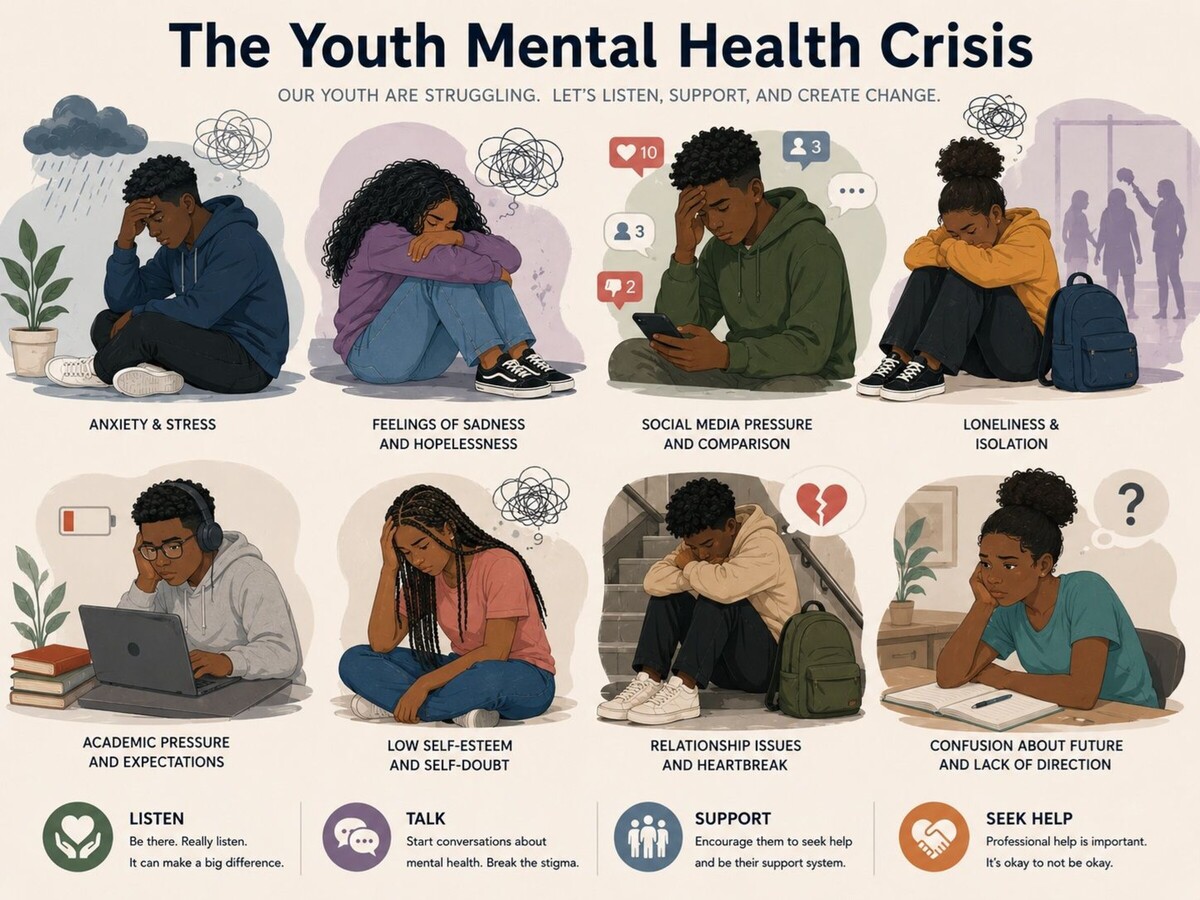



May is recognized nationally as Mental Health Awareness Month, but awareness alone is no longer sufficient to meet the scale of the crisis unfolding among young people across the United States. The conversation has advanced beyond whether youth mental health is deteriorating. The evidence is already overwhelming. The more urgent question now is why so many young people are struggling simultaneously, and why many communities, institutions, and policymakers still appear unable or unwilling to confront the deeper structural conditions contributing to the problem.
Across Minnesota and throughout the country, schools, hospitals, parents, counselors, faith leaders, and community organizations are increasingly sounding alarms about rising anxiety, depression, emotional isolation, behavioral distress, and suicide risk among adolescents and young adults. The crisis has become especially concerning within immigrant communities where mental health discussions often remain deeply stigmatized and where emotional distress is frequently hidden behind cultural expectations, family pressure, silence, or shame.
The issue can no longer be dismissed as a temporary social trend, a byproduct of adolescence, or merely a lingering effect of the COVID-19 pandemic. What is unfolding among many young people reflects a broader social fracture involving digital overexposure, weakened community infrastructure, economic stress, family instability, educational pressure, declining social trust, and the erosion of meaningful human connection.
In many respects, the youth mental health crisis has become one of the defining public health and social challenges of this generation.
National data continues to underscore the severity of the situation. According to the Centers for Disease Control and Prevention, persistent feelings of sadness and hopelessness among high school students have risen dramatically over the past decade. Emergency room visits for mental health crises involving adolescents increased significantly following the pandemic years, while suicide remains among the leading causes of death for young people in the United States.
Yet statistics alone often fail to capture the lived realities behind the numbers.
Teachers increasingly report students struggling with emotional regulation, disengagement, and chronic anxiety inside classrooms. Parents describe children becoming socially withdrawn, emotionally overwhelmed, and heavily dependent on digital devices for stimulation, validation, and escape. Counselors report growing caseloads and longer waiting lists. Hospitals continue facing shortages of youth psychiatric beds and mental health professionals. In some communities, students wait weeks or even months to access therapy services.
The crisis is visible not only in clinical data, but in daily public life.
Minnesota has not been immune to these pressures. School districts throughout the state have expanded student support initiatives, mental health programming, and crisis response services in recent years. At the same time, many educators and health professionals acknowledge that existing systems remain overwhelmed by growing demand.
The situation becomes even more complicated inside immigrant communities where mental health conversations are often shaped by cultural stigma, generational misunderstanding, and limited access to culturally competent care.
In many households, emotional suffering remains difficult to discuss openly. Depression may be interpreted as laziness or weakness. Anxiety may be dismissed as overthinking or lack of discipline. Trauma symptoms may go unrecognized entirely. In some cases, families fear community judgment more than the underlying problem itself.
Among some immigrant parents, survival priorities understandably dominate family life. Many arrived in the United States carrying the pressures of migration, financial instability, political upheaval, war, displacement, or economic sacrifice. Their focus often centers on educational advancement, financial security, and protecting their children from external dangers. Mental health struggles may therefore appear secondary compared to immediate economic realities.
At the same time, many young people growing up in immigrant households are navigating complex cultural tensions that previous generations did not experience in the same way. They often move daily between different cultural expectations at home, school, online spaces, and broader American society. Some struggle with identity, belonging, language barriers, discrimination, academic pressure, family expectations, or feelings of emotional isolation they do not know how to articulate.
Too often, those struggles remain hidden until they become severe.
Mental health silence is not unique to immigrant communities, but the consequences can become particularly dangerous when emotional distress is treated as a private family matter rather than a legitimate health concern requiring support and intervention.
The conversation also cannot ignore the role technology now plays in adolescent life.
Modern youth are growing up inside a digital environment unlike anything previous generations experienced. Smartphones, social media platforms, algorithm-driven content, and constant online engagement have fundamentally reshaped how young people communicate, socialize, compare themselves to others, and process their emotions.
Many adolescents now spend substantial portions of their day online, often late into the night. Research continues linking excessive screen exposure to disrupted sleep, heightened anxiety, depressive symptoms, reduced attention spans, and social withdrawal. Social media platforms reward comparison, performance, and constant visibility while exposing young users to cyberbullying, misinformation, unrealistic beauty standards, outrage-driven content, and nonstop social pressure.
The result is a generation that is digitally connected at nearly all times, yet increasingly disconnected from stable in-person relationships and community interaction.
This dynamic matters because human beings, particularly young people, require more than digital communication to maintain emotional well-being. Healthy development depends heavily on trusted relationships, social belonging, physical activity, mentorship, recreation, family engagement, and meaningful participation in community life.
Many of those structures have weakened considerably over time.
Previous generations often benefited from stronger neighborhood relationships, more intergenerational interaction, local recreation programs, youth-centered community activities, and more consistent face-to-face socialization. Today, many families operate under intense economic pressure and fragmented schedules that leave less time for sustained communal interaction.
In many communities, youth gathering spaces have declined. Recreation centers face budget constraints. Community programs struggle for funding. Families are stretched between multiple jobs and responsibilities. Social interaction increasingly occurs through screens rather than physical spaces.
The weakening of social infrastructure has created conditions where many young people experience profound loneliness despite being constantly surrounded by digital activity.
The crisis also intersects directly with education systems now serving as de facto frontline mental health institutions.
Teachers and school staff are increasingly expected to address emotional crises alongside academic responsibilities. School counselors in many districts manage overwhelming student ratios. Behavioral incidents, emotional dysregulation, absenteeism, and mental health emergencies have become more common challenges inside classrooms.
While many schools have expanded counseling services and social-emotional learning initiatives, significant disparities remain in access to care, especially for lower-income families and culturally diverse communities.
Language barriers continue limiting access for some immigrant families. Mental health resources may not always reflect cultural understanding or community realities. Families unfamiliar with the American healthcare system may struggle navigating available services. Insurance limitations, provider shortages, transportation barriers, and long waitlists further complicate access to treatment.
These gaps create conditions where young people often suffer quietly without early intervention.
The public conversation around youth mental health must also move beyond purely individual explanations. Not every mental health challenge can be solved through personal resilience, motivational messaging, or self-care language. Structural conditions matter.
Young people today are growing up during a period marked by economic instability, political polarization, housing insecurity, climate anxiety, social distrust, gun violence concerns, and nonstop exposure to crisis-driven media cycles. Many adolescents encounter a daily stream of catastrophic information before they are emotionally equipped to process it.
At the same time, expectations continue rising.
Students face pressure to excel academically, build competitive resumes, maintain online visibility, navigate social pressures, prepare for uncertain economic futures, and absorb constant societal instability simultaneously. For many, the cumulative emotional burden becomes overwhelming.
The growing normalization of emotional exhaustion among young people should concern every sector of society.
Mental health cannot be treated solely as a medical issue detached from broader civic life. It is deeply connected to how communities function, how families interact, how schools operate, how economies are structured, and whether young people feel supported, valued, and connected to something larger than themselves.
This reality demands a broader policy response.
Minnesota lawmakers, school districts, healthcare systems, nonprofit organizations, faith institutions, and local communities all have roles to play in addressing the crisis more seriously and more comprehensively.
Expanding school-based mental health services must remain a priority. Increasing access to culturally competent counselors and multilingual support services is essential. Early intervention programs should receive greater investment. Community-based mentorship initiatives and youth recreation programs deserve stronger public support. Mental health education for parents and caregivers, particularly within immigrant communities, should become more widely accessible.
Faith leaders and cultural organizations also have an important role in helping reduce stigma surrounding mental health discussions. In many immigrant communities, religious institutions remain among the most trusted spaces available. That influence can either reinforce silence or help create pathways toward understanding, compassion, and treatment.
The conversation must be approached carefully and respectfully. Cultural traditions should not be attacked or caricatured. Immigrant communities possess extraordinary strengths including resilience, strong family bonds, spiritual grounding, and communal support traditions that have sustained generations through hardship.
But acknowledging those strengths should not prevent honest conversations about harmful silence where it exists.
No family should feel ashamed seeking mental health support for a child. No young person should feel forced to hide emotional distress out of fear of judgment. No parent should interpret therapy or counseling as personal failure.
The stakes are simply too high.
The youth mental health crisis will not be solved through awareness campaigns alone. It requires sustained public investment, stronger community infrastructure, more accessible healthcare systems, healthier digital environments, and renewed commitment to rebuilding meaningful social connection.
Most importantly, it requires society to stop treating youth emotional suffering as isolated individual weakness disconnected from the environments young people are being asked to navigate every day.
Mental health conversations must become more grounded, more honest, and more structurally aware.
For many young people, the struggle is not simply internal. It reflects the conditions surrounding them.
Mental Health Awareness Month should therefore serve as more than a symbolic observance. It should force communities, institutions, and policymakers to confront uncomfortable realities about the social environment many young people now inhabit.
The future health of any society depends heavily on whether its young people feel connected, supported, emotionally safe, and hopeful about their place in the world.
Far too many currently do not.
That should concern everyone.
MinneapoliMedia | Community. Culture. Civic Life.



Sunny, with a high of 86 and low of 49 degrees. Sunny in the morning, clear overnight.