60° and Clear
Image
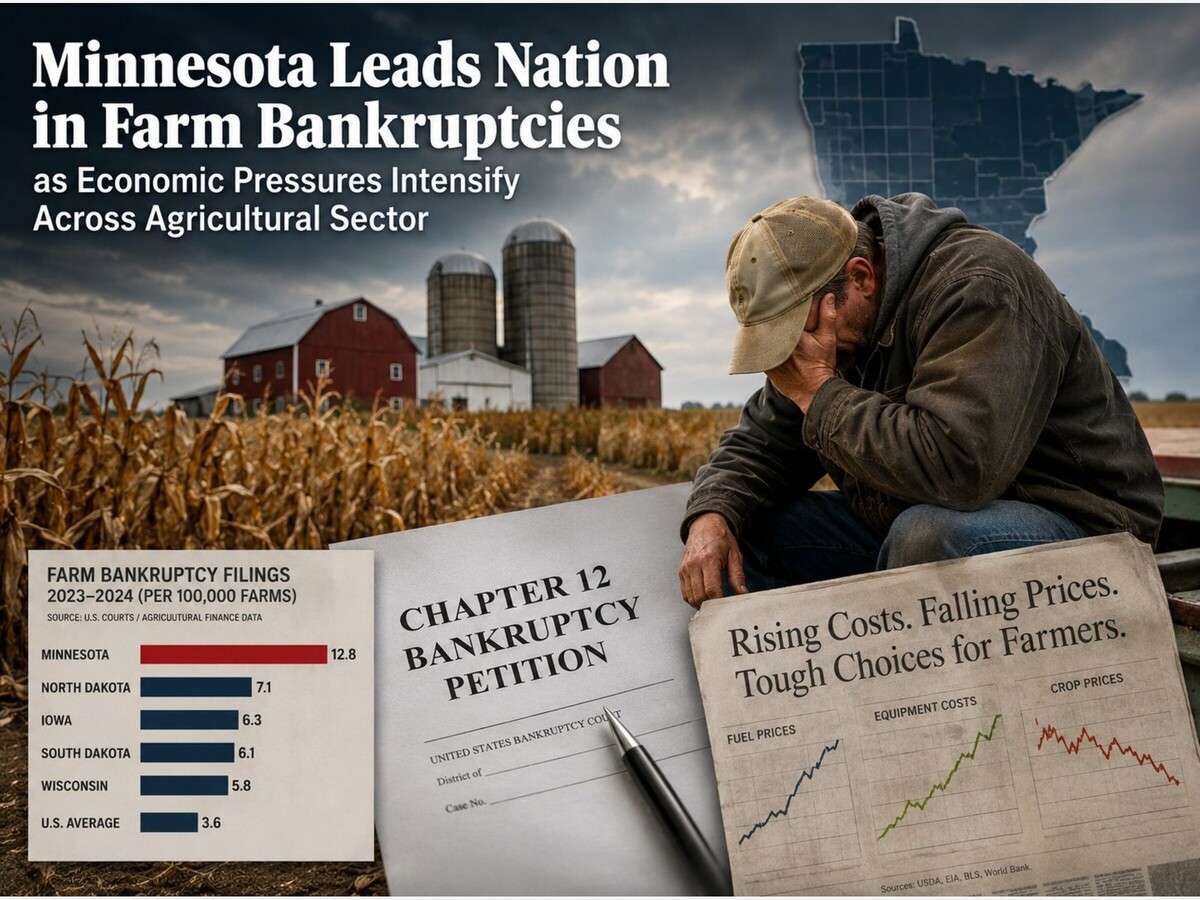



ST. PAUL, MN (June 2026) Minnesota farmers are facing mounting financial pressure as falling commodity prices, elevated production costs, higher borrowing expenses, and uncertainty surrounding federal farm policy continue to strain agricultural operations across the state.
The latest evidence of that stress can be found in bankruptcy court filings.
Minnesota recorded more Chapter 12 farm bankruptcies than any other state during the first quarter of 2026, according to national bankruptcy data, underscoring growing concern among agricultural economists, lenders, attorneys, and farm organizations about the health of the farm economy.
Eight Minnesota farm operations sought Chapter 12 bankruptcy protection during the first three months of the year, the highest total of any state in the nation. That figure alone exceeded the total number of Chapter 12 filings recorded in Minnesota during all of 2024, highlighting the speed at which financial pressures have intensified for some producers.
Nationally, 86 Chapter 12 farm bankruptcies were filed during the first quarter. Minnesota led the nation with eight filings, followed by Arkansas with seven, Texas with six, and Georgia and Oregon with four each.
The trend accelerated further in April.
According to bankruptcy tracking data cited by agricultural industry analysts, 62 Chapter 12 cases were filed nationwide during April 2026, a 130 percent increase from April 2025 and the highest monthly total since February 2020.
For agricultural observers, the filings represent more than a legal statistic.
They are often viewed as a leading indicator of stress within rural economies.
Chapter 12 bankruptcy was created specifically for family farmers and family fishing operations. Unlike liquidation proceedings, Chapter 12 allows producers to reorganize debt while continuing operations under a court-approved repayment plan. As a result, bankruptcy filings frequently signal that producers have exhausted other options, including refinancing, restructuring loans, selling assets, or drawing down operating reserves.
Agricultural economists point to a convergence of economic forces that have steadily eroded profitability across much of the farm sector.
Austin Peiffer, an agricultural attorney with Ag and Business Legal Strategies, said farmers are navigating one of the most difficult operating environments in recent years.
"We still have weak commodity prices, and we don't have a lot of certainty with federal farm policy," Peiffer said in discussing the rise in bankruptcy filings.
The challenges confronting producers are widespread.
Commodity prices for many major crops have declined substantially from the highs experienced during the market disruptions of 2021 and 2022. While prices remain above historic lows in some sectors, revenue has fallen for many producers at the same time operating expenses remain elevated.
That imbalance has created what agricultural economists commonly describe as a "margin squeeze," a situation in which expenses rise faster than income.
Samantha Ayoub, an economist with the American Farm Bureau Federation, has noted that farm businesses often operate on narrow profit margins even during favorable market conditions. When multiple cost pressures emerge simultaneously, those margins can disappear quickly.
Fuel, fertilizer, machinery repairs, seed, crop protection products, labor, land rents, and interest expenses all remain significant cost factors for Minnesota farmers.
Global geopolitical instability has added another layer of uncertainty.
Conflicts affecting energy markets, including tensions and military activity in the Middle East, have contributed to volatility in fuel and fertilizer prices. Because fertilizer production and transportation are closely linked to global energy markets, increases in oil and natural gas prices frequently translate into higher costs for agricultural producers.
For farms already operating with limited financial flexibility, even modest increases in input costs can significantly affect annual profitability.
Interest rates have become another major concern.
Many producers expanded operations, purchased land, financed equipment, or increased borrowing during years of historically low interest rates. As loans renew or variable-rate debt adjusts, financing costs have increased substantially for some operations.
The result is a farm economy where many producers face higher expenses on nearly every front while generating less revenue from the commodities they sell.
Beyond market conditions, uncertainty surrounding federal agricultural policy remains a significant concern for producers.
Congress has yet to provide the long-term certainty many agricultural organizations have sought through a comprehensive Farm Bill framework. Farmers rely on federal programs for crop insurance, conservation initiatives, disaster assistance, and other risk-management tools that help stabilize farm finances during periods of market volatility.
Without clear long-term policy direction, many producers are finding it more difficult to make strategic decisions regarding land, equipment, expansion plans, and future investments.
Agricultural organizations across the country have repeatedly urged lawmakers to provide greater certainty through stable federal farm policy, arguing that predictability is essential in an industry already subject to weather risks, global market fluctuations, and international trade dynamics.
The effects of financial stress in agriculture extend well beyond individual farm operations.
Minnesota consistently ranks among the nation's leading agricultural states, producing significant quantities of corn, soybeans, sugar beets, wheat, dairy products, hogs, turkeys, and other commodities. Agriculture and food production contribute billions of dollars annually to the state's economy and support thousands of jobs.
When farm income declines, the consequences often ripple through rural communities.
Equipment dealers, grain elevators, trucking companies, veterinarians, feed suppliers, local banks, retailers, and Main Street businesses frequently experience reduced economic activity as producers cut spending and delay purchases.
For many communities across Greater Minnesota, agriculture remains a foundational economic engine.
As a result, prolonged weakness in the farm economy can affect employment, business investment, and local tax bases throughout rural regions.
Few agricultural analysts expect immediate relief.
Peiffer said he does not anticipate significant improvement in the broader farm economy in the near term, given ongoing pressures from commodity markets, production costs, and policy uncertainty.
As producers move toward the fall harvest season, agricultural attorneys, lenders, and financial consultants are encouraging farmers to conduct detailed financial reviews and maintain close communication with creditors.
Industry experts recommend regular budget analysis, updated balance sheets, enterprise-level profitability reviews, and early debt restructuring discussions when necessary. Those steps can help identify financial vulnerabilities before they escalate into defaults, forced asset sales, or bankruptcy proceedings.
While many Minnesota farms remain financially stable, the recent rise in Chapter 12 filings serves as a warning sign that economic challenges continue to intensify across portions of the agricultural sector.
For a state whose identity and economy remain deeply connected to farming, the bankruptcy figures offer a sobering reminder that many producers are navigating one of the most financially challenging environments of the post-pandemic era.
MinneapoliMedia | Community. Culture. Civic Life.



Overcast, with a high of 72 and low of 56 degrees. Partly Cloudy in the morning, light rain shower for the afternoon, overcast during the evening,