Image



Small drones.
The aircraft are not conducting surveillance, delivering packages, or capturing aerial photography. Instead, they represent the latest tool in a decades-long regional effort to control mosquito populations before they emerge as a nuisance and potential public health concern.
The Metropolitan Mosquito Control District (MMCD), the regional agency responsible for mosquito management across the seven-county Twin Cities metropolitan area, has expanded the use of unmanned aircraft systems as part of its 2026 mosquito-control operations. The drones are being deployed in Brooklyn Park and other communities to apply biological larvicides to wetlands and standing-water habitats where mosquitoes develop during the earliest stages of their life cycle.
According to the City of Brooklyn Park and MMCD officials, the technology allows treatment crews to safely reach breeding sites that can be difficult, time-consuming, or hazardous to access on foot.
The approach reflects a broader evolution in mosquito-control practices, one increasingly driven by precision, efficiency, and environmental stewardship.
"We use drones to access areas that are challenging for field staff to reach while improving treatment accuracy," MMCD has explained in its public outreach materials. By targeting mosquito populations before they become flying adults, officials can reduce nuisance mosquito numbers while minimizing broader intervention later in the season.
The science behind the operation begins long before residents encounter their first summer mosquito.
Mosquitoes spend the earliest portion of their life cycle in water. Eggs hatch into larvae that live beneath the surface of wetlands, temporary pools, flooded lowlands, and stormwater habitats. These larvae eventually mature into adult mosquitoes capable of traveling significant distances in search of food and breeding sites.
Rather than targeting adult mosquitoes after they emerge, MMCD's strategy focuses on interrupting that cycle before adulthood.
The drones distribute biological larvicides containing Bacillus thuringiensis israelensis (Bti) and, in some locations, Bacillus sphaericus. Both are naturally occurring soil bacteria that have been used for decades in mosquito-control programs throughout North America.
The products are typically formulated as pellets or granules and applied directly to standing water where mosquito larvae are present.
What makes the treatment notable is its specificity.
The active ingredients affect mosquito and black fly larvae through a biological process tied to their digestive systems. Once ingested, the bacteria disrupt larval development and prevent the insects from reaching adulthood. Because the mechanism targets specific insect groups, the products are considered non-toxic to humans, pets, livestock, fish, birds, and pollinators when applied according to regulatory standards established by federal and state agencies.
Environmental regulators, public health agencies, and mosquito-control districts throughout the United States have long utilized Bti-based larvicides because of their ability to target mosquitoes while minimizing impacts on surrounding ecosystems.
For Brooklyn Park residents, however, the most visible aspect of the program may be the drones themselves.
MMCD officials emphasize that every flight operates under Federal Aviation Administration Part 107 regulations governing commercial drone operations. Each mission is supervised by a licensed remote pilot who maintains continuous visual contact with the aircraft throughout the flight.
Residents who encounter drone activity may also notice several visual indicators that mosquito-control operations are underway.
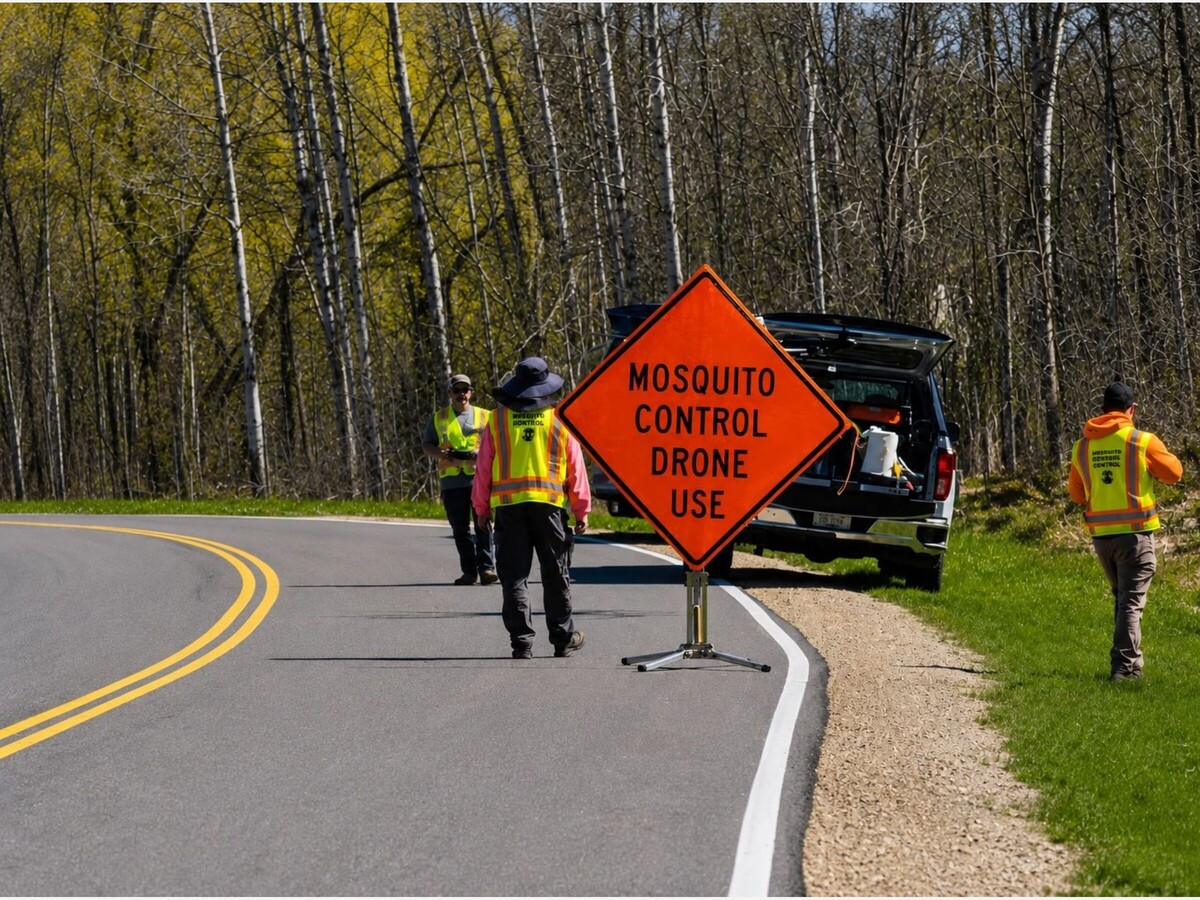
Bright orange signs posted near public access points identify treatment zones with the words "Mosquito Control Drone Use." Field personnel wear high-visibility yellow or green safety vests displaying MMCD identification, while district vehicles bearing official logos and safety lighting are typically stationed nearby.
The district stresses that drones are never operating independently. Personnel remain on site throughout treatment activities and maintain direct oversight of every operation.
The expansion of drone technology comes as mosquito-control agencies nationwide explore new methods for improving access to environmentally sensitive landscapes. Wetlands often provide ideal mosquito breeding habitat but can present logistical challenges for traditional ground-based treatment methods. Drones allow operators to treat these areas with greater precision while reducing the need for workers to traverse unstable terrain.
The Metropolitan Mosquito Control District, established by the Minnesota Legislature in 1958, serves Anoka, Carver, Dakota, Hennepin, Ramsey, Scott, and Washington counties. Its responsibilities include monitoring and controlling mosquito populations, black flies, and ticks while balancing public health concerns with environmental protection.
Each year, the district conducts extensive surveillance of mosquito populations, monitors breeding conditions, and applies treatments when thresholds warrant intervention.
Residents interested in monitoring local operations can view weekly drone treatment maps and planned activity locations through the district's online Drone Activity Portal, which is updated regularly throughout the mosquito season.
For many residents, the sight of a drone gliding quietly over a marsh may seem like a symbol of emerging technology.
In reality, officials say, it represents something far more practical: a modern tool being used to solve a familiar Minnesota problem.
As summer temperatures rise and mosquito season intensifies, those small aircraft hovering over Brooklyn Park's wetlands are working to ensure that fewer mosquitoes ultimately find their way into neighborhoods, parks, trails, and backyards across the community.
Sources: Metropolitan Mosquito Control District; City of Brooklyn Park; Federal Aviation Administration Part 107 Regulations; Minnesota Statutes establishing the Metropolitan Mosquito Control District; MMCD Drone Activity Program and Operational Guidance.
MinneapoliMedia | Community. Culture. Civic Life.



Overcast, with a high of 73 and low of 53 degrees. Sunny for the morning, light rain shower for the afternoon, light drizzle in the evening, overcast overnight.