76° and Sunny
Image




For Damaris Melo-Gyasi, the founder and principal architect of Design by Melo, architecture is never neutral. It is a system of profound social signals.
"Even if you think you’re just designing a building," Melo-Gyasi notes, "your building is going to carry an agenda. If you aren't intentional about it, it might very well carry a bad one."
This realization sits at the molten core of Builders of Minnesota, MinneapoliMedia’s archival series documenting the innovators reshaping our state's physical and social topographies. In a striking follow-up to her initial profile in The Power of Her series, which traced her foundational journey from São Paulo, Brazil, to the American Midwest, Melo-Gyasi returned to dissect the systemic mechanics of the trade itself.
To sit with her is to understand that a builder is not someone who simply manages a construction timeline. A builder is an urban ethicist. Through landmark projects like Opportunity Crossing in South Minneapolis, Melo-Gyasi has forced a vital question into the rooms where development capital and municipal power collide: How do we create a building that does not just house people, but honors them?
Architecture teaches people where they stand in the social hierarchy long before they ever cross a threshold. Melo-Gyasi understands this because she has parsed the mechanics of exclusion at every scale.
Early in her career, while working on an educational facility for the U.S. Army in northern Minnesota, she watched how security frameworks were seamlessly baked into the geography. Fences and razor wire were bypassed for protective landscaping, meaning spiky, hostile rock formations and pokey, defensive plantings meticulously positioned to keep the public at bay without disrupting the aesthetic veneer.
"It is a very objective, in-your-face way of a design having an agenda," she says. "I don’t want you to come over here; I want you to stay over there."
The true danger, she argues, is that this exact spatial policing happens daily in civilian neighborhoods, completely unannounced. A brilliantly illuminated, transparent civic plaza beckons a specific class of citizens forward; a darkened, unventilated corner behind a structural wall quietly corrals another.
"All of those messages, we receive them," Melo-Gyasi says. "A lot of times designers do not realize they are delivering a message, and users do not understand they are receiving it. But we are absorbing it. And if you are unaware of this social architecture, you might internalize it. You begin to believe you do not deserve beautiful things."

This systemic bias manifests frequently in the subtle, low-expectation bigotry of property management. She recalls recent pushback regarding a beautiful mural damaged by moving carts near an elevator bank in one of her affordable housing builds.
"Someone immediately blamed the tenants, saying, 'Affordable housing, man, people don't know how to take care of beautiful things.' I live in a luxury building in Minneapolis, and they put padded blankets over the elevator walls because moving carts are inherently hard to maneuver. It has nothing to do with income. It is management's failure to plan for human life. To assume poor people are just destructive is the baggage people carry into these spaces."
[TYPICAL COMPLIANT AFFORDABLE UNIT]

┌───────────────────────────────────────┐

│   Windowless   │  Windowless   │ Ext. │

│    Bedroom     │    Bedroom    │ Wall │

│  (Dark Zone)   │  (Dark Zone)  │ (W)  │

├────────────────────────────────┤ (W)  │

│         Living Area            │ (W)  │

└───────────────────────────────────────┘

  (W) = Exterior Windows Required Only for Living Spaces
Nowhere is this design triage more glaring than in the floor plates of subsidized residential complexes. In the relentless pursuit of maximizing units per square foot to satisfy financial pro formas, developers frequently deepen the building footprint. The casualty of this efficiency is light.
Melo-Gyasi remembers the visceral shock of auditing local affordable housing plans where multiple bedrooms were entirely cut off from the exterior envelope, left completely windowless.
"I assumed building codes wouldn't allow it," she says. "I assumed the institutional funders wouldn't allow it. I went and read the codes, read the design guidelines. They both allowed it."
For Melo-Gyasi, bureaucratic compliance is the absolute floor of architectural responsibility, not the ceiling. She draws a sharp line between merely housing a demographic and respecting their humanity.
"I asked the developers who build both affordable and market-rate portfolios: 'Would you build this for your market-rate housing?' No, you wouldn't. Then why is it acceptable here? The funders will cap my architectural fees at 3.7 percent of construction costs, dictating exactly what my labor is worth, while simultaneously signing off on a box that deprives a child of sunlight. I refuse to design for those developers. I will not put a person in the dark."
This is not an abstract aesthetic crusade; it is a matter of public health and economic survival.
"If you or I have a bedroom without a window, we can leave," she notes with sharp candor. "We can go to a cafe, sit on a patio, and decompress over an overpriced salad. But the families we are designing for are often working two or three jobs. When they come home, those four walls are their absolute and only respite from the world. If that home doesn't honor them, nothing does."
The antidote to this top-down displacement is a methodology Melo-Gyasi defines as designing with community, rather than for them. It is an approach she describes with immediate, refreshing honesty: it is stressful, deeply inefficient, and inherently messy.
"There is no 100 percent consensus in community design," she explains. "When you bring together sixteen different stakeholders, including residents, elders, and organizers, everyone wants something different, and the budget cannot accommodate it all. You are intentionally committing to a process that is less than perfect. But it is infinitely better to have 80 percent of something fundamentally good, where the community sees their fingerprints on the wall, than 100 percent of a top-down corporate vision that makes nobody happy but the developer."
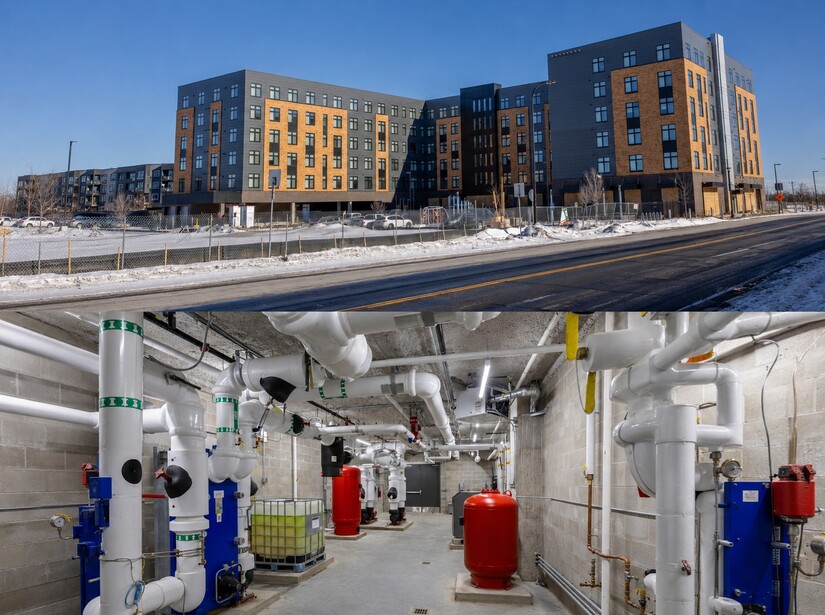
This grueling collaborative dance defined the trajectory of Opportunity Crossing, the commanding six-story, mixed-use development at 3030 Nicollet Avenue in South Minneapolis. The project fractured Design by Melo's timeline into a definitive before and after, transforming the practice from a nimble, two-person operation into a highly visible, authoritative force in urban design.
MELO-GYASI'S COMMUNITY VALUE HIERARCHY

┌────────────────────────────────────────────────────────┐

│ PROTECTED PRIORITY (Non-Negotiable Civic Capital)      │

│ ↳ Neighborhood Playground / Central Park / Comm. Room │

├────────────────────────────────────────────────────────┤

│ VALUE-ENGINEERED COMPROMISE (Aesthetic Luxury)         │

│ ↳ Rooftop Patio Units / Specialized Mechanical Trims  │

└────────────────────────────────────────────────────────┘
During the protracted community engagement phases for the Nicollet Avenue site, Melo-Gyasi encountered the profound limitations of traditional architectural discovery. When she spoke to neighborhood mothers about what they required from the building, the word that surfaced repeatedly was safety. Yet when pressed for technical specifics, such as lighting lumens, sightlines, or access control, the language dissolved.
"They couldn't define it through architecture," Melo-Gyasi recalls. "They defined it through relationships. They remembered feeling safe not because of a structural wall, but because of an environment where their children were recognized, valued, and protected by the people around them. It was deeply humbling. As architects, we like to think of ourselves as gods of the built environment. But the most gorgeous four walls on earth will fail if the property management is hostile, polices the youth, and refuses to invite people in."
The community's insistence on long-term stability radically altered the building's economic blueprint. Originally conceived as standard ground-floor commercial rental space, the neighborhood challenged the team on the structural transience of the model. They asked why public investments always stopped at affordable rental margins rather than building generational wealth.
"Rental housing is a Band-Aid on a much larger income wound," Melo-Gyasi insists. "It calms the crisis down, but it doesn't fix the underlying system."
Because regional underwriting mechanisms rarely accommodate affordable commercial homeownership, the team had to innovate. Community agitation directly drove the restructuring of the floor plan into commercial condominiums, allowing local entrepreneurs of color to purchase and hold equity in their storefronts. That systemic shift, coupled with an expansive public mural documenting the multi-ethnic heritage of the corridor, transformed the building into a literal love letter to the neighborhood.
When hyper-inflation and supply chain disruptions forced late-stage budget cuts, the community’s value hierarchy dictated what stayed and what went.
"We lost the rooftop patio," Melo-Gyasi says. "It was expensive, and in the grand scheme of human dignity, less vital than what happened at grade. We fought like hell to keep the central park, the playground, and the community room. Parents needed to look out their apartment windows and see their kids playing safely on the ground. We gave up the luxury to preserve the life."
Melo-Gyasi traces this systemic perspective back to an unforgiving professor during her university years who mapped the evolution of classical civilizations through urban design. It was there she realized that the layout of public squares in Rome or Athens was never an accident of geography; it was an apparatus used to allocate power, manage mobility, and enforce class borders.
"Architecture is an incredible tool for changing the quality of human life, but it historically serves only those who have already been served," she says.
The remedy requires a drastic diversification of the industry itself. Currently, the American architectural landscape remains overwhelmingly white, wealthy, and male, creating a monolithic demographic pipeline that reproduces the same safe, Eurocentric design paradigms decade after decade.
"The vast majority of architects come from a very limited, privileged reality," Melo-Gyasi states bluntly. "I wish our profession wasn't so elitist. It is incredibly expensive to acquire the education, and the entry-level pay is notorious, which completely locks out working-class talent. We need designers who possess a comprehensive, lived understanding of real life, rather than a boutique, insulated view of the world."
For this reason, she actively refuses to cultivate a recognizable, signature aesthetic for Design by Melo.
"I don't want a brand. I don't want someone walking up to a facade and saying, 'Oh, that must be a Damaris Melo-Gyasi building because it has her signature flourish.' A building should be a mirror, not a monument to my ego. It should look uniquely and intensely like the people who fought to bring it into existence."
This profound refusal to separate the creator from the context came to a beautiful, quiet culmination at the close of our conversation. When asked where to locate her newly published book, Melo-Gyasi directed me to Black Garnet Books, the vital, independent, Black-woman-owned bookstore in St. Paul.
Then, almost as an afterthought, she shared a final detail. She didn't just support the shop; she designed it.
It is a perfect, poetic synthesis of her entire worldview. A reader can walk into a physical environment carved out by her hand, sit under light curated by her vision, and open a text written by her voice. It is a space where the architecture does not dominate or perform; it opens its arms, steps back, and allows the community inside to take center stage.
Across a changing Minnesota, one hard-fought compromise and one window at a time, Damaris Melo-Gyasi is proving that our buildings can do so much more than keep out the cold. They can finally tell us we are home.
MinneapoliMedia | Community. Culture. Civic Life.



Patchy rain nearby, with a high of 81 and low of 55 degrees. Sunny during the morning, light rain shower in the afternoon and evening, clear overnight.