72° and Overcast
Image
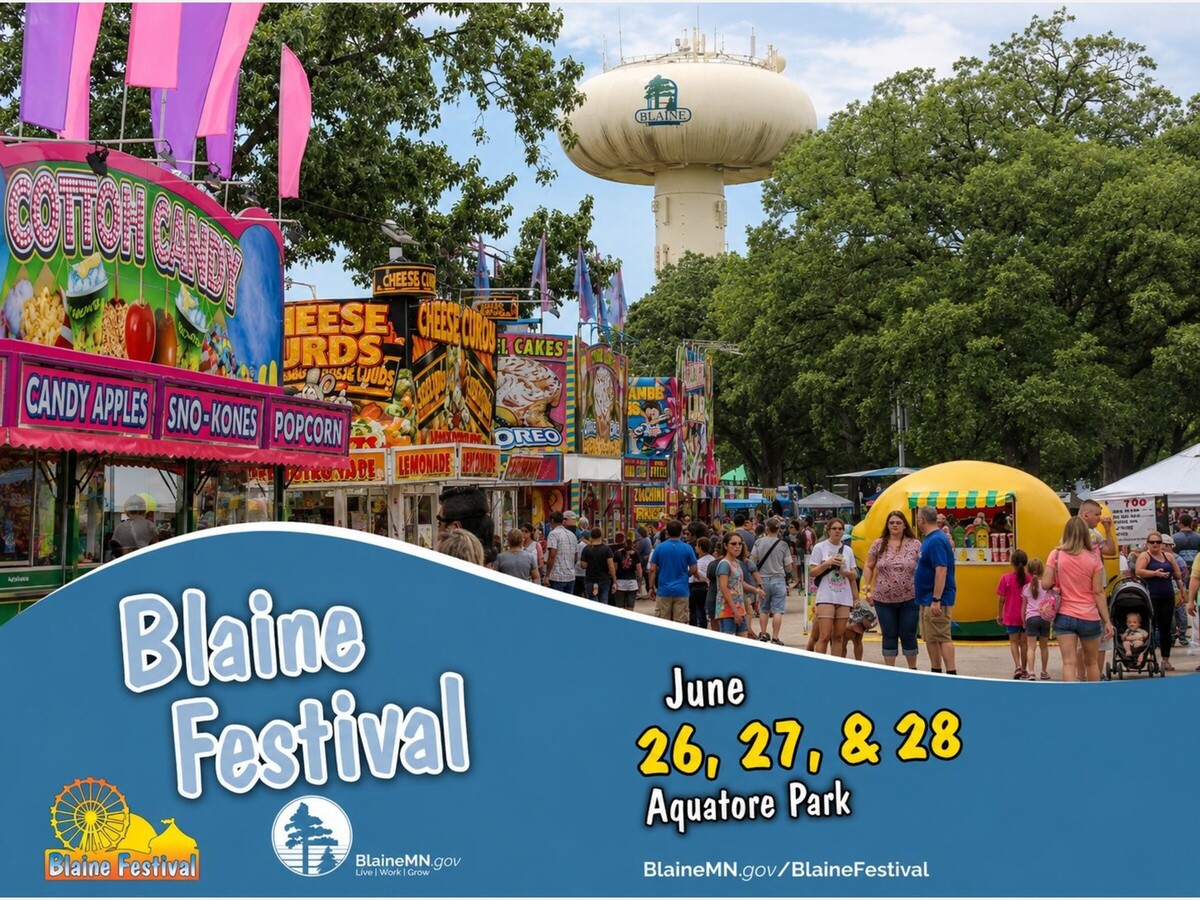



Just a few miles away, city staff, volunteers, police officers, community organizations, and civic groups are preparing for a very different undertaking. Aquatore Park is being transformed into the centerpiece of Blaine Festival 2026, the city's largest annual celebration, where families will gather for concerts, parades, carnival rides, pig races, children's activities, and neighborhood traditions that have become woven into the fabric of community life.
Together, the projects tell a larger story about one of Minnesota's fastest-growing cities: a community simultaneously investing in the infrastructure necessary to support its future while preserving the civic traditions that define its identity.
For decades, Highway 65 has served as the primary commercial and transportation spine running through Blaine and neighboring communities.
It has also been one of the region's most frustrating and hazardous roadways.
The corridor carries tens of thousands of vehicles daily, linking northern Anoka County communities with Minneapolis and the broader metropolitan area. As population growth accelerated throughout Blaine, traffic volumes surged while the highway's at-grade intersections increasingly became bottlenecks for commuters, commercial traffic, emergency responders, and local residents.
Transportation planners have spent years studying solutions.
Now those plans are becoming reality.
The Minnesota Department of Transportation, in partnership with the City of Blaine and Anoka County, has launched the first phase of a multiyear reconstruction project estimated at approximately $195 million.
Current construction activity is concentrated along the corridor between 97th Avenue Northeast and 121st Avenue Northeast/Paul Parkway, where crews have begun widening roadway segments, installing storm sewer infrastructure, constructing temporary traffic crossovers, and preparing the corridor for future phases of work.
Although major highway closures are not expected until later construction stages, motorists are already encountering localized side-street closures, access adjustments, lane shifts, and detours where construction activity intersects with neighborhood connections.
When completed, the project will fundamentally alter the corridor.
The existing signalized highway will be converted into a freeway-style facility featuring grade-separated interchanges at 99th Avenue, 105th Avenue, 109th Avenue, and 117th Avenue/Cloud Drive. Traffic signals that have long contributed to congestion and crash risks will be removed. Access points will be consolidated. New frontage and backage roads will improve local circulation while reducing vehicle conflict points.
The project also includes significant investments beyond automobile travel, including new pedestrian and bicycle connections, Americans with Disabilities Act accessibility upgrades, drainage improvements, culvert replacements, and a new pedestrian bridge connecting the area between 113th and 114th avenues.
For transportation officials, the goal is straightforward: improve safety, reduce delays, and create a corridor capable of supporting future growth throughout the region.
For residents, however, the project represents something more personal. It is an acknowledgment that the transportation system serving today's Blaine was largely built for a much smaller city.
While state and local officials focus on long-term transportation safety, city leaders are also directing attention toward the next generation of roadway users.
The Blaine Police Department and city park officials have finalized plans for the annual Blaine Bike Rodeo, scheduled for June 30 from 5 p.m. to 6:30 p.m. at Aquatore Park.
The free community event combines recreation with education, giving children and families opportunities to learn bicycle safety skills while interacting directly with public safety personnel.
Police bicycle patrol officers will oversee skills courses and agility stations designed to teach safe riding practices, traffic awareness, and maneuvering techniques. Bicycle technicians will provide free mechanical inspections to ensure equipment is operating safely.
Organizers will also distribute free bicycle helmets while supplies last and conduct a raffle for a new bicycle.
The event serves another community purpose as well.
Aquatore Park will function as a collection site for Bikes4Kids, a nonprofit organization that refurbishes donated bicycles and distributes them to children and families who may not otherwise have access to one. Residents are encouraged to donate gently used bicycles for redistribution throughout the community.
The evening will also include complimentary hot dogs, chips, water, and live entertainment from family-oriented musical act Riffin' Griffin.
For city officials, the Bike Rodeo reflects a broader philosophy that public safety extends beyond emergency response and enforcement. Education, prevention, accessibility, and community engagement are increasingly viewed as equally important components of keeping residents safe.
Meanwhile, attention is increasingly turning toward Aquatore Park's largest event of the year.
The Blaine Festival returns June 26 through June 28, bringing three days of entertainment, recreation, food, music, and community celebration to the city.
Municipal crews, volunteers, vendors, nonprofit organizations, public safety agencies, and festival organizers have entered the final stages of preparation for what is expected to be one of the largest gatherings of the summer season.
The festival grounds will feature a traditional carnival, live music performances, a craft fair, a car show, food vendors, family activities, and an open-air beer garden.
Returning attractions include the popular Swifty Swine Pig Races, a perennial crowd favorite that has become one of the festival's most recognizable traditions.
Families will also find children's activities throughout the grounds, including the Fantasy Corral Petting Zoo, Kids Corner programming, and public safety demonstrations.
One of the festival's signature events remains the annual parade, which will once again bring together community organizations, civic groups, youth organizations, local businesses, public safety agencies, marching units, and performers along city streets.
For many residents, the festival functions as more than a summer event.
It serves as an annual civic gathering point where longtime residents reconnect, new families establish roots, and community organizations showcase the work they do throughout the year.
The contrast between a massive highway reconstruction project and a community festival may appear stark.
One involves engineering drawings, drainage systems, traffic modeling, and public financing.
The other involves music, food, parades, volunteers, and shared experiences.
Yet both are responses to the same question confronting rapidly growing suburban communities across Minnesota: how does a city continue to grow without losing its sense of place?
In Blaine, the answer appears to be unfolding on two fronts simultaneously.
Construction crews are rebuilding the infrastructure needed to support the next generation of growth. Volunteers and community leaders are preserving the traditions that help residents feel connected to one another.
One effort is measured in millions of dollars and years of construction schedules.
The other is measured in attendance, participation, and community memories.
Together, they represent the ongoing work of building not only a larger city, but a stronger one.
As June draws to a close, both stories are unfolding side by side across Blaine, from the construction zone along Highway 65 to the festival grounds at Aquatore Park where thousands of residents will gather to celebrate another Minnesota summer.
MinneapoliMedia | Community. Culture. Civic Life.

Overcast, with a high of 68 and low of 54 degrees. Overcast in the morning, clear for the afternoon and evening, overcast overnight.