47° and Light drizzle
Image
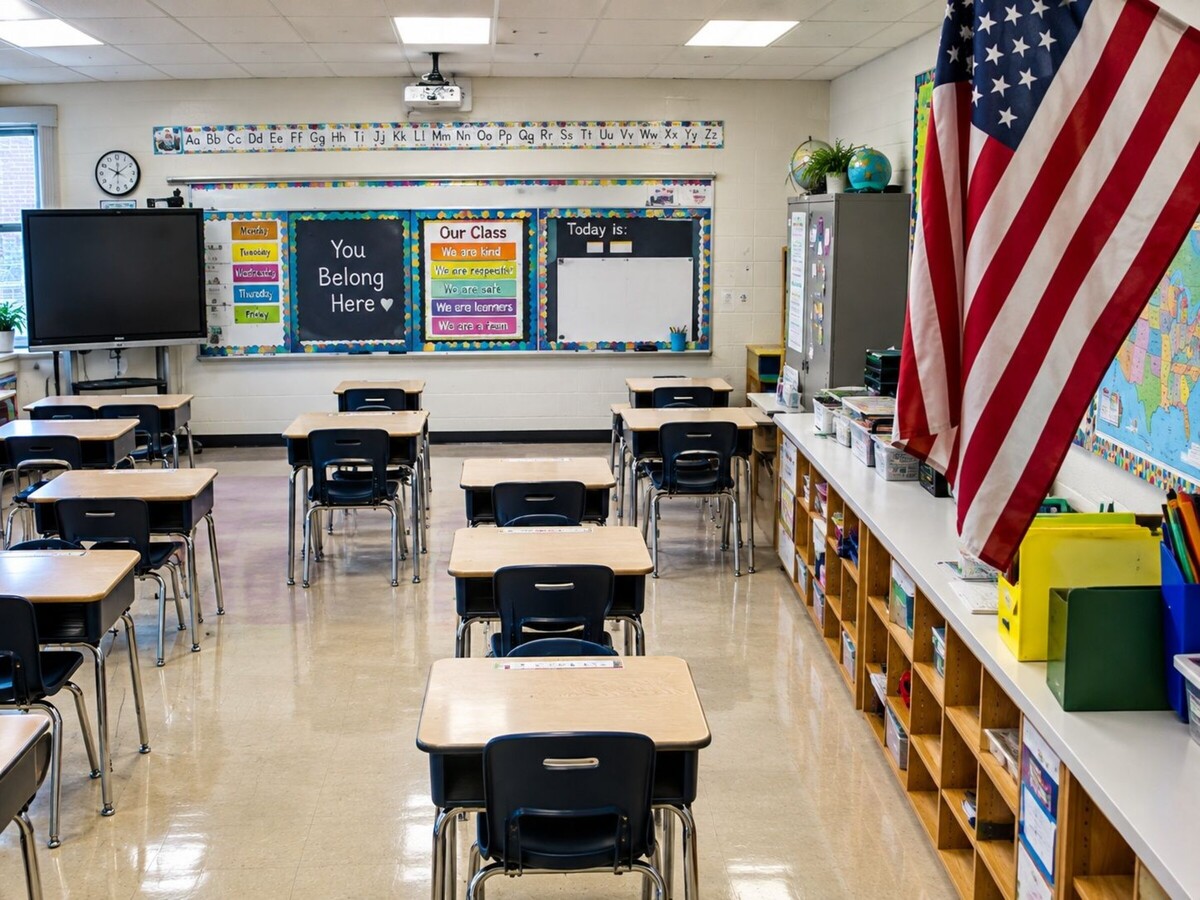



MINNEAPOLIS, MN (September 3, 2026). A child’s empty desk does not explain itself.
It does not tell a teacher whether the student transferred to another school, moved to another state, left the country, entered federal detention with a parent, or stopped receiving formal instruction altogether. It does not reveal whether the family departed voluntarily, lost its housing after a parent could no longer work, or decided that traveling to school had become too dangerous.
The desk only establishes that a student who once belonged to a classroom is no longer there.
Minnesota now has at least 1,700 reasons to start asking what happened.
A Sahan Journal analysis published August 31 found that enrollment declined by approximately 1,700 students between October 2025 and March 2026 among 29 Minnesota school districts and charter schools serving large populations of English learners. The decline occurred during and immediately after Operation Metro Surge, the federal immigration-enforcement campaign that brought thousands of federal officers into Minnesota.
The comparison with the previous year makes the finding especially alarming. During the same portion of the 2024–25 school year, enrollment among those institutions declined by fewer than 80 students.
This was not an ordinary midyear fluctuation. It was an abrupt disruption concentrated in schools serving communities most directly affected by federal immigration enforcement.
The number requires careful handling. It is not a complete statewide count. Sahan Journal requested information from the 20 public school districts and 20 charter schools with Minnesota’s highest percentages of English learners, but only 29 supplied data that could be compared across the relevant periods. The actual number of students who left schools during the operation may therefore be higher.
The analysis also does not prove that every departure resulted from Operation Metro Surge. Families move for many reasons. Students transfer between districts, enter private schools, or begin home instruction. Minnesota was already experiencing enrollment pressure caused by declining birth rates, reduced refugee arrivals, and fewer new immigrant families entering the state.
Those limitations do not erase the pattern. Enrollment across the responding institutions fell by approximately 1,700 students during a period when thousands of federal officers were conducting an aggressive immigration operation across the state. Educators reported families hiding at home, leaving Minnesota, moving in with relatives, and withdrawing children because they feared encounters with federal agents. Some students returned after the operation subsided. Others did not.
In Minneapolis and Saint Paul, enrollment fell by nearly 500 students in each district between October and March. Roseville, Fridley, Columbia Heights, North St. Paul-Maplewood-Oakdale, and Burnsville-Eagan-Savage recorded unusually large midyear losses. The disruption also reached communities outside the Twin Cities, including Faribault, St. James, Willmar, and Long Prairie-Grey Eagle.
The breadth of that decline should end any attempt to dismiss this as a Minneapolis political dispute. Minnesota’s immigrant families live throughout the state. They work in hospitals, hotels, schools, warehouses, restaurants, farms, food-processing plants, and manufacturing facilities. Their children attend urban, suburban, and rural schools. When those families are destabilized, the effects spread through classrooms, workplaces, rental markets, and local economies.
During Operation Metro Surge, many districts tried to keep frightened students connected to school through temporary online instruction. At its peak, those arrangements served more than 20,000 students, according to the data collected by Sahan Journal. Fridley Public Schools moved more than 460 students online while staff delivered groceries, communicated with families, and helped households locate rent and utility assistance.
Schools undertook that work because ordinary attendance had become impossible for many families. Parents feared driving children to school. Students worried about what might happen while they were away from home. Some families would not wait at bus stops or open their doors to unfamiliar visitors. When parents were detained at work, children sometimes moved abruptly to live with relatives.
This was not a conventional attendance problem that could be addressed with automated phone calls or truancy notices. It was a community emergency created by fear, detention, displacement, and uncertainty.
Minnesota law adds urgency to the need for an accounting. Under state statute, a student absent for 15 consecutive school days during the regular academic year must be dropped from the attendance roll and classified as withdrawn. Districts must notify local welfare agencies when students are removed for unexcused absences exceeding that period.
The rule serves legitimate administrative and financial purposes. A school cannot indefinitely count a student who is no longer attending. In the circumstances surrounding Operation Metro Surge, however, removal from the roll did not necessarily mean that the district knew where the child had gone.
Fridley reported that the number of students dropped after prolonged absences who never returned increased from four during the 2024–25 school year to 12 during 2025–26. Faribault Public Schools experienced an increase from 11 to 48. Faribault appropriately cautioned that no single cause could explain every case, but the district said there was likely a correlation between the operation and the increase recorded during January and February.
These figures represent more than lost enrollment. They identify children whose educational continuity could not be confirmed by the schools that had been serving them.
Minnesota should not describe every one of these students as a missing child in the law-enforcement sense. Some enrolled elsewhere. Some left the state or country with their families. Some may be receiving private or home instruction. Words matter, particularly when children and immigration status are involved.
The state still has a responsibility to determine whether those students remained connected to education.
That work must be conducted by education and child-welfare professionals under strict privacy protections. It cannot become a method of collecting immigration information, locating families for federal authorities, or discouraging parents from communicating with schools. Any reconnection effort will fail if families believe the information they provide could expose them or their relatives to enforcement.
The Minnesota Department of Education should coordinate a statewide review of students removed from school rolls during and immediately after Operation Metro Surge. Districts should document whether each student transferred within Minnesota, enrolled in another state, entered home instruction, left the country, or remains educationally unaccounted for. County agencies should receive the staff and language resources necessary to complete the work without treating immigration status as evidence of neglect.
The purpose must be educational continuity and child welfare, not immigration enforcement.
That distinction matters because many students affected by the operation were United States citizens. English learners are not synonymous with undocumented immigrants. They include citizens, lawful permanent residents, refugees, and children from mixed-status households. Other students from immigrant families speak English proficiently and are not included in English-learner counts.
A federal operation directed at immigration violations can therefore destabilize many children who are not subject to removal. A parent’s detention can change a citizen child’s housing, transportation, income, and caregiving arrangements in a matter of hours. The legal status of that child does not protect the household from those consequences.
The federal government has authority to enforce immigration law. Recognizing that authority does not require Minnesota to accept every enforcement method or ignore the damage caused when operations are carried out without sufficient safeguards for children.
Government power must be judged partly by how carefully it is exercised. An enforcement strategy that predictably empties classrooms, separates students from trusted adults, and forces school districts to construct emergency learning systems carries public costs that cannot be dismissed as someone else’s responsibility.
Federal officials have argued that strict enforcement protects public safety and restores respect for immigration law. If those are the stated objectives, the government should also explain how removing children from stable educational environments advances them. It should disclose what procedures were used when agents detained parents or children, how school-related locations were treated, and what protections were provided for households with minor children.
In January 2025, the Department of Homeland Security rescinded the previous federal policy limiting immigration-enforcement activity in or near schools, churches, hospitals, and other protected locations. The replacement approach gave officers greater discretion to conduct operations near places families must use.
Minnesota districts and Education Minnesota later challenged that policy, arguing that the change contributed to absenteeism, withdrawals, and widespread fear. A federal judge rejected an effort to restore the earlier restrictions, but the failure of that legal challenge does not make the underlying policy sound.
Schools are not ordinary public spaces. Attendance is compulsory, and children cannot choose whether education is worth the risk their families perceive. When enforcement activity occurs near schools, buses, or routes used by students, the resulting fear can interfere with a legal obligation Minnesota places on every family.
The federal government should restore clear limits on routine civil immigration enforcement at schools, school events, bus stops, and child-care facilities. Exceptions can remain for immediate threats, serious criminal matters, and other extraordinary circumstances. Those exceptions should not become an excuse to treat schools as convenient places to locate families.
Minnesota must also address the financial consequences.
School funding is closely tied to enrollment and average daily membership. Under Minnesota’s school-finance statute, students absent for 15 consecutive days generally must be removed from the roll. Once that occurs, a district can lose revenue even though its fixed expenses remain.
Buildings must still be heated. Bus routes must still operate. Teachers cannot be hired and dismissed each time enrollment changes during a semester. Special education, counseling, interpretation, and English-language instruction must remain available to the students who continue attending.
Operation Metro Surge added extraordinary expenses. Districts developed online programs, purchased or distributed technology, modified transportation, delivered food, translated information, conducted family outreach, and expanded emotional support. Staff members spent days trying to locate students and reassure families.
Schools were required to spend more while losing the enrollment that supports their funding.
The Legislature should create a limited hold-harmless provision for districts able to document extraordinary enrollment losses associated with the federal operation. Funding could be calculated using enrollment immediately before the surge and adjusted as students return or confirm enrollment elsewhere.
Such protection must be temporary and transparent. It should not become a permanent subsidy for unrelated demographic decline or shield districts from every enrollment change. The state can distinguish between a gradual, foreseeable reduction and a sudden disruption produced by an exceptional federal deployment.
Minnesota should also seek federal reimbursement for the direct costs imposed on its schools. Local taxpayers should not bear the entire expense of emergency education, food delivery, security planning, family outreach, and additional mental-health support necessitated by a federal operation.
An accurate accounting will be necessary before any reimbursement request can succeed. Every affected district should document its enrollment changes, emergency expenditures, staffing demands, and service reductions. The Minnesota Department of Education should compile those costs in a public report while withholding information that could identify individual students or families.
Saint Paul Public Schools demonstrates why delay would be costly. The district experienced a net decline of approximately 900 students between October 2024 and March 2026, including nearly 500 English learners. Another 150 English learners left between March and June, according to the district official interviewed by Sahan Journal.
Facing a $14 million budget shortfall, the Saint Paul school board eliminated 16.3 English-language teaching positions. The district said it would continue meeting staffing ratios required under its labor agreement, but services exceeding those minimums became more difficult to sustain.
This is how a temporary enforcement operation becomes a lasting educational setback. Students leave, revenue declines, and districts cut the teachers, counselors, and family liaisons most important to the children who remain. Larger classes and fewer specialized staff then make recovery harder.
The students who returned did not necessarily return unchanged. Some spent weeks inside their homes. Others lived through the detention of a parent, sudden relocation, interrupted employment, or the loss of family income. Children who moved elsewhere had to adapt to new schools while their families remained under pressure. Those who returned to Minnesota had to rebuild academic routines and social connections.
Schools need resources to respond to that experience. Counselors, social workers, multilingual educators, and family liaisons are not peripheral services under these conditions. They are part of restoring a student’s ability to learn.
The state should provide targeted recovery grants to districts with documented enrollment disruption. Funding should support academic assessments, tutoring, mental-health services, attendance outreach, transportation, and the restoration of English-language positions eliminated because of sudden revenue loss.
Community organizations should be included. Immigrant families may be more willing to speak with trusted cultural, faith, and neighborhood organizations than with government offices. Those organizations can help locate displaced students, explain enrollment options, and reconnect families with schools without collecting unnecessary information about legal status.
Minnesota should also improve the way it tracks abrupt enrollment changes. State officials should not have to rely entirely on a news organization to identify a statewide pattern months later. The Sahan Journal analysis performed an important public service, but government agencies possess the authority and institutional capacity to monitor enrollment continuously.
The Department of Education should create an early-warning system for unusual withdrawals, extended absences, and reductions among particular student groups or geographic areas. A sudden departure from historical patterns should trigger assistance and investigation, not merely appear later in an annual report.
That monitoring must be designed carefully. Data about immigrant students and families can be dangerous if collected broadly, stored carelessly, or shared for purposes unrelated to education. The state should track educational disruption without creating a registry of households that federal agencies could seek to use.
Minnesota leaders must also resist turning these children into instruments of partisan argument. Students should not be reduced to symbols for defending or condemning an administration. They are entitled to education regardless of their parents’ immigration status or political debates surrounding federal enforcement.
Supporters of Operation Metro Surge should be willing to confront its measurable effects. Opponents should be equally disciplined about the evidence. Not every student departure can be attributed to federal action, and not every absent child vanished from education. Exaggeration would make it easier for federal officials to disregard the legitimate findings.
The verified facts are serious enough.
Twenty-nine districts and charter schools serving large English-learner populations lost approximately 1,700 students between October and March. Those same institutions lost fewer than 80 during the corresponding period one year earlier. Nearly every responding school district experienced a decline. Some schools lost contact with children whose whereabouts and educational status were unknown to them. Districts incurred emergency costs while facing reduced revenue, and Saint Paul cut English-language teaching positions amid a broader budget shortfall.
Those facts describe a public failure requiring a public response.
Operation Metro Surge may have ended as a formally designated deployment, but its consequences remain in school budgets, staffing decisions, and disrupted families. Children do not recover according to an enforcement timetable. A student who lost months of instruction cannot regain them because federal officers left. A school that eliminated positions cannot recreate them without money. A family that moved under pressure may not return.
Minnesota cannot reverse every consequence. It can establish which students remain disconnected from education, protect their information, help families reenroll, and prevent sudden federal actions from permanently weakening the schools that served them.
The federal government must also accept responsibility for the foreseeable civilian costs of its enforcement choices. Authority over immigration law does not grant immunity from accountability when those choices destabilize children and public institutions.
The title of this editorial is deliberately specific. Minnesota must account for the children who never returned to school. That does not mean publishing their names, investigating their immigration status, or assuming that every child remains in danger. It means refusing to let their departure become an unexplained subtraction in a state database.
For every student, Minnesota should seek a basic answer: Is this child receiving an education somewhere?
If the answer is yes, the state can document educational continuity without intruding further into the family’s life. If the answer is unknown, education and child-welfare agencies must make careful, confidential efforts to reconnect. If the answer is no, Minnesota must help the child return to a classroom without making that return a pathway to immigration enforcement.
A public school’s responsibility does not end when a frightened family stops answering the telephone. The state’s responsibility does not end when a student is removed from an attendance roll. The federal government’s responsibility does not end when an operation is declared complete.
Minnesota’s classrooms have already recorded the loss. The work now is to find out what happened, repair what can be repaired, and ensure that no child’s education is treated as acceptable collateral damage.

Local stories matter. Subscribe free to MinneapoliMedia and receive independent news, community reporting and important updates from Minneapolis, the North Metro and communities across Minnesota.
SUBSCRIBE FREE: https://minneapolimedia.town.news/subscribe
MinneapoliMedia | Community. Culture. Civic Life


Overcast, with a high of 50 and low of 43 degrees. Overcast during the morning, light rain in the afternoon, overcast in the evening,