40° and Light rain
Image
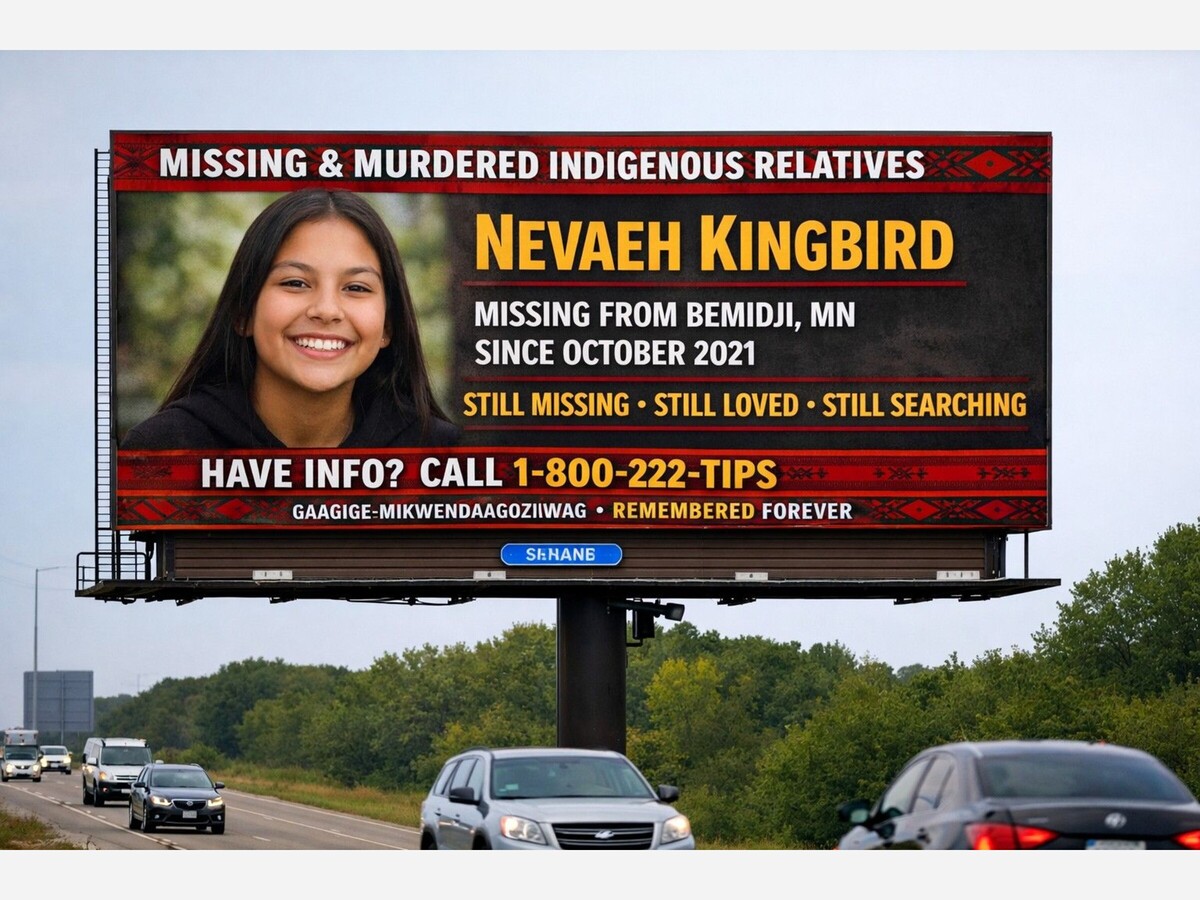



Along Minnesota’s highways and major transit corridors, a new series of billboards has begun to speak a language long absent from public space: the language of remembrance, urgency, and refusal to forget.
The billboards honor Missing and Murdered Indigenous Relatives, known widely as MMIR, and they arrive as both memorials and appeals. They are meant to be seen, deliberately interrupting the everyday flow of traffic with faces, names, and lives that demand recognition in a state still reckoning with a deep and persistent crisis.
One of the first faces now displayed belongs to Nevaeh Kingbird, a 15 year old member of the Red Lake Nation who vanished in Bemidji in October 2021. For her mother, Teddi Wind, the billboards are not symbolic gestures. They are daily reminders of a daughter still missing and of a search that has never stopped.
Nevaeh is not remembered as a statistic. She is remembered as a volleyball player, an Ojibwe language learner, a young person rooted in culture and family. Wind has said that seeing Nevaeh’s smile in public spaces fuels her determination and reinforces a truth advocates repeat often: visibility itself can be an act of justice.
The campaign is intentionally personal. Each billboard centers an individual life, countering what Indigenous families describe as a long history of erasure within law enforcement systems, media coverage, and public consciousness.
Among those now featured are Kateri Mishow, missing since 2007 from the Twin Cities area, and Frank Ortley, whose case underscores that the MMIR crisis affects Indigenous people across gender and age, including men and elders. Their inclusion reflects a central message of the movement: these cases do not expire with time, and remembrance must be sustained for as long as answers remain elusive.
Billboards have been placed along Interstate 35 and other major corridors, areas advocates describe as “transit intersections,” where trafficking, travel, and disappearances statistically overlap. Officials say additional names will be added as families consent and funding allows.
The billboards are supported through donations to the Gaagige-Mikwendaagoziwag Reward Fund, a state authorized fund whose name translates from Ojibwe as “they will be remembered forever.”
Established by the Minnesota Legislature, the fund exists to provide financial rewards for information leading to the location of missing Indigenous persons or the resolution of homicide cases. While the Minnesota Office of Missing and Murdered Indigenous Relatives operates as a state agency, the reward fund and public visibility efforts like the billboards rely heavily on private donations and community contributions.
That structure matters. Advocates say it reflects both collective responsibility and the reality that sustained attention often requires sustained public investment beyond baseline government operations.
Minnesota became the first state in the nation to establish a dedicated MMIR Office in 2021, following years of advocacy, community organizing, and the work of the Minnesota MMIR Task Force. The office was created in direct response to systemic failures that left Indigenous families navigating fragmented investigations across tribal, state, and federal jurisdictions.
Its core functions include coordinating between law enforcement agencies, improving the accuracy of data collection, and recommending policy changes to address gaps in emergency alerts and investigative protocols. Misclassification remains a critical issue. Indigenous victims are frequently listed incorrectly in police reports, often as White or Other, obscuring the true scale of the crisis and delaying appropriate responses.
The language used by families and officials is not accidental. The term “epidemic” reflects stark disparities documented by the Minnesota MMIR Task Force.
Indigenous people make up roughly 1 percent of Minnesota’s population, yet Indigenous women and girls account for approximately 8 percent of female homicide victims in the state. Between 2012 and 2020, task force data showed that between 27 and 54 Indigenous women were missing in Minnesota in any given month.
For families, these numbers explain why remembrance must be public, persistent, and impossible to ignore.
The billboards do not promise closure. They promise presence.
They assert that these relatives existed, were loved, and still matter. They challenge Minnesotans to see what has too often been pushed to the margins and to understand that remembrance and accountability are inseparable.
As more faces appear along Minnesota’s roadways, the message grows louder with each passing mile: these relatives are still missing, still remembered, and still deserving of answers.

Overcast, with a high of 56 and low of 41 degrees. Light drizzle in the morning, overcast during the afternoon, patchy rain nearby overnight.