57° and Mist
Image




It mentions railroads and milling.
Retail giants and manufacturing plants.
Fortune 500 headquarters that came to define the state’s modern economy.
But economies are not built only by corporations.
They are built by individuals who see possibilities where others see barriers. People who take risks, create enterprises, and transform ideas into institutions that support communities.
Across Minnesota’s history, women have been among those builders.
Sometimes they worked quietly, opening small businesses that provided stability for families and neighborhoods. Other times they created companies that would reshape entire industries.
Their work expanded opportunity not only for themselves but also for the people they employed, mentored, and inspired.
Minnesota’s economic landscape carries their imprint.
Entrepreneurship always involves uncertainty.
To start a business is to step into risk. It requires capital, vision, persistence, and the willingness to navigate systems that are often slow to support new entrants.
For many women, particularly women of color, those challenges were even greater.
Access to financing was limited. Professional networks were often closed. Markets were not always welcoming to entrepreneurs who did not fit traditional expectations of leadership.
Yet women built businesses anyway.
They opened restaurants and retail stores.
They founded consulting firms and creative companies.
They launched organizations that blended entrepreneurship with community development.
Through determination and ingenuity, they carved space within Minnesota’s economic life.
One of the most influential African American entrepreneurs in American history, Madam C. J. Walker, spent part of her early life in Minnesota, where she developed skills that would later help shape her business career.
Walker went on to build a groundbreaking hair care enterprise for African American women and became one of the first self-made female millionaires in the United States.
Her legacy resonates far beyond her own company.
Walker demonstrated that entrepreneurship could serve as both economic empowerment and community advancement. She invested in educational initiatives, philanthropy, and political advocacy, believing that economic success carried a responsibility to uplift others.
For generations of women entrepreneurs, her story became a powerful example of what determination and vision could accomplish.
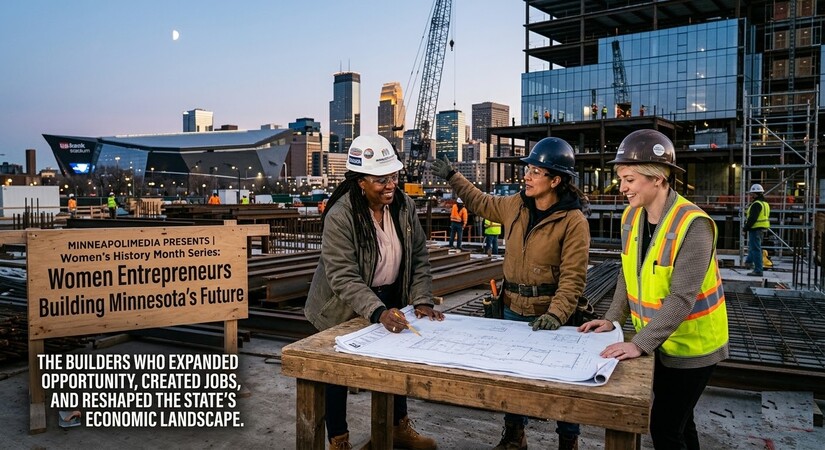
Minnesota’s entrepreneurial landscape has also been shaped by women whose companies grew into major enterprises.
Among them is Doris Sorenson, who opened the first Maurices store in Duluth in 1931.
What began as a single clothing store eventually grew into a national retail brand with hundreds of locations across the United States.
Sorenson’s success demonstrated how a locally rooted business could grow into an influential national enterprise while maintaining strong ties to its Minnesota origins.
Her work helped expand the presence of women entrepreneurs in retail and fashion industries traditionally dominated by male executives.
Economic development is not limited to traditional industries. Culture, media, and storytelling also play powerful roles in shaping communities.
Few people illustrate this better than Syl Jones.
Jones has spent decades contributing to Minnesota’s arts and media landscape as a playwright, journalist, and community voice. Through her work in theater and storytelling, she has helped elevate narratives that reflect the diverse experiences of Minnesotans.
Cultural entrepreneurship strengthens communities by ensuring that stories are told, identities are preserved, and public dialogue reflects the voices of many different communities.
In that sense, cultural creators are also economic builders.
They contribute to industries that generate employment, tourism, and civic engagement.
Across Minnesota today, women entrepreneurs continue to build businesses that shape local economies.
They launch technology startups in the Twin Cities.
They operate family-owned restaurants that become community landmarks.
They create consulting firms, marketing agencies, and social enterprises that employ workers and serve clients across the state.
Many of these businesses do more than generate profit.
They mentor young professionals.
They support neighborhood initiatives.
They sponsor community programs and educational opportunities.
Entrepreneurship often becomes a form of civic leadership.
When businesses succeed, they create jobs, stabilize neighborhoods, and expand economic opportunity.
For generations, business leadership in America was often portrayed through a narrow lens.
Yet women entrepreneurs in Minnesota have steadily expanded that definition.
They have shown that leadership can combine:
vision and empathy
innovation and community responsibility
profit and purpose
Their enterprises demonstrate that economic success and social contribution are not mutually exclusive.
In fact, they often strengthen one another.
Minnesota’s economic future will continue to depend on people willing to innovate, take risks, and create opportunities for others.
Women entrepreneurs remain central to that process.
They are launching companies in technology, healthcare, education, and creative industries.
They are mentoring younger founders and expanding professional networks that support emerging leaders.
They are redefining what entrepreneurship looks like in the twenty-first century.
Their work ensures that Minnesota’s economy continues to evolve.
Every successful business begins with an idea.
But ideas alone do not build companies.
Entrepreneurs must transform vision into action. They must navigate uncertainty, learn from failure, and persist through challenges that might discourage others.
Women entrepreneurs across Minnesota have done exactly that.
Through resilience and imagination, they have helped build industries, create jobs, and expand the horizons of what is possible in the state’s economic life.
Their work reminds us that economic progress is not simply the result of market forces.
It is also the result of people who believe they can create something new.
And who are courageous enough to try.
MinneapoliMedia
Community. Culture. Civic Life.


Moderate rain, with a high of 60 and low of 56 degrees. Mist during the morning, patchy rain nearby in the afternoon, mist overnight.