55° and Clear
Image
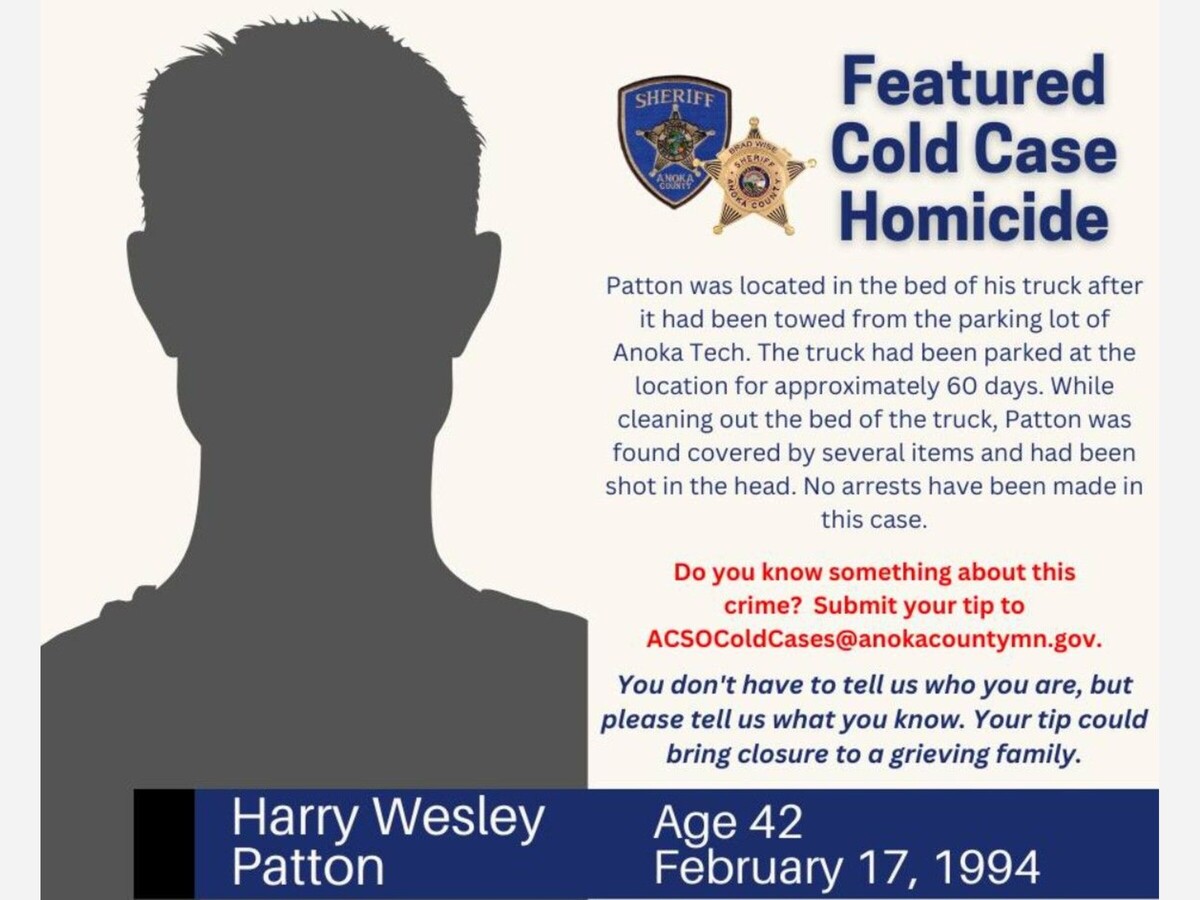



In the winter of 1994, a pickup truck sat quietly among rows of student and faculty vehicles at Anoka Technical College. Snow fell. Classes resumed after the holidays. Engines turned over each morning in the cold.
For roughly 60 days, the truck did not move.
On February 17, 1994, after it was finally flagged as abandoned and towed from the campus lot, workers cleaning out the bed of the vehicle made a grim discovery. Beneath debris and miscellaneous items lay the body of Harry Wesley Patton, 42, concealed in plain sight. An autopsy determined he had been shot in the head.
More than three decades later, the case, filed as 94-025524, remains unsolved.
This week, the Anoka County Sheriff's Office renewed its public appeal for information, marking another anniversary without an arrest, a named suspect, or public resolution.
Investigators believe Patton likely disappeared or was killed in mid to late December 1993. His truck was left parked at the college, then known as Anoka Hennepin Technical College, during a time of year when Minnesota winters conceal as much as they reveal.
Because the vehicle was situated among other cars in a busy campus lot, it did not immediately draw suspicion. Snow accumulation and routine campus turnover may have further obscured its significance.
By the time authorities discovered Patton’s body in February 1994, weeks had passed. The truck bed had been exposed to winter weather and the natural degradation of time. Any crime scene evidence was compromised by delay, temperature fluctuation, and environmental exposure.
That passage of time created what investigators now describe as one of the case’s most significant barriers: a wide and uncertain timeline.
Where was Patton killed?
Was the shooting carried out at the college parking lot, or was the vehicle deposited there afterward in an attempt to hide the crime in plain sight?
Who last saw him alive in December 1993?
Those questions remain unanswered.
While forensic science in 1994 included fingerprinting and early forms of DNA analysis, the era predated the advanced genetic genealogy, high sensitivity testing, and digital investigative tools now available to law enforcement.
The Sheriff’s Office Cold Case Homicide Unit has stated that modern forensic techniques are being applied to older cases where evidence allows. Authorities have not disclosed what physical evidence, if any, remains viable in Patton’s file.
But technology alone cannot reconstruct human context. For that, investigators are turning back to the public.
Little has been released publicly about Patton’s personal life, occupation, or relationships. Law enforcement officials acknowledge they lack a high quality photograph suitable for broad public distribution. They are asking anyone who possesses images of Patton to share them for investigative use.
They are also seeking people who knew him in 1993, particularly those familiar with his movements, associations, or conflicts in the weeks leading up to his disappearance in December of that year.
“Do you have information about this investigation?” the Sheriff’s Office wrote in its renewed appeal. “You don't have to tell us who you are, but please tell us what you know.”
Tips can be submitted anonymously to ACSOColdCases@anokacountymn.gov.
Cold cases often sit at the intersection of silence and time. Witnesses relocate. Memories fade. Relationships shift. Allegiances dissolve. In some instances, what once felt dangerous to reveal becomes possible to say.
Across Minnesota and nationally, decades old homicides have been solved through renewed outreach, forensic reexamination, and community memory. Investigators in Anoka County say even minor details, a recollection of an unusual conversation, a name once mentioned casually, a sighting from late 1993, could reframe the investigation.
For now, the facts remain stark.
A 42-year-old man was shot in the head.
His body was hidden beneath debris in the bed of his own truck.
The vehicle sat for nearly two months in a public parking lot.
No one has been held accountable.
Thirty-two years later, the question is no longer only what happened in the winter of 1993. It is whether someone who knows will finally speak.
For Patton’s family, for investigators who inherited the file, and for a county that has carried this unanswered crime for three decades, the passage of time has not closed the case.
It has simply made memory the most valuable evidence left.



Sunny, with a high of 78 and low of 51 degrees. Sunny for the morning, clear overnight.