Image




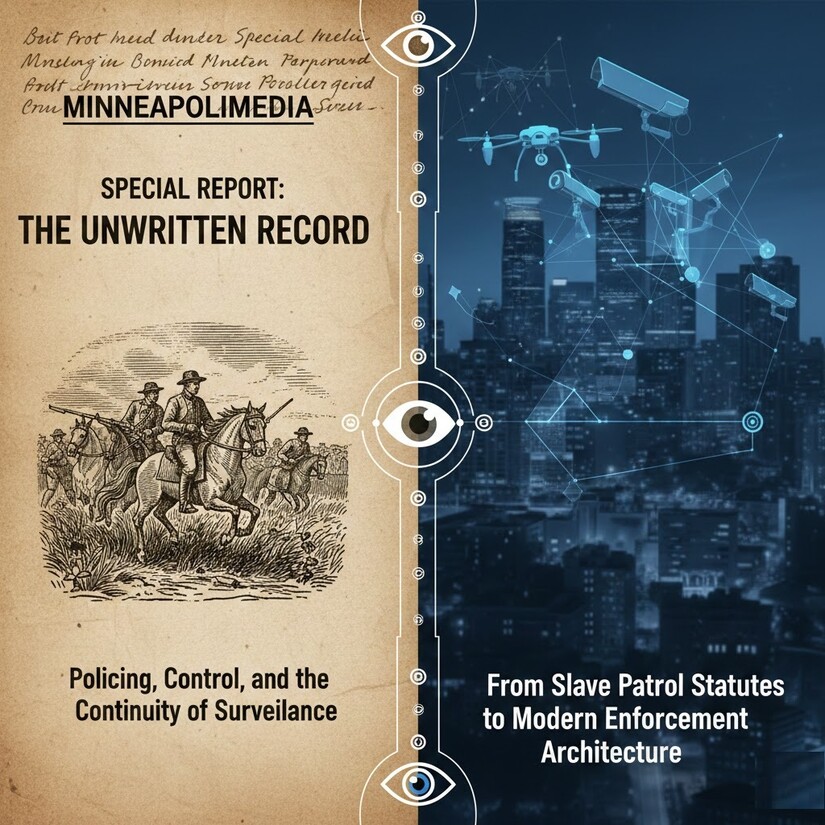
In 1704, the colony of South Carolina enacted legislation establishing organized slave patrols. The statute required white male citizens to serve in rotating patrols charged with “searching all Negro houses for offensive weapons” and dispersing “all unlawful assemblies of slaves.”
The law granted patrol members authority to enter property without warrant. It authorized physical punishment for those found off plantation grounds without written passes. Patrols were permitted to seize firearms, restrict movement after dark, and interrogate Black individuals traveling on public roads.
The statute did not disguise its intention.
Its objective was containment.
Mobility was treated as destabilizing. Assembly was treated as subversive. Communication was treated as risk.
Slave patrols institutionalized surveillance as civic duty.
They were publicly mandated. They were state sanctioned. They were legally justified as preventive public safety.
When emancipation arrived in 1865, this enforcement logic did not evaporate. It shifted form.
Within months of the Civil War’s conclusion, Southern legislatures passed Black Codes.
Mississippi’s 1865 statute declared that “all freedmen, free negroes and mulattoes” without lawful employment could be arrested for vagrancy. Louisiana adopted similar measures. Alabama criminalized “idle” behavior.
The language appeared administrative.
The effect was coercive.
Freed people without documented employment could be fined. Failure to pay fines led to compulsory labor.
Convict leasing emerged from this architecture.
By the 1870s, Alabama leased nearly all of its state prisoners to private coal companies and ironworks. Prisoners were forced to work under brutal conditions. Historians have documented mortality rates in certain leasing camps that rivaled or exceeded those under slavery.
The Thirteenth Amendment abolished slavery except as punishment for crime.
The Black Codes manufactured crime through status.
Enforcement became the pipeline.
Surveillance ensured supply.
Reconstruction amendments promised federal protection of civil rights.
But Supreme Court decisions narrowed those protections.
In United States v. Cruikshank in 1876, the Court overturned federal convictions related to the Colfax Massacre, holding that the Fourteenth Amendment constrained state action but not private violence.
The ruling limited federal authority to prosecute racial terror.
In the 1883 Civil Rights Cases, the Court struck down portions of the Civil Rights Act of 1875, declaring that Congress could not regulate private discrimination.
These decisions weakened federal oversight of state and local enforcement.
Local policing structures operated within an environment where segregation and discriminatory enforcement could proceed with limited federal interference.
Judicial architecture shaped enforcement latitude.
By the early twentieth century, segregation statutes governed public transportation, schools, parks, and businesses.
Police officers enforced these statutes.
Violation of racial boundaries could result in arrest under trespass, disorderly conduct, or disturbing the peace.
The language was facially neutral.
The application was racialized.
In addition, anti-loitering and vagrancy laws continued to provide broad discretionary authority.
Courts later invalidated some vagrancy statutes for vagueness, such as in Papachristou v. City of Jacksonville in 1972. But for decades prior, these laws functioned as enforcement tools against marginalized populations.
Surveillance did not require explicit racial language. It required discretionary latitude.
During the Great Migration, African American populations in northern cities expanded rapidly.
Chicago’s Black population grew more than fivefold between 1910 and 1930. Detroit’s growth was even more dramatic.
Urban police departments expanded patrol forces, precinct structures, and surveillance practices.
Race riots in cities including Chicago in 1919 exposed uneven enforcement.
Historical accounts show that police frequently arrested African American residents during unrest while failing to prevent white mob violence.
Migration was treated as instability.
Policing concentrated accordingly.
In Terry v. Ohio in 1968, the Supreme Court held that officers could conduct limited searches based on reasonable suspicion.
The decision was framed as pragmatic balance.
But it expanded officer discretion significantly.
In Whren v. United States in 1996, the Court ruled that as long as an officer has objective probable cause to believe a traffic violation occurred, the subjective motive for the stop is irrelevant.
Pretextual stops were constitutionally permissible.
Traffic codes are extensive. Nearly every driver violates some minor provision at some point.
The decision effectively granted broad discretion in vehicle stops.
In Graham v. Connor in 1989, the Court established that use-of-force claims must be evaluated under an objective reasonableness standard, considering perspective of a reasonable officer on the scene.
The standard emphasized deference to split-second judgment.
Judicial doctrine shaped enforcement environment.
Discretion widened. Accountability thresholds rose.
Between 1970 and 2000, the incarcerated population in the United States increased more than sixfold.
Drug policy played central role.
The Anti-Drug Abuse Act of 1986 created mandatory minimum sentences and established the 100-to-1 disparity between crack and powder cocaine.
Because crack enforcement concentrated in urban neighborhoods with higher African American populations, sentencing outcomes were racially disparate.
By the 1990s, African Americans comprised roughly 13 percent of the national population but nearly 40 percent of the incarcerated population.
Federal funding mechanisms reinforced expansion.
The 1994 Crime Bill authorized billions for prison construction and police hiring.
Local departments could receive funding tied to enforcement initiatives.
Arrest volume became measurable output.
Surveillance translated into numbers.
Numbers justified expansion.
Qualified immunity doctrine shields officers from civil liability unless they violate clearly established law.
Courts often require plaintiffs to identify prior case law with highly similar factual patterns.
This standard has made successful civil suits challenging.
Supporters argue it protects officers from frivolous claims.
Critics argue it limits accountability and weakens deterrence.
The doctrine reflects institutional priority: protect decision-making authority within discretionary framework.
Accountability is shaped by legal design.
Predictive policing systems rely on historical crime data to forecast deployment needs.
If historical policing disproportionately targeted certain neighborhoods, predictive models may reproduce that focus.
License plate readers track vehicle movement. Facial recognition systems analyze images against databases. Social media monitoring tools collect digital activity.
Technology increases capacity.
Governance determines equity.
Data is not neutral. It reflects prior enforcement patterns.
Without oversight, digital systems may encode historical bias.
Minnesota has experienced national attention regarding police conduct.
State-level data in recent years has shown racial disparities in traffic stops and use-of-force incidents in multiple jurisdictions.
Legislative reforms have included duty-to-intervene requirements, adjustments to use-of-force standards, and enhanced data transparency.
Federal investigations into local departments have examined patterns of conduct.
Public debate in Minnesota reflects broader national tension between safety and accountability.
Communities call for effective crime response and equitable enforcement.
Trust remains central.
Trust is cumulative.
Expansion of school resource officers and zero-tolerance policies increased law enforcement presence in educational settings.
Minor infractions sometimes resulted in criminal citations rather than administrative discipline.
Disproportionate disciplinary action against African American students has been documented in national and state data.
Surveillance entered formative environments.
The architecture of monitoring extended into youth space.
From 1704 patrol statutes to modern predictive algorithms, the logic of monitoring Black mobility has recurred.
The form evolves.
The rationale shifts.
The architecture adapts.
But historical lineage matters.
Understanding origin clarifies pattern.
Public safety remains essential.
Yet safety divorced from equity undermines legitimacy.
If policing institutions seek durable trust, structural acknowledgment is prerequisite.
Documentation is not indictment of individuals.
It is examination of systems.
The archive must contain both the necessity of law enforcement and the history of uneven application.
Only then can reform be informed rather than reactive.


Sunny, with a high of 59 and low of 33 degrees. Sunny in the morning, clear in the afternoon and evening,