Image
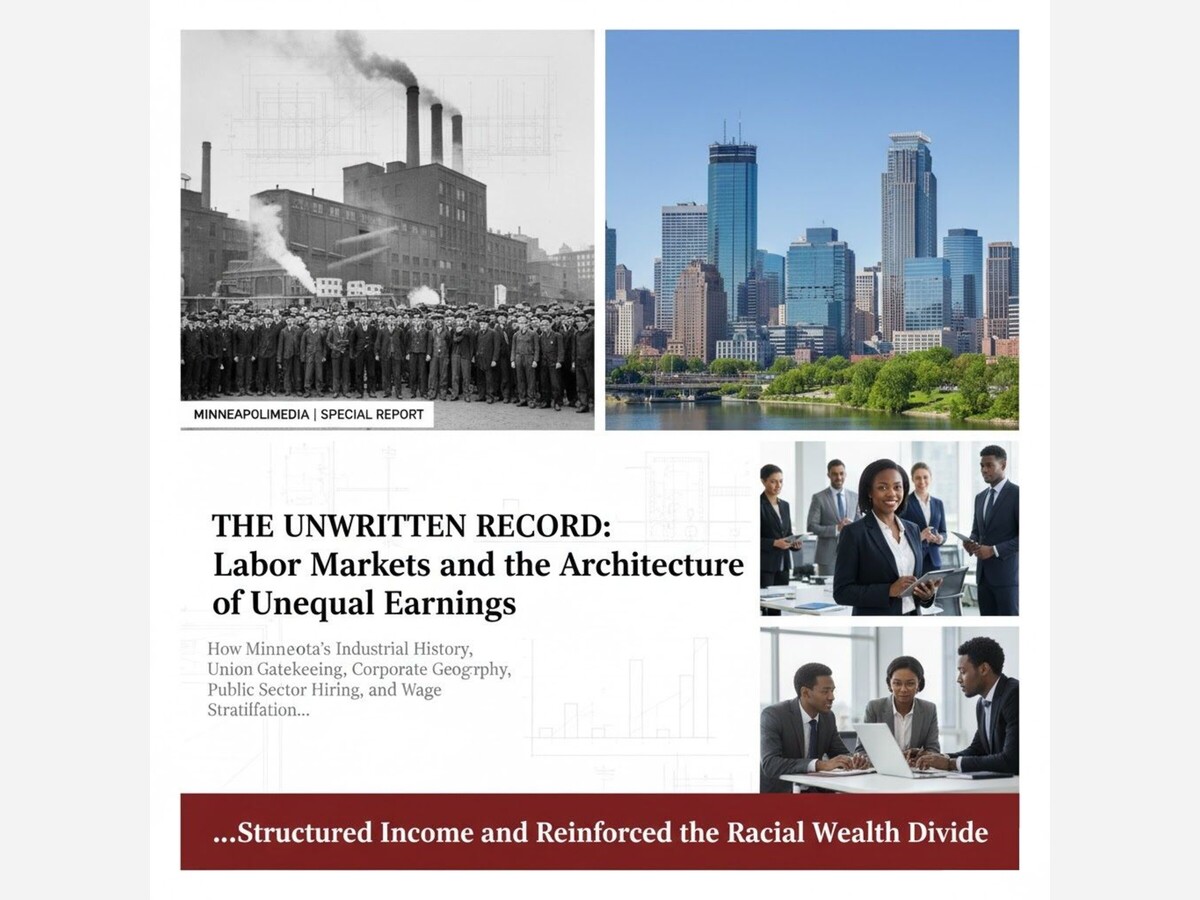



Before equity accumulates, wages are earned.
Before property appreciates, paychecks clear.
Before retirement accounts compound, income flows.
Housing stores wealth.
Labor generates it.
If wages are uneven, everything built on top of them is uneven.
Minnesota’s prosperity narrative is often told through innovation, industry, and high civic engagement. The state built railroads, milled grain, mined iron, manufactured equipment, and developed global corporations.
The deeper record asks a harder question.
Who entered those industries at the level where wealth could compound, and who remained in sectors where wages barely stabilized survival.
Equal opportunity in labor is often assumed. It has never been structurally neutral.
To understand Minnesota’s wealth gap, one must examine its labor markets with the same rigor applied to housing and voting.
Income is the bloodstream of the system.
In the late nineteenth and early twentieth centuries, Minnesota’s economy rested on four industrial pillars: flour milling in Minneapolis, lumber and logging in northern regions, iron mining on the Mesabi Range, and rail transport linking the Midwest to national markets.
These industries generated significant wealth and political power.
The flour mills of Minneapolis made the city the “Flour Milling Capital of the World.”
The Iron Range supplied steel production nationally.
Rail corridors connected agricultural output to urban markets.
Unionization expanded during the early twentieth century, particularly through the American Federation of Labor and later the Congress of Industrial Organizations.
Union membership provided wage stability, collective bargaining power, and access to benefits.
But access to skilled trades and apprenticeship programs often depended on informal networks and internal sponsorship.
African Americans in Minnesota were disproportionately concentrated in service labor, janitorial work, domestic employment, portering, and lower tier industrial positions.
Pullman porters traveling through Minnesota’s rail lines earned wages, but those wages were tightly constrained by occupational hierarchy.
The pathway into skilled trades such as electrical work, plumbing, and advanced manufacturing was often mediated by union apprenticeship programs that were not structurally open in practice.
Occupational segregation does not require statutory language to operate. It functions through access control.
Higher wage trades generate long term earnings stability. Lower wage service sectors generate income volatility.
The industrial wealth of Minnesota was not distributed evenly across racial lines.
The Mesabi Iron Range became one of the most unionized regions in Minnesota during the twentieth century.
Mining unions negotiated wages, pensions, and safety protections.
Mining wages supported homeownership, small business investment, and generational stability for many families.
But geographic concentration of mining employment limited access to those wages to those residing in specific communities.
Urban African American populations in Minneapolis and St. Paul were less likely to benefit directly from Range unionized wage structures.
Geography shaped access.
Labor opportunity did not float freely across the state. It followed residential concentration.
Housing segregation limited proximity to certain sectors.
South St. Paul’s meatpacking industry provides another instructive case.
Meatpacking plants offered industrial employment throughout the early and mid twentieth century.
These facilities often structured work hierarchically, with wage tiers corresponding to job category.
Lower paid, physically demanding, and less stable positions were disproportionately filled by workers with fewer advancement pathways.
When meatpacking declined nationally in the late twentieth century and production relocated or automated, communities dependent on those wages experienced instability.
Sectoral decline without wealth buffers creates generational disruption.
Labor markets are not static. When industries collapse, those positioned without diversified skill pipelines face disproportionate harm.
Minnesota became home to major corporate employers including 3M, Honeywell, General Mills, Target Corporation, and later UnitedHealth Group and Medtronic.
These corporations generated high salary managerial, engineering, and professional positions.
Access to those positions depended on educational credentialing, professional networks, and recruitment pipelines.
If suburban school districts provided greater access to advanced coursework and college preparatory tracks due to higher funding levels, graduates from those districts entered professional pipelines at higher rates.
Educational stratification feeds labor stratification.
Corporate campuses often developed in suburban areas shaped by postwar housing exclusion and zoning policy.
Job geography moved outward from urban cores.
Without reliable transportation access, urban residents faced barriers to suburban employment clusters.
Labor markets follow housing patterns.
Public sector employment has long served as a pathway to middle class stability.
Minnesota’s state government, university system, municipal agencies, and public schools employ tens of thousands.
Entry level public sector employment expanded opportunities for many historically excluded communities.
However, representation in supervisory, executive, and senior management roles has historically lagged behind workforce diversity.
Income disparities persist not only across sectors but within institutional hierarchies.
Promotion pathways determine lifetime earnings.
Lifetime earnings determine wealth accumulation.
Minnesota has consistently reported one of the largest racial income gaps in the United States.
Median household income for white households significantly exceeds that of African American households in the state.
The gap is measurable.
Income differences translate into:
Reduced down payment accumulation
Reduced emergency savings
Higher reliance on credit
Lower retirement contribution capacity
Income inequality precedes wealth inequality.
When wage differences persist year after year, the compounding effect magnifies across generations.
A household earning even ten thousand dollars more annually accumulates significantly more wealth over thirty years, particularly when that income is invested in appreciating property.
Labor market inequality compounds just as housing appreciation compounds.
Union density in Minnesota remains higher than many states, yet it has declined from mid twentieth century peaks.
Union jobs historically provided wage premiums and benefits such as pensions and healthcare coverage.
When union representation declines, wage compression weakens.
Service sector expansion often produces lower wage positions with fewer long term benefits.
If marginalized communities are disproportionately concentrated in lower wage service sectors, income volatility increases.
Volatility undermines mortgage stability.
Mortgage instability increases foreclosure risk.
Foreclosure erodes accumulated wealth.
Labor shocks cascade into housing loss.
Postwar suburbanization relocated many high wage employment centers away from urban cores.
Corporate headquarters, industrial parks, and medical complexes expanded in suburban counties.
Public transit connectivity between historically segregated neighborhoods and suburban job centers has often lagged behind development patterns.
Transportation gaps limit employment mobility.
Geography restricts opportunity.
Labor markets do not operate independently from infrastructure decisions.
Highways enabled suburban expansion.
Transit limitations constrained urban mobility.
The architecture intersects again.
Entrepreneurship represents another income pathway.
Access to capital determines whether businesses launch, scale, or fail.
Historical redlining limited credit access in specific neighborhoods.
Modern lending disparities continue to influence small business formation rates.
If startup capital is harder to secure in communities historically excluded from mainstream banking networks, business ownership disparities follow.
Business ownership accelerates wealth accumulation.
When capital access is uneven, labor income remains the primary pathway, limiting wealth diversification.
Labor generates income.
Income determines housing eligibility.
Housing determines school district access.
School district access shapes educational attainment.
Educational attainment shapes occupational entry.
Occupational entry shapes income.
Political power influences minimum wage law, workforce development funding, and union protections.
Voting shapes labor regulation.
Labor markets are not isolated economic arenas. They are political constructs.
Minnesota’s labor history is a story of mills, mines, railroads, corporations, and public institutions.
It is also a story of segmentation.
Who entered the skilled trades.
Who advanced into management.
Who remained in low wage sectors.
Who absorbed industrial collapse.
Income disparities do not emerge from individual deficiency. They emerge from structural positioning.
Housing stored wealth.
Voting allocated power.
Education reproduced opportunity.
Labor determined who had the income to enter the system at all.
When wages flow unevenly, opportunity flows unevenly.
The myth of equal opportunity persists because the architecture is layered.
But layer by layer, the pattern reveals itself.
Minnesota’s prosperity rests on labor.
The question the record forces is not whether people worked.
It is whether the system allowed their work to translate into generational wealth.
The answer is visible in income data, corporate geography, union history, and wage compounding.
Income is the origin.
If the origin is unequal, the outcome will be unequal.
And the record shows that Minnesota’s labor markets were never detached from housing, education, or political power.
They were the engine that fed them.



Sunny, with a high of 67 and low of 42 degrees. Sunny in the morning, partly cloudy during the afternoon and evening, clear overnight.