82° and Sunny
Image




The deal, still in its early stages, represents far more than a corporate restructuring. It is a test case for how healthcare systems navigate financial strain, technological transformation, and the growing national debate over consolidation.
If finalized, the combined organization would span California, Minnesota, and western Wisconsin, bringing together a vast network of hospitals, clinics, and care providers:
At the center of this transformation sits Minnesota.
Allina operates 12 hospitals across the state, including Abbott Northwestern Hospital in Minneapolis, United Hospital in St. Paul, and Mercy Hospital in Coon Rapids. Under the proposed agreement, those facilities would continue operating under the Allina name, with headquarters remaining in Minneapolis.
Allina President and CEO Lisa Shannon would retain her role and also lead the newly formed Upper Midwest Division within the combined system.
The announcement is not yet a finalized merger agreement but a letter of intent, initiating a period of due diligence and negotiation. Both organizations say they expect to finalize terms in the coming months, with a target closing date before the end of 2026, pending regulatory approval.
Allina officials have described the structure as similar to a “member substitution,” a common framework in nonprofit healthcare transactions, though the precise legal architecture will be defined in the definitive agreement.
Publicly, Allina leaders have emphasized that the transaction is not a bailout, but a strategic move to expand capabilities and remain competitive in a rapidly evolving healthcare landscape.
Yet financial data provides important context.
By contrast:
The imbalance does not define the deal, but it does explain its urgency.
In effect, this is a partnership between a system seeking stability and one positioned to scale.

What distinguishes this proposed combination is how both organizations are framing its purpose.
Not as consolidation for its own sake, but as the creation of a healthcare innovation engine.
The strategic alignment is geographic and intellectual:
Together, the systems argue, they can accelerate transformation in care delivery.
Planned initiatives include:
To support that vision, the organizations have committed to $2 billion in investment over five years in Minnesota and western Wisconsin, focused on outpatient expansion, infrastructure modernization, and workforce growth.

Despite assurances that Allina will retain its identity and leadership, the implications for Minnesota are profound.
For the first time, one of the state’s largest nonprofit health systems would be integrated into a multi-state parent organization headquartered elsewhere.
That raises enduring questions:
These questions are not hypothetical. They are central to how Minnesota has historically governed its healthcare institutions.
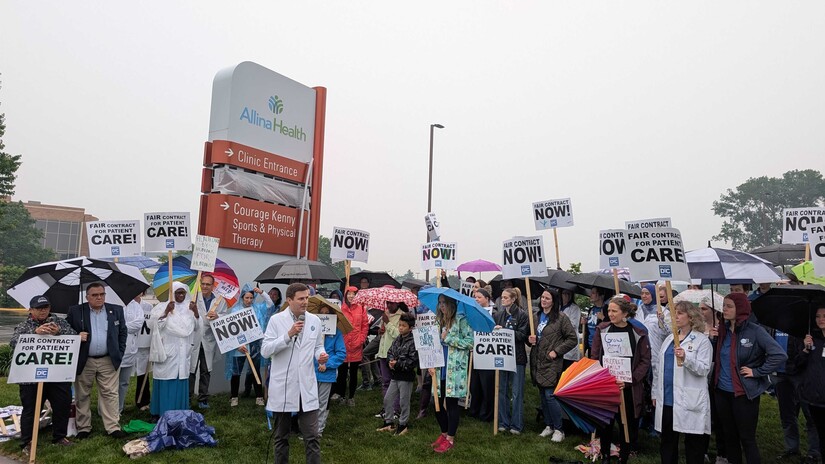
The announcement has already triggered strong reactions from labor organizations.
SEIU Healthcare Minnesota & Iowa and Doctors Council-SEIU have called on Keith Ellison to conduct “all appropriate inquiry and oversight,” warning that consolidation has too often led to higher costs and diminished accountability.
The unions raised concerns that:
The Minnesota Nurses Association has similarly expressed skepticism, framing the deal as part of a broader trend toward healthcare consolidation driven by financial priorities.
The proposed transaction will face rigorous scrutiny under Minnesota law.
Under the state’s healthcare transaction oversight framework, the Attorney General has broad authority to:
This process is not procedural. It is often decisive.
Recent healthcare transactions in Minnesota have resulted in binding conditions, including investment commitments, service guarantees, and long-term oversight agreements.
In this case, regulators will likely examine not just the structure of the deal, but its long-term consequences.
The Allina-Sutter proposal arrives at a moment when healthcare consolidation is under increasing national examination.
Research from organizations such as KFF has found that hospital consolidation often leads to higher prices, while improvements in quality and access are less consistent.
Because this transaction is a cross-market merger, rather than a direct in-state consolidation, its competitive effects may be more complex. Still, the underlying concern remains the same: whether scale delivers better care, or simply greater negotiating power.
For now, the deal remains a proposal.
The coming months will include:
Only after those steps will the true shape of the transaction emerge.
At its core, this moment is about more than two organizations.
It is about the future of nonprofit healthcare in Minnesota.
Whether that future is defined by expanded access, technological advancement, and sustained community investment or by consolidation, centralization, and new forms of distance between systems and the people they serve will depend on decisions made in the months ahead.
The announcement on March 17 was the beginning.
What follows will determine whether this becomes a model for the future of healthcare or a cautionary chapter in its ongoing transformation.
MinneapoliMedia
Community. Culture. Civic Life.



Patchy rain nearby, with a high of 89 and low of 69 degrees. Cloudy during the morning, partly cloudy in the afternoon, sunny during the evening, patchy rain nearby overnight.