Image
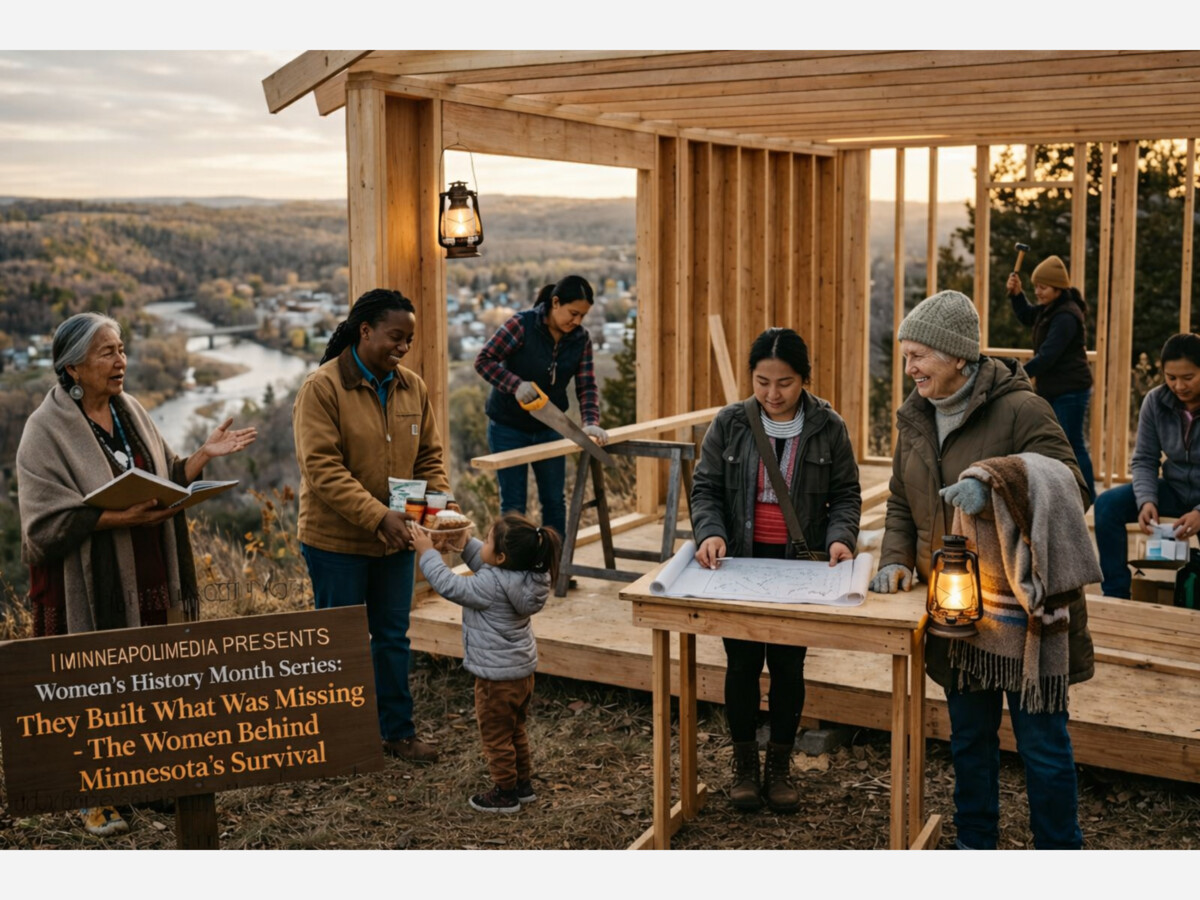



There is a version of Minnesota’s history that resists easy documentation. It does not sit inside legislative archives or institutional reports. It is not marked by ribbon cuttings, policy signatures, or the formal language of progress. It lives instead in the quiet, unrecorded spaces where survival was negotiated, protected, and sustained long before systems were built to recognize it.
It exists in the early mornings before work began and the late nights after it ended. In kitchens where meals were stretched beyond what seemed possible. In living rooms where neighbors gathered to solve problems no institution had yet addressed. In moments when the distance between stability and collapse was measured not in policy, but in people.
This is the history of the women who kept Minnesota alive.
Not as a metaphor. Not as a gesture of recognition.
But as a matter of record.
Modern Minnesota is often understood through the systems it has built. Healthcare networks, educational institutions, housing programs, and civic structures form the visible architecture of the state. They are documented, funded, studied, and debated.
But systems do not emerge fully formed. They are responses to needs that existed long before they were formally acknowledged. And in Minnesota, as in many places, those needs were first met by women who did not wait for formal solutions to arrive.
They responded immediately, practically, and collectively.
In the absence of accessible healthcare, women became caregivers, midwives, and informal health providers within their communities. Knowledge was shared through experience, passed from one generation to the next, refined not through academic institutions but through necessity.
In the absence of structured childcare, women created networks of shared responsibility, ensuring that families could work, survive, and remain connected. These were not casual arrangements. They were coordinated systems of trust, accountability, and mutual reliance.
In the absence of economic security, women stretched limited resources across entire households. They budgeted, bartered, supplemented income, and absorbed the emotional and logistical weight of uncertainty. Their labor was often unpaid, frequently unrecognized, but always essential.
This was not peripheral work.
It was foundational.
Long before Minnesota’s statehood in 1858, Indigenous women in Dakota and Ojibwe communities were central to the social, economic, and cultural systems that sustained life in this region.
They were responsible for food cultivation, including the harvesting of wild rice, a staple deeply tied to both sustenance and cultural identity. They played key roles in governance structures, influencing decisions that affected community direction and survival. They carried and preserved knowledge systems that ensured continuity across generations.
These were not informal contributions. They were structured, respected, and integral.
Colonization disrupted these systems with force and intention. Land dispossession, treaty violations, and forced displacement fractured communities and imposed external structures that often excluded or diminished the roles Indigenous women had long held.
Yet even within that disruption, Indigenous women adapted and continued. They preserved language, cultural practices, and systems of care under conditions designed to erase them. Their work became both survival and resistance.
To understand Minnesota’s foundations without acknowledging this layer is to overlook one of the state’s earliest and most enduring systems of stability.
As Minnesota’s population grew through waves of immigration in the 19th and early 20th centuries, women again became the stabilizing force within environments defined by uncertainty.
Scandinavian, German, and Eastern European immigrant women arrived into harsh climates, limited economic opportunity, and social systems that were not built with them in mind. They worked inside homes and outside of them, contributing to family survival while building new forms of community in unfamiliar surroundings.
They established informal support networks that helped families navigate language barriers, employment challenges, and cultural transitions. They created continuity where none existed, blending traditions from their countries of origin with the demands of their new environment.
Later waves of immigrants, including African, Southeast Asian, and Latin American communities, followed similar patterns. Women became translators, advocates, caregivers, and organizers. They navigated school systems, healthcare institutions, and employment structures on behalf of their families, often without formal support.
In each instance, the pattern repeated.
When systems were incomplete or inaccessible, women built what was needed.
There is an economy that rarely appears in official statistics. It is not measured in GDP or reflected in employment reports. Yet it sustains households, stabilizes communities, and reduces the strain on formal systems.
It is the economy of care.
In Minnesota, women have long been its primary architects.
They cared for children, elders, and those experiencing illness. They managed households under financial pressure. They provided emotional stability in moments of crisis. They organized community responses to challenges that extended beyond any single family.
This work carries measurable value, though it is often excluded from traditional economic frameworks. Without it, the demands placed on healthcare systems, social services, and public institutions would be exponentially greater.
To overlook this labor is not simply an omission. It is a misreading of how stability is actually maintained.
Throughout Minnesota’s history, there have been moments when existing systems were either overwhelmed or insufficient.
Economic downturns placed pressure on families already operating with limited resources. Public health crises exposed gaps in access and infrastructure. Social unrest created uncertainty and disrupted daily life.
In each of these moments, the response followed a familiar pattern.
Women organized.
They distributed food through informal networks when supply chains faltered. They checked on neighbors when isolation increased vulnerability. They created spaces for dialogue, healing, and coordination when communities faced tension or division.
These actions were not coordinated through official channels. They emerged organically, driven by proximity, trust, and necessity.
They were effective because they were immediate.
The idea that this work belongs only to the past is inaccurate.
Across Minnesota today, women continue to build and sustain community-based systems that address gaps in healthcare, housing, food access, and mental health support.
They lead nonprofits that operate at the intersection of service and advocacy. They organize mutual aid networks that respond in real time to community needs. They mentor young people, providing guidance that extends beyond formal education.
They navigate complex systems on behalf of others, ensuring that resources reach those who might otherwise be overlooked.
In many cases, they do this work while balancing professional responsibilities, family obligations, and the ongoing demands of daily life.
The scale of the contribution remains significant.
The level of recognition remains inconsistent.
There is a growing emphasis on documenting history with greater accuracy and inclusion. This requires not only adding new narratives, but re-evaluating existing ones.
Minnesota’s story has often been told through the lens of institutional development. While those structures are important, they do not fully account for how stability was achieved or maintained.
The contributions of women, particularly those whose work occurred outside formal systems, must be understood as central, not supplemental.
This is not a symbolic correction. It is a factual one.
Endurance is often framed in terms of resilience, a word that suggests strength under pressure. But resilience alone does not explain how communities survive.
Survival requires action.
It requires people who are willing to step into uncertainty and create stability where none exists. It requires consistency in the face of fatigue, and commitment in the absence of recognition.
In Minnesota, that work has repeatedly been carried by women.
Not because they were assigned the role, but because the need was present and immediate.
There are histories that are visible, and there are histories that are essential.
This is essential history.
Minnesota did not endure through systems alone.
It endured because, in its most fragile moments, there were women who refused to let it fall apart.
They built what was missing.
They carried what was heavy.
They sustained what could have been lost.
This is not a tribute.
It is a record.
The Women Who Kept Minnesota Alive.
MinneapoliMedia
Community. Culture. Civic Life.



Sunny, with a high of 90 and low of 59 degrees. Sunny in the morning, clear overnight.