Image
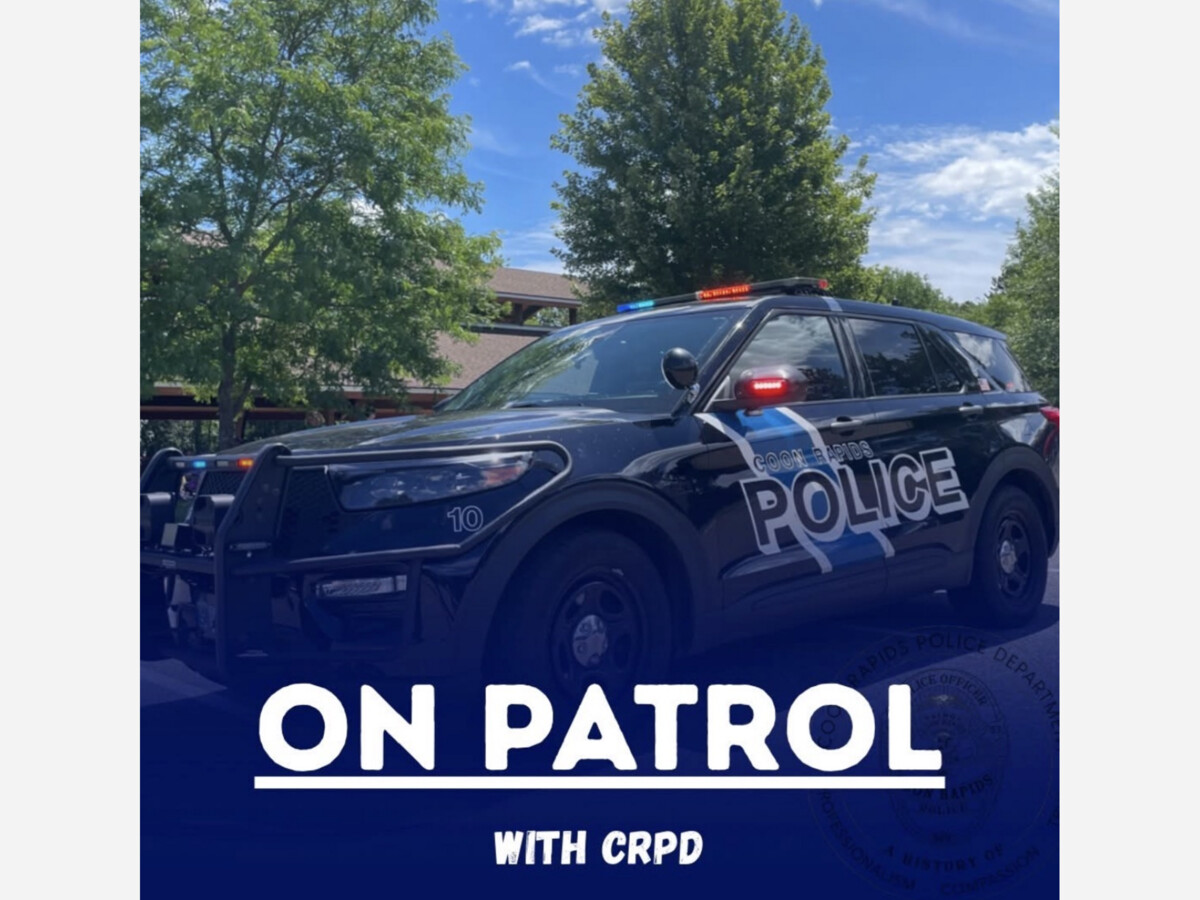
Coon Rapids Police Department Vehicle On Patrol: Courtesy of Coon Rapids PD



COON RAPIDS, MN
The public often encounters policing through moments of crisis, captured in headlines or breaking alerts. Far less visible is the steady, hour-by-hour cadence of calls that define a typical shift. On a recent evening, the Coon Rapids Police Department opened a window into that reality, inviting residents to follow a “virtual ride along” in real time.
What unfolded between late afternoon and nightfall was not a singular dramatic event, but a layered portrait of modern suburban policing, where mental health response, medical assistance, traffic enforcement, and administrative duties intersect in rapid succession.
The initiative itself reflects a growing effort among law enforcement agencies to increase transparency and public understanding. By documenting a live shift, the department offered more than updates. It provided context for how officers allocate time, prioritize calls, and navigate situations that rarely make headlines but shape community safety every day.
At 4:00 p.m., officers were dispatched to assist an individual in crisis. The situation was resolved through de-escalation, and the individual was transported to a hospital for evaluation.
Encounters like this have become a defining feature of policing across Minnesota and the country. Law enforcement officers are frequently the first to respond to mental health emergencies, particularly in communities where dedicated crisis response teams are limited or unavailable. Training programs increasingly emphasize de-escalation techniques, aiming to divert individuals toward care rather than the criminal justice system.
Just minutes later, at 4:37 p.m., officers responded to a medical emergency involving a seizure. The call was ultimately handled by the Coon Rapids Fire Department, underscoring the coordinated nature of emergency response. In many cases, police arrive first, stabilize the scene, and then transition responsibility to fire or medical personnel.
Together, these early calls set the tone for the evening: policing as immediate response, but also as triage, coordination, and care.
As the evening progressed, a clear pattern emerged. Traffic enforcement accounted for nearly half of the documented activity.
Beginning at 4:47 p.m., officers initiated a series of traffic stops for equipment violations, including broken tail lights and headlights, as well as moving violations such as failure to signal. By the end of the shift, six separate stops had been conducted.
While these infractions may appear minor, they often serve as entry points into broader enforcement. During two of the stops, drivers were cited for operating a vehicle after license suspension, a violation associated with increased crash risk and uninsured driving. Another driver was cited for lack of insurance.
Other stops resulted in verbal warnings, including a pedestrian observed walking in the roadway and a driver failing to signal a lane change. These interactions reflect what many departments describe as “educational enforcement,” where the goal is behavioral correction rather than citation.
Traffic stops remain one of the most common forms of police-public interaction nationwide, and in suburban environments like Coon Rapids, they are a primary tool for maintaining roadway safety while also identifying more serious violations.
Beyond active calls, officers spent a significant portion of the shift handling reports and follow-up tasks.
At 4:27 p.m., an officer took a theft report over the phone. Later, at 5:48 p.m., another theft report was taken from a retail store. These types of cases are common in commercial corridors such as the Riverdale area, one of the region’s primary shopping destinations.
While less visible than emergency responses, report-taking is a critical function. It initiates investigations, supports insurance claims, and contributes to crime data that informs broader public safety strategies.
At 5:15 p.m., officers conducted a civil standby while an individual retrieved personal belongings. These calls, often connected to domestic disputes or separations, are preventative in nature. The presence of law enforcement can reduce the likelihood of conflict escalating into violence.
At 7:20 p.m., officers responded to a domestic incident report. Details were limited, but such calls are widely recognized as among the most complex and potentially volatile situations officers encounter.
Domestic-related incidents require rapid assessment, de-escalation, and, when necessary, enforcement actions aligned with Minnesota law. They also reflect the deeply human dimensions of policing, where officers navigate emotionally charged environments with long-term implications for those involved.
Later in the evening, at 9:44 p.m., an officer conducted a Predatory Offender Registration address check. These checks are a routine but essential component of public safety, ensuring compliance with state-mandated registration requirements.
Such administrative duties, though rarely visible to the public, are integral to broader systems of accountability and risk management.
The shift concluded shortly after 10:00 p.m. with a final traffic stop for failure to signal, resulting in a verbal warning.
Taken together, the evening’s activity reflects a profession defined less by singular events and more by constant transition between roles.
Over the course of several hours, officers moved from crisis intervention to medical response, from traffic enforcement to theft reporting, from domestic calls to compliance checks. The work required mobility, judgment, and adaptability, often within minutes of one another.
A breakdown of the shift underscores this balance:
What emerges is not a portrait of constant emergency, but of sustained engagement. The majority of calls involved stabilization, documentation, and prevention rather than arrest or escalation.
By opening this window into a routine shift, the Coon Rapids Police Department offered more than a timeline. It provided insight into the evolving nature of policing itself.
In suburban communities, the work is often defined by balance: enforcing the law while serving as first responders, mediators, and caretakers. It is a model that depends as much on discretion and communication as it does on authority.
For residents following along in real time, the “virtual ride along” revealed something both ordinary and essential. Public safety is not built in moments of crisis alone. It is constructed, call by call, through decisions that rarely draw attention but collectively shape the stability of a community.
MinneapoliMedia
Community. Culture. Civic Life.


Sunny, with a high of 67 and low of 42 degrees. Sunny in the morning, partly cloudy during the afternoon and evening, clear overnight.