78° and Sunny



Image
St. Paul, MN
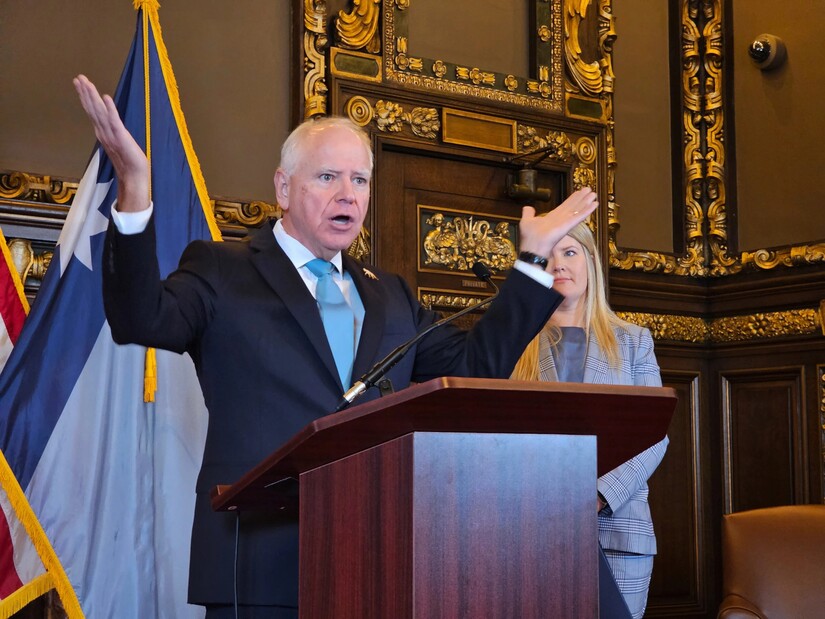
Standing inside the Robbinsdale Water Treatment Plant on Wednesday afternoon, Governor Tim Walz began what is both a policy tour and a political campaign.
The setting was deliberate. The message was direct. And the stakes, as the 2026 legislative session unfolds, are unmistakably high.
Walz’s statewide infrastructure tour opened on March 25 at the Robbinsdale facility, a recently completed project that now serves as a working example of what state bonding dollars can produce when aligned with local investment. The visit marks the first stop in a multi-city push to build momentum behind the governor’s proposed $907 million capital investment plan, a bonding package centered on public safety, clean water, transportation, and housing.
“It’s the core responsibilities of government: safety and security of our citizens and the delivery of the basic infrastructure, water, safe roads, schools,” Walz said during the visit, framing infrastructure not as discretionary spending, but as foundational governance.
The Robbinsdale Water Treatment Plant, completed in 2022 at a cost of approximately $35 million, represents the kind of state-local partnership Walz is attempting to scale statewide.
By launching the tour at a water facility, the administration is signaling where urgency is most visible. Across Minnesota, aging water systems face mounting regulatory demands, rising costs, and infrastructure that in many cases predates modern environmental standards. For smaller municipalities in particular, state bonding dollars often determine whether critical upgrades move forward or stall indefinitely.
The governor’s team has increasingly framed clean water not only as an environmental priority, but as a public health and economic stability issue, particularly in Greater Minnesota communities where infrastructure gaps can slow development and strain local budgets.
Walz’s proposal is structured as both a maintenance strategy and a forward-looking investment plan, balancing preservation of existing assets with targeted expansion.
The framework includes:
The proposal is financed primarily through general obligation bonds, which require legislative approval and long-term repayment through the state’s general fund. The administration has characterized the plan as a starting point for negotiation, rather than a fixed ceiling.
The scale of the proposal, while substantial, sits in stark contrast to the volume of unmet demand across the state.
Requests submitted by state agencies and local governments total approximately $6.8 billion, reflecting a backlog of infrastructure needs that has grown over multiple budget cycles. The governor’s $907 million plan addresses only a portion of that demand, setting up a familiar tension inside the Capitol.
Some lawmakers argue the proposal is too modest given the scope of need, pushing instead for a bonding bill that meets or exceeds $1 billion. For these legislators, the question is not whether to invest, but whether the state is moving aggressively enough to address projects that are already designed, approved, and ready to begin construction.
At the same time, others caution against expanding the bonding total too far, pointing to long-term debt obligations and the need to maintain fiscal discipline as interest rates and construction costs fluctuate.
Unlike standard budget legislation, bonding bills in Minnesota carry a higher threshold for passage.
Any bill that authorizes general obligation bonds requires a three-fifths supermajority, or 60 percent approval, in both the House and Senate. That requirement effectively guarantees that no bonding bill can pass without bipartisan support.
It is this reality that shapes the governor’s tour as much as the policy itself.
By appearing alongside labor leaders, construction workers, and local officials, Walz is building a case that extends beyond policy frameworks into economic impact. Infrastructure spending in Minnesota has long been tied to job creation in the construction trades, and the administration is emphasizing that connection as it seeks to attract Republican votes necessary to reach the supermajority threshold.
The current debate is unfolding against a backdrop of uneven bonding cycles.
While Minnesota approved a $700 million infrastructure package in 2025, lawmakers failed to pass a bonding bill in 2024, contributing to a growing backlog of deferred maintenance and delayed projects. In many cases, those delays have increased costs, as inflation and supply chain pressures continue to reshape the economics of construction.
The result is a legislative environment where urgency is widely acknowledged, but consensus remains elusive.
Walz’s tour represents an attempt to shift that dynamic.
Rather than allowing the bonding debate to remain confined to committee rooms and fiscal notes, the governor is bringing lawmakers, media, and the public directly into the physical spaces where infrastructure decisions take shape.
Water plants. Roads. Correctional facilities. Campuses.
Each stop is designed to answer a single question with visible evidence: what happens when the state invests, and what happens when it does not.
As the legislative session progresses, negotiations over the final size and structure of the bonding bill are expected to intensify.
The governor’s $907 million proposal may ultimately expand, contract, or stall altogether depending on bipartisan negotiations. What is clear, however, is that the conversation has moved beyond whether infrastructure investment is needed.
The debate now centers on scale, timing, and political will.
For communities across Minnesota, the outcome will determine more than budget lines. It will shape whether long-planned projects move from paper to construction, whether aging systems are repaired or deferred again, and whether the state’s infrastructure keeps pace with its growth.
Standing in Robbinsdale, Walz framed the issue in its simplest terms.
The question is no longer what needs to be built.
It is whether Minnesota is prepared to build it.
MinneapoliMedia
Community. Culture. Civic Life.



Sunny, with a high of 92 and low of 60 degrees. Sunny in the morning, clear in the afternoon and evening,