61° and Mist
Image
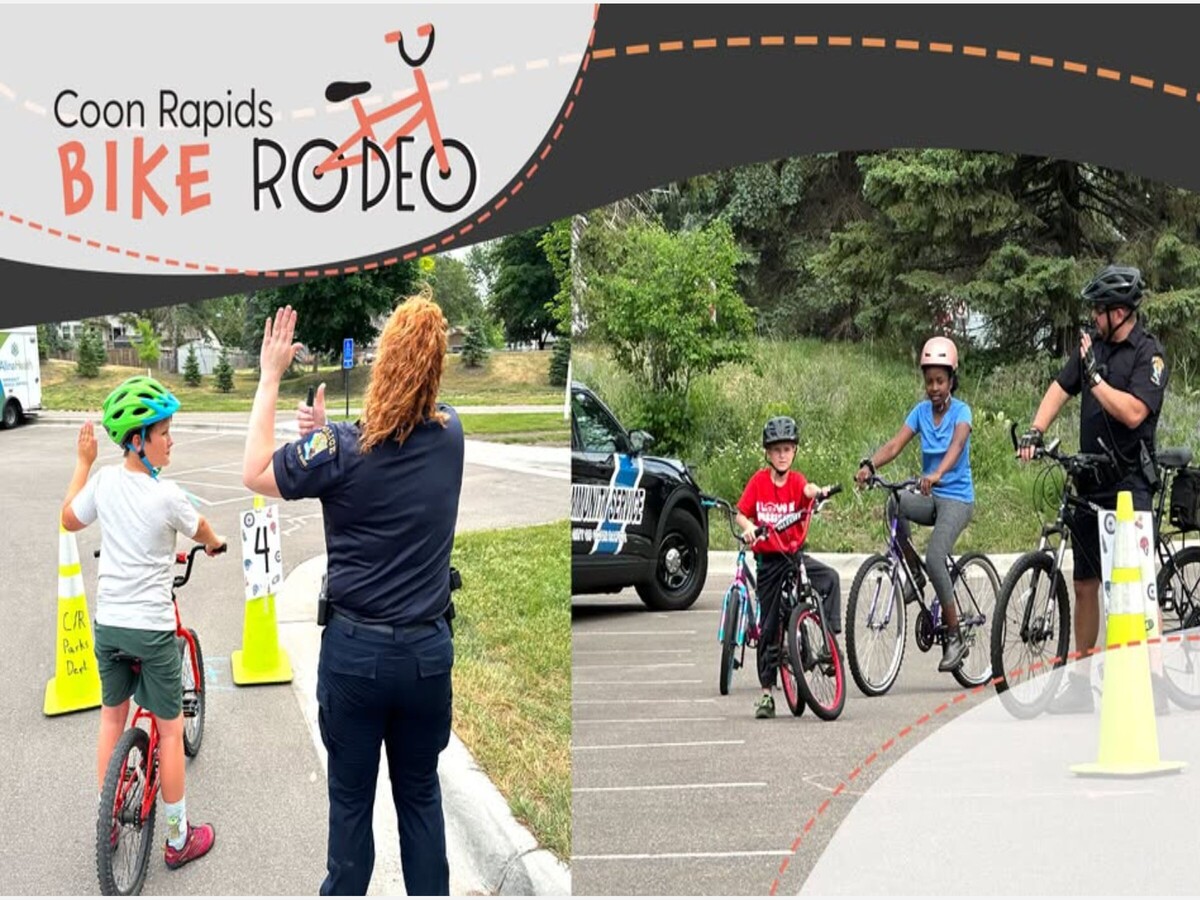



COON RAPIDS, MN (May 28, 2026) On most summer mornings in Minnesota, the sound arrives before the sight of it.
The faint clicking of bicycle chains. Helmet straps snapping into place. Children pushing off driveways toward neighborhood sidewalks, park trails, basketball courts, convenience stores, and the small freedoms that arrive with school break and longer daylight.
For many families, bicycling marks one of childhood’s first experiences with independence.
For police officers, emergency responders, and healthcare workers, it is also one of the seasons when preventable injuries sharply increase.
That intersection between freedom and vulnerability is what the annual Coon Rapids Bike Rodeo is designed to address.
The free event will run from 10 a.m. to noon, with no registration required. Families are encouraged to bring bicycles and helmets, though organizers say accommodations will be available for children who do not have functioning equipment. A limited number of donated and loaner bicycles are expected to be available onsite to ensure broader participation.
The Bike Rodeo, now a recurring seasonal tradition in Coon Rapids, operates less like a festival and more like a carefully structured public safety classroom disguised as recreation.
Children rotate through a series of progressive, hands-on safety stations designed to teach the practical mechanics of riding, traffic awareness, balance control, emergency maneuvering, and injury prevention. Unlike lecture-style safety programs, the event emphasizes repetition, movement, and direct physical practice.
The initiative is organized as a collaborative effort involving the Coon Rapids Police Department, Coon Rapids Fire Department, Allina Health, and Safe Kids Anoka County, reflecting the increasingly multidisciplinary nature of modern injury prevention programs.
Police officers help oversee skill stations and teach traffic awareness principles rooted in Minnesota bicycle laws, which require cyclists to follow many of the same traffic rules governing motor vehicles. Riders practice hand signals for turning and stopping while learning how to navigate intersections, communicate with drivers, and remain alert to pedestrians and roadway hazards.
Healthcare professionals and safety advocates focus on injury reduction, particularly head trauma prevention.
According to the Centers for Disease Control and Prevention, bicycle-related injuries remain one of the leading causes of emergency room visits among children nationwide. Federal health officials consistently identify properly fitted helmets as one of the most effective tools for reducing traumatic brain injuries among youth cyclists.
But organizers note that helmet ownership alone is not enough.
At the Bike Rodeo, trained staff and volunteers personally inspect and fit helmets for participating children, ensuring correct brow positioning, side strap alignment, and tightening. Safety officials say improperly worn helmets can significantly reduce protection during crashes or falls.
For families needing updated equipment, discounted helmets are expected to be available onsite.
Mechanical safety also plays a central role in the event.
Volunteers and officers assist families with basic bicycle inspections, checking brakes, tire pressure, seat positioning, steering alignment, and overall bicycle condition. Proper bicycle sizing and ergonomics, organizers say, help improve rider control and reduce accidents caused by instability or delayed braking.
At the center of the event sits the obstacle course itself, a guided riding circuit designed to simulate real-world cycling conditions.
Children practice controlled starts and stops, low-speed balance, maneuvering around hazards, weaving through cones, signaling directional changes, and responding to simulated traffic scenarios. The course is intentionally designed to build muscle memory through repetition, particularly for younger riders still developing coordination and roadway awareness.
The broader philosophy behind events like the Bike Rodeo reflects a growing shift in community policing and public safety strategy.
Rather than focusing solely on emergency response after accidents occur, departments increasingly invest in preventive education programs aimed at reducing injuries before they happen. Bike rodeos have become common across the United States because they allow children to learn safety skills in controlled, low-pressure environments before navigating busier public streets independently.
In Minnesota, the timing carries additional importance.
As schools prepare for summer break, bicycle activity traditionally increases across neighborhoods, parks, and trail systems throughout the state. Public safety officials often view late spring and early summer as critical periods for reinforcing safe riding habits before children spend longer unsupervised hours outdoors.
The event also reflects broader conversations taking place nationally around youth mobility, outdoor recreation, neighborhood design, and childhood independence in an era increasingly shaped by screens and indoor activity.
For a few hours at Lions Coon Creek Park, though, the focus will remain more immediate.
A properly tightened helmet.
A child learning how to stop safely before crossing a street.
A young rider discovering how to balance through a turn without panic.
The quiet repetition of skills that, under the right circumstances, may someday prevent tragedy.
Additional information about the Bike Rodeo is available through the City of Coon Rapids Bike Rodeo page.
MinneapoliMedia | Community. Culture. Civic Life.


Mist, with a high of 74 and low of 59 degrees. Mist in the morning, overcast in the afternoon, mist overnight.