66° and Partly cloudy
Image
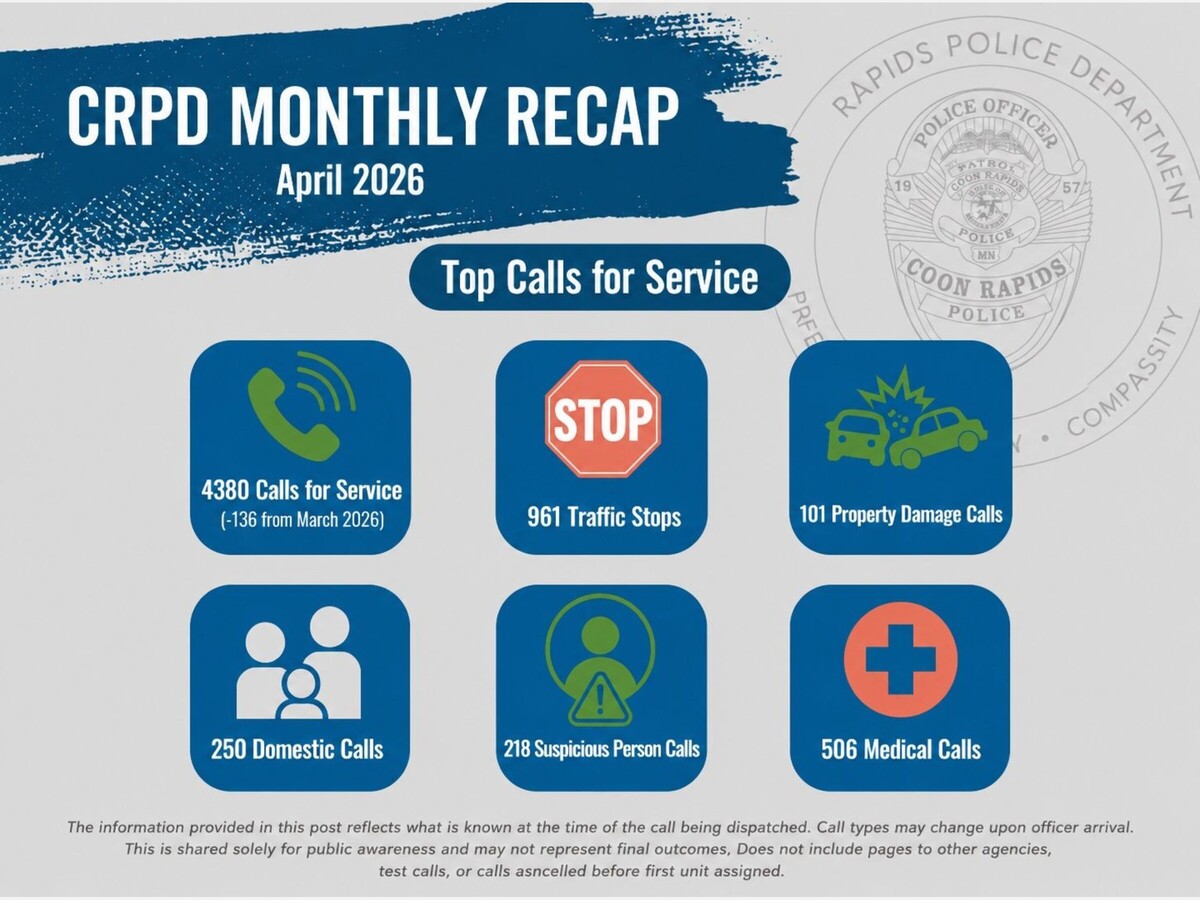



Published as part of the department’s ongoing public transparency initiative, the April report outlines the volume and types of incidents officers responded to throughout the month, ranging from traffic enforcement and medical emergencies to domestic disturbances and suspicious activity investigations. The data, released publicly by the department, reflects not only traditional law enforcement activity, but also the increasingly broad public safety responsibilities now routinely carried by local police agencies across Minnesota’s suburban communities.
The April total represented a decrease of 136 calls compared to March 2026.
While the numbers themselves appear statistical and procedural on the surface, together they provide a revealing snapshot of the operational demands placed on one of the northern Twin Cities metro’s busiest suburban police departments. Behind each dispatch category lies a wide spectrum of incidents requiring rapid response, public interaction, investigative judgment, and, increasingly, crisis intervention skills extending well beyond traditional criminal enforcement.
Among the department’s most significant activity categories during April were 961 traffic stops, 506 medical calls, 250 domestic calls, 218 suspicious person calls, and 101 property damage incidents.
The department stated that the monthly recap is intended to “promote transparency and keep our community informed about how our officers serve and support the community every day.”
The figures also reflect the evolving role of local law enforcement agencies nationwide as police departments increasingly function as first responders not only to criminal activity, but also to medical crises, mental health emergencies, family disputes, traffic safety concerns, and public welfare situations.
Traffic enforcement represented the department’s single largest identified activity category during April, with officers conducting 961 traffic stops throughout the city.
That emphasis mirrors broader statewide traffic safety concerns that have intensified in Minnesota in recent years. According to the Minnesota Department of Public Safety’s Office of Traffic Safety, state officials have continued urging increased enforcement efforts following sustained increases in speeding, impaired driving, distracted driving, and reckless driving behaviors that contributed to elevated roadway fatalities during and after the COVID-19 pandemic period. State traffic safety officials have repeatedly identified speeding as one of the leading contributors to serious crashes and fatal collisions across Minnesota roadways.
The department also responded to 101 property damage calls during April, incidents that commonly include non-injury vehicle crashes, accidental property damage, vandalism reports, and related insurance documentation calls requiring officer response and reporting.
Medical emergencies represented another major portion of the department’s monthly workload, with officers dispatched to 506 medical calls.
Across Minnesota, suburban police officers increasingly operate alongside firefighters, paramedics, and emergency medical technicians during overdose incidents, welfare checks, mental health emergencies, cardiac events, and other public health-related calls requiring coordinated multi-agency response. Public safety researchers and municipal officials have increasingly acknowledged that modern policing frequently intersects with healthcare, addiction response, behavioral health crises, and social service gaps.
The department additionally handled 250 domestic calls during April, one of the more operationally sensitive categories officers routinely encounter.
Law enforcement experts have long identified domestic disturbance calls as among the most unpredictable and potentially dangerous incidents faced by responding officers because of emotionally volatile circumstances, family tensions, and the possibility of escalating violence. Such calls often require rapid de-escalation, victim protection measures, investigative assessment, and coordination with victim advocacy or social service resources.
Meanwhile, officers responded to 218 suspicious person calls during the month, reflecting another common aspect of suburban policing heavily influenced by resident reporting and community vigilance. These calls can range from trespassing complaints and welfare concerns to reports of unusual behavior, loitering, or circumstances residents perceive as potentially unsafe or concerning.
The monthly recap also included an important clarification regarding how the data should be interpreted.
According to the department’s public notice, the information reflects conditions known “at the time of the call being dispatched,” meaning classifications can later change after officers arrive, investigate, or determine final case outcomes. The department further noted that the figures do not include pages to outside agencies, test calls, or calls canceled before a first responding unit was assigned.
That distinction underscores a broader challenge surrounding public crime and policing data: dispatch records are not synonymous with criminal convictions or finalized investigative findings. Instead, they represent the initial operational picture presented to emergency dispatchers at the time residents request police assistance.
Coon Rapids, one of the larger suburban communities in Anoka County, continues to experience ongoing residential growth and increased traffic activity as development expands across the northern Twin Cities metropolitan region. With that growth has come increasing demand on municipal public safety agencies tasked with balancing enforcement responsibilities, emergency response obligations, and community engagement expectations.
In recent years, police departments throughout Minnesota and nationally have increasingly embraced public-facing statistical recaps, social media reporting, and data dashboards as part of broader transparency and public communication strategies aimed at strengthening community trust and public understanding of law enforcement operations.
For many residents, the monthly reports offer a clearer view into the volume and diversity of calls officers manage daily, much of which occurs outside highly publicized criminal incidents that typically dominate headlines.
Additional information and community updates are available through the official Coon Rapids Police Department communication channels and City of Coon Rapids public information platforms.
MinneapoliMedia | Community. Culture. Civic Life.



Sunny, with a high of 87 and low of 64 degrees. Sunny in the morning, patchy rain nearby overnight.