82° and Sunny
Image
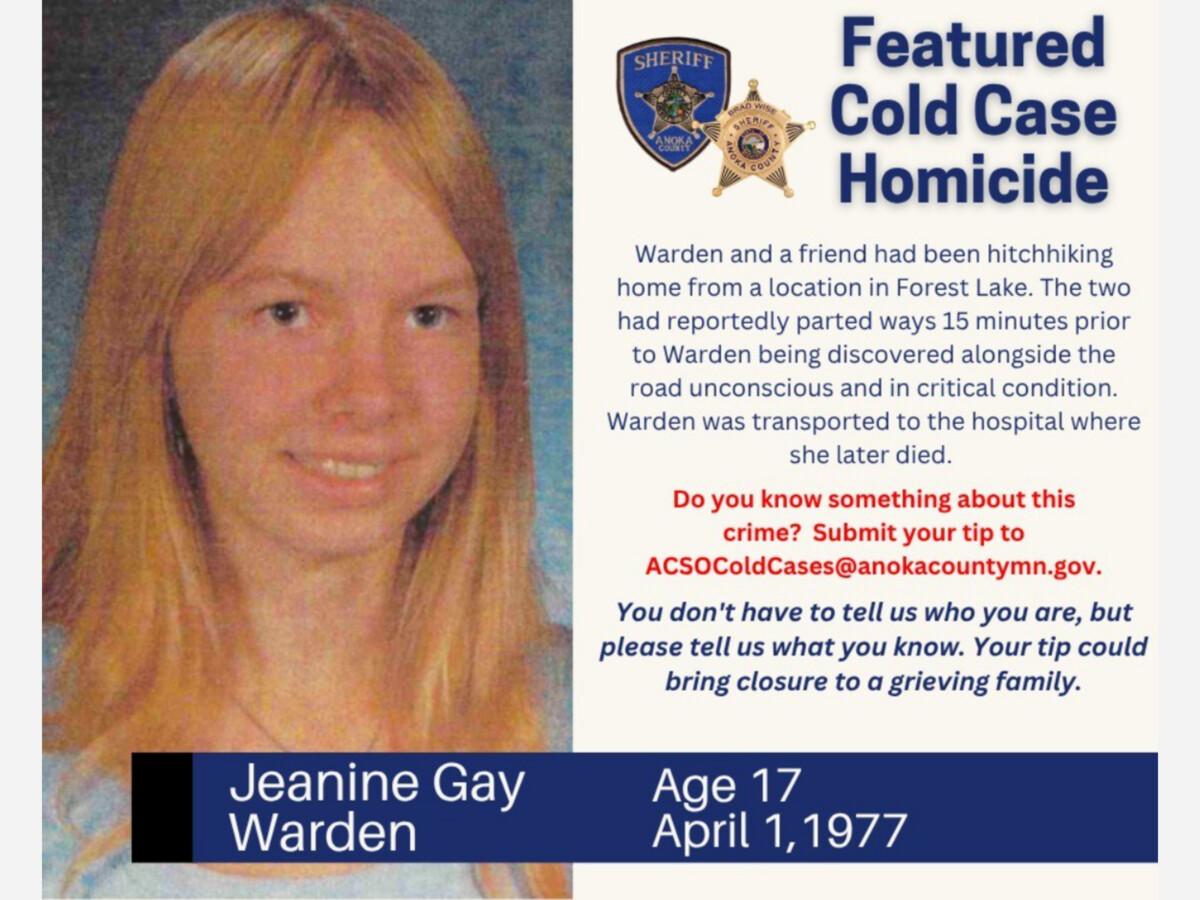



Nearly five decades later, the death of Jeanine Gay Warden remains one of the most enduring and unresolved mysteries in Anoka County, a case suspended between possibility and proof, where the known facts are precise, but the truth remains just out of reach.
This week, the Anoka County Sheriff's Office вновь marked the anniversary of Warden’s death with a renewed public appeal. Case Number 77-019287 remains open.
On the evening of Friday, April 1, 1977, Jeanine Warden, a high school junior, attended a Future Farmers of America awards banquet in Forest Lake. For the occasion, she wore a powder-blue formal dress, one she had previously worn as a bridesmaid in her sister’s wedding.
At some point after the event, she changed into more casual clothing. The formal dress was placed in a bag she carried with her.
Later that night, Warden and a friend began their journey back toward Linwood Township. Like many young people in rural Minnesota at the time, the two chose to hitchhike.
They were picked up by a driver and transported toward home.
At a point near their residences, the girls were dropped off. They parted ways.
It would be the last confirmed moment Jeanine Gay Warden was seen conscious and alive.
Investigators have long focused on the brief and critical gap that followed.
Approximately 10 to 15 minutes after the two girls separated, a passing motorist discovered Warden lying unconscious in a roadside ditch, just blocks from her home. She had sustained a severe head injury.
Emergency responders transported her to Regions Hospital in St. Paul. She remained in a coma for six weeks.
At her bedside was her mother, Marlys Ostlund, who kept constant vigil as days stretched into weeks. Warden never regained consciousness.
She died in May 1977.
From the outset, the investigation was marked not only by what was found, but by what could not be determined.
The official cause of death was a head injury. But the manner of death was classified as undetermined.
Investigators could not conclusively establish whether Warden had been struck by a vehicle in a hit-and-run, pushed or ejected from a vehicle, or suffered a fall under unknown circumstances.
Several key elements have continued to complicate the case:
The Missing Dress
The bag containing Warden’s powder-blue formal dress was never recovered. While other personal belongings were accounted for, the disappearance of the dress remains one of the most persistent and unexplained details in the case.
Weather Conditions
Reports indicate it was raining that night, a factor that may have degraded or erased physical evidence at the roadside scene.
The Lack of Witnesses
Despite the narrow timeframe between her drop-off and discovery, no witnesses have ever come forward with information about the driver who transported the girls or any other vehicles in the area at that moment.
The Critical Gap
The estimated 10 to 15 minutes between separation and discovery represents one of the smallest yet most consequential windows in the case. Within that span, something occurred that investigators have never been able to reconstruct.
In 1977, investigative tools were limited. DNA analysis was not yet part of criminal investigations, and forensic reconstruction relied heavily on physical evidence and eyewitness accounts.
Neither proved sufficient.
Over the decades, the case has been revisited multiple times, including renewed investigative efforts in 2009 and 2011, often prompted by family advocacy and local media attention.
Today, the Anoka County Sheriff’s Office Cold Case Unit continues to review the case using modern techniques, including advancements in forensic science and database analysis. While no definitive breakthroughs have been announced, investigators maintain that the possibility of resolution remains.
For Warden’s family, time has not closed the case.
She is remembered not as a file number, but as a daughter, a sister, and a young woman whose life was interrupted without explanation. Her sister, Charmaine Schodde, along with extended family members, has continued to seek answers in the decades since.
Unsolved cases carry a unique weight. They do not end. They persist, resurfacing in anniversaries, in renewed appeals, and in the quiet absence of resolution.
The Anoka County Sheriff's Office вновь is asking the public to come forward.
Even now, investigators emphasize that seemingly small details, conversations, or memories from that time could hold significance. What may have once felt irrelevant could, in the context of modern investigative tools, become pivotal.
Anyone with information related to the death of Jeanine Gay Warden is encouraged to contact the Cold Case Unit at:
ACSOColdCases@anokacountymn.gov
The case of Jeanine Gay Warden does not hinge on a lack of effort. It hinges on a moment.
A short walk.
A narrow window of time.
An event no one witnessed, or at least no one has ever publicly described.
Forty-seven years later, that moment remains unaccounted for.
And somewhere within it, the answer still waits.
MinneapoliMedia | Community. Culture. Civic Life.
#4: Anoka County Sheriff’s Office Blends Humor With Public Safety Message in “Scooter Division” Announcement
ANOKA COUNTY, MN
The Anoka County Sheriff's Office introduced what appeared to be a new “Scooter Division” this week, using humor and satire to deliver a serious message about the growing presence of small motorized vehicles on public trails, sidewalks, and roadways.
In a social media post shared Wednesday, the department announced the fictional rollout of “state-of-the-art patrol scooters,” describing them as capable of speeds up to 6 miles per hour and equipped with “stealth mode” so quiet that residents might only hear a faint hum as deputies pass by.
The post, which included tongue-in-cheek references to “zero-turn maneuverability for tight-radius donut runs,” quickly drew engagement from residents. But beneath the humor was a clear public safety objective: educating the public on the proper and legal use of electric-assisted bicycles, scooters, and other motorized devices that have become increasingly common across Minnesota communities.
In recent years, electric-assisted bicycles, motorized scooters, and electric dirt bikes have surged in popularity across the Twin Cities metro and suburban areas like Anoka County. Their accessibility and relatively low cost have made them especially appealing to younger riders, while also creating new challenges for law enforcement and city officials.
Parks, trails, and sidewalks — spaces traditionally designed for pedestrians and standard bicycles — are now shared with faster, motorized devices that can pose safety risks when improperly used.
The Sheriff’s Office used the viral-style post to reinforce that these devices are not all treated equally under Minnesota law.
Under Minnesota statutes and guidance from the League of Minnesota Cities, different categories of small vehicles are governed by distinct rules:
Electric-Assisted Bicycles (E-Bikes)
E-bikes are legally classified similarly to traditional bicycles, provided they meet specific criteria, including having a saddle and operable pedals. Riders must be at least 15 years old to operate them. They are generally allowed on roadways and many trails, depending on local ordinances.
Motorized Foot Scooters
Often seen in neighborhoods and parks, motorized scooters can be operated by individuals as young as 12. Riders under 18 are required to wear a helmet. These devices must be equipped with headlights and taillights and are granted the same rights and responsibilities as bicycles when used on public ways.
Motorcycles and Electric Dirt Bikes
More powerful vehicles, including electric dirt bikes, fall into a different legal category. Operators must hold a valid driver’s license with a motorcycle endorsement. These vehicles are prohibited from sidewalks and bike paths and must comply with all roadway laws, including registration, insurance, and equipment requirements such as mirrors and lighting.
While the “Scooter Division” itself is fictional, the enforcement priorities behind the message are not.
Authorities across Minnesota have reported increasing concerns about unsafe riding behaviors, particularly involving unlicensed dirt bikes and high-speed electric vehicles operating in pedestrian areas. These behaviors can lead to collisions, injuries, and conflicts between trail users.
The Sheriff’s Office emphasized that residents who witness dangerous or reckless operation of any motorized device should report it to law enforcement. In urgent situations, officials advise calling 911.
Law enforcement agencies nationwide have increasingly turned to humor and social media creativity to connect with the communities they serve. By framing the announcement as a lighthearted innovation, the Anoka County Sheriff’s Office was able to capture attention while delivering information that might otherwise be overlooked.
The strategy reflects a broader shift toward community-oriented policing, where communication and education are seen as key tools alongside enforcement.
Behind the jokes about slow-speed patrol scooters is a straightforward message: as new forms of transportation become more common, understanding the rules that govern them is essential for keeping public spaces safe.
Whether riding an e-bike through a neighborhood, a scooter on a trail, or operating a dirt bike on a roadway, the responsibility ultimately rests with the operator to know the law — and to share the space safely with others.
MinneapoliMedia | Community. Culture. Civic Life.



Patchy rain nearby, with a high of 89 and low of 69 degrees. Cloudy during the morning, partly cloudy in the afternoon, sunny during the evening, patchy rain nearby overnight.