Image




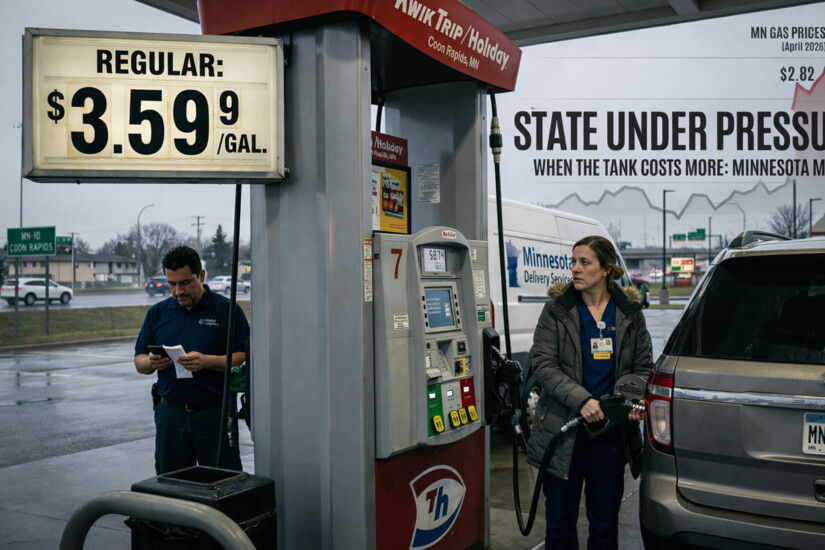
On a recent morning in the north metro, a driver pulled into a gas station just off Highway 10 in Coon Rapids. The routine was unchanged. Card in. Select grade. Begin fueling.
But the moment itself had changed.
The driver stood still for a few seconds longer than usual, eyes fixed on the numbers above the pump. $3.59 per gallon. Not the highest price Minnesota has ever seen, but high enough to signal something different. High enough to require a recalculation.
A few feet away, a delivery driver leaned against his van, phone in hand, reviewing the day’s route. Stops, mileage, timing, fuel. The math no longer balanced the way it had just weeks ago.
Inside the store, a cashier overheard the same quiet refrain repeated by different customers throughout the morning.
It keeps going up.
No one needed a headline to explain it. The reality was already visible.
As of April 1, 2026, Minnesota’s statewide average for regular unleaded gasoline reached approximately $3.52 per gallon. That number, while still below the national average, reflects a sharp and sustained increase over the past month. The cause is not local. It is global.
The war involving Iran has disrupted oil markets in ways that ripple outward quickly. Crude oil prices surged past $100 per barrel. Shipping lanes through the Strait of Hormuz, one of the most critical oil transit points in the world, tightened under geopolitical strain. When that corridor is threatened, supply contracts. When supply contracts, prices rise.
Minnesota does not sit at the center of that conflict. But it absorbs its consequences in real time.
Over the course of a month, gas prices in Minnesota have risen by roughly seventy cents.
That increase does not announce itself loudly. It accumulates. A few cents every few days. A noticeable difference by the end of the week. A structural shift by the end of the month.
For a commuter traveling from Anoka County into Minneapolis five days a week, the added cost becomes part of a new baseline. For a parent balancing school, work, and errands, the increase spreads across multiple trips and multiple obligations. For households managing two or three vehicles, it compounds quickly.
This is how a price change becomes a lifestyle adjustment.
Households begin to make decisions that are not always visible from the outside. Grocery lists become more deliberate. Nonessential purchases are postponed. Weekend travel is reconsidered. Savings plans are paused or reduced.
These are not dramatic shifts. They are incremental. But they are consistent.
For lower income households, the margin for adjustment is limited. Fuel is not discretionary. It is a requirement tied directly to employment, education, and access to basic services. When fuel costs rise, the trade offs become immediate.
Something else must be reduced to accommodate it.
Fuel does not stay at the pump.
Every gallon purchased at a higher price moves through the economy.
In Minnesota, regional differences already reflect the mechanics of distribution. The Twin Cities continue to trend slightly above the statewide average. Rochester is among the highest in the state. St. Cloud remains somewhat lower, but still elevated compared to recent weeks.
Behind those regional differences is a broader pattern that is now taking shape.
Trucking companies are adjusting fuel surcharges. Airlines are recalibrating pricing models. Freight operators are absorbing higher costs and passing them along. Retailers are seeing increased expenses tied to logistics.
A restaurant in Blaine pays more for food deliveries. A contractor in Coon Rapids factors fuel into every job estimate. A small business owner in Brooklyn Park sees rising costs tied to both incoming inventory and outgoing service.
These changes do not occur in isolation. They move outward, gradually, into the price of goods and services.
This is the mechanism through which gas prices become the cost of living.
Energy prices have always held a central role in shaping inflation.
When fuel costs rise, they influence production, transportation, and distribution simultaneously. The effect is broad and difficult to contain.
At a time when inflation had begun to stabilize, rising oil prices introduced a new layer of pressure. For policymakers, this complicates efforts to maintain economic balance. For households, it means that relief from elevated prices may be delayed.
Minnesota’s economy is diverse, but it is not insulated. Agriculture depends on fuel for equipment and transport. Manufacturing relies on energy for production and distribution. Service industries depend on mobility.
When the cost of energy shifts, the entire system adjusts with it.
Consumer behavior rarely shifts all at once. It changes in patterns.
A family that once dined out twice a week reduces that to once. A planned trip is delayed. A discretionary purchase is reconsidered.
Individually, these decisions appear small. Collectively, they reshape demand.
Businesses begin to notice changes in traffic, spending, and customer behavior. The shift is gradual but measurable.
Rising gas prices do not immediately trigger an economic downturn. They create the conditions that make one more likely.
For certain sectors, the impact is immediate and unavoidable.
Delivery drivers, contractors, transportation workers, and service providers operate in systems where fuel is a daily cost. When prices rise, their operating margins shrink.
In Minnesota, delivery operations have already reported increased fuel expenses that affect route planning and cost efficiency. Nonprofit organizations that rely on transportation to deliver food, supplies, and services face the same pressures with fewer financial buffers.
Small businesses confront a familiar set of choices. Raise prices and risk losing customers. Absorb costs and reduce profitability. Delay hiring or expansion.
There is no option that leaves them unaffected.
The rise in gas prices intersects with a broader fiscal moment for Minnesota.
Federal funding reductions across multiple sectors have placed added strain on state planning and budgeting. Programs that once relied on federal support are now being reassessed, restructured, or scaled back.
At the same time, Minnesota’s state government is working to maintain stability across essential services. Transportation infrastructure, public safety, healthcare systems, and community programs all require sustained investment.
Rising fuel costs add pressure to each of these areas.
Road maintenance becomes more expensive. Public transit systems face higher operating costs. Emergency response services absorb increased expenses tied to mobility. School transportation budgets tighten.
The state is balancing reduced federal support and rising operational costs at the same time.
The goal remains consistent. Keep Minnesotans safe. Keep systems functioning. Limit disruption.
But achieving that goal now requires more difficult trade offs.
Gas prices carry a unique weight in how people interpret economic conditions.
They are visible. They change frequently. They require no explanation.
When prices rise steadily, they influence perception.
Households begin to anticipate further increases. Spending becomes more cautious. Financial planning becomes more conservative.
This shift in sentiment matters as much as the price itself. Confidence influences behavior, and behavior shapes outcomes.
In Minnesota, that shift is already underway.
Minnesota continues to maintain gas prices below the national average. That distinction offers some relief, but it does not change the underlying trajectory.
The state operates within a global energy system. It does not control the forces driving prices upward.
Regional infrastructure and supply chains provide some insulation, but they do not eliminate exposure.
When global supply tightens, Minnesota feels it. When global demand shifts, Minnesota adjusts.
The question is not whether Minnesota is affected. The question is how long these pressures persist.
Energy shocks have shaped past economic periods in the United States. They have altered behavior, influenced policy, and exposed the link between global events and local realities.
What is unfolding now follows that pattern.
It is not defined by a single spike, but by sustained increases that accumulate over time. A few cents become a few dollars. A few dollars become a monthly burden. A monthly burden becomes a structural shift.
The moment at the pump is brief. The consequences extend far beyond it.
In Minnesota, those consequences are already visible.
They are present in household budgets. They are reflected in business decisions. They are embedded in the cost of goods and services.
This is how a global conflict becomes a local reality.
The trajectory of gas prices will depend on global conditions that extend beyond Minnesota’s borders.
But the impact within the state is already unfolding.
Households are adjusting. Businesses are recalibrating. State leaders are navigating a more complex fiscal environment.
The margin for stability is narrowing.
This is a moment that will be understood not by a single price increase, but by accumulation.
The number on the pump is the beginning.
What follows is everything it changes.
Minnesota is not at the center of the forces driving this shift. But it is fully within their reach.
The price has already changed.
Now the question is how the state responds.
MinneapoliMedia | Community. Culture. Civic Life.

Overcast, with a high of 75 and low of 61 degrees. Fog in the morning, overcast in the afternoon, fog overnight.