Image




James Reginal Willis and Garrett Christopher Willis are each charged with making threats of violence with reckless disregard and brandishing replica firearms. Both men are scheduled to make their initial court appearances on April 21.
According to the criminal complaint and witness accounts, the events unfolded in two separate locations on the same day.
In a residential area of south Minneapolis, the men were first observed operating from a van with tinted windows and a plumbing company decal that investigators later determined was not associated with a functioning business. Community members and individuals monitoring immigration enforcement activity reported suspicious behavior after seeing the men detain an individual.
Witnesses stated that a confrontation escalated when the men exited the vehicle and engaged with observers and residents. One of the defendants allegedly pointed a weapon at a driver approaching the scene, while others reported verbal threats directed at civilians.
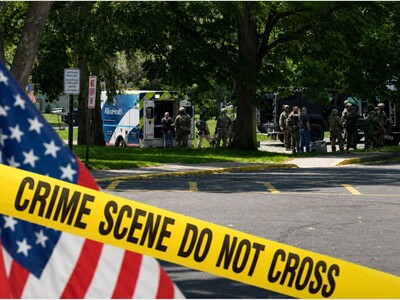
Later that day, outside the Hennepin County Jail in downtown Minneapolis, a second confrontation occurred. Witnesses reported that one man pointed a handgun at individuals and pulled the trigger, though the weapon did not fire. Another individual discharged a rifle-style weapon toward the ground near civilians, later identified as firing pepper ball rounds.
Prosecutors stated that the weapons used in both incidents were replica or less-lethal firearms designed to resemble real weapons, including pistols modeled after Glock handguns and rifle-style launchers.
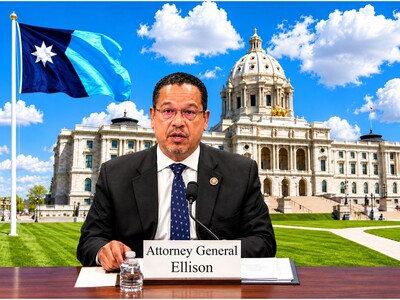
Mary Moriarty said the weapons were visually indistinguishable from real firearms, a key factor in the charges. Under Minnesota law, the use of replica firearms in a manner that threatens or terrorizes others can carry the same legal consequences as real firearms in certain contexts.
Investigators emphasized that the appearance and manner of use created a credible perception of deadly force among those present.
One of the defendants told investigators that the situation appeared more severe in video recordings than it was in reality and maintained that the weapons were non-lethal pepper ball devices. Authorities reported they did not find video evidence supporting claims that civilians threatened the men.
Witnesses described a chaotic and alarming scene. Individuals present reported that weapons were pointed at civilians who were not engaged in violent behavior, including observers using whistles to signal potential immigration enforcement activity.
Video evidence reviewed by investigators shows the discharge of pepper ball rounds near civilians and the vehicle used by the defendants making contact with a bystander while leaving the scene.
The incidents contributed to confusion and fear among residents, particularly amid ongoing concerns about distinguishing between official law enforcement activity and private actors.
The case has drawn renewed attention to the lack of direct oversight of bounty hunters in Minnesota.
While bail bond agents are licensed and regulated by the Minnesota Department of Commerce, no state agency currently oversees the licensing, training, or certification of bounty hunters, also known as apprehension agents. They are subject only to general criminal statutes.
Moriarty has called on state lawmakers to establish new requirements, including professional licensing, mandatory training in use-of-force and de-escalation, and bonding requirements to ensure accountability for unlawful conduct.
The charges do not allege any formal relationship between the defendants and U.S. Immigration and Customs Enforcement or other federal agencies.
However, the incident occurred during a period of increased federal immigration enforcement activity in Minnesota, which began in late 2025. Community observers have reported heightened activity and raised concerns about the possible involvement of private individuals in enforcement-related operations.
A separate federal court filing referenced in connection with enforcement activity in Minnesota described an incident in which private individuals allegedly detained a person before transferring custody to ICE agents. Those claims have not been independently verified in connection with the Willis case.
Federal officials have previously denied employing bounty hunters, characterizing such reports as unfounded. At the same time, national reporting has documented Department of Homeland Security programs that contract with private entities for surveillance and tracking operations.
The case is expected to test how Minnesota law applies to replica firearms used in threatening situations and could influence future legislative action.
Prosecutors have indicated that the conduct in this case meets the threshold for felony charges due to the combination of perceived lethal force, public setting, and impact on civilians.
The outcome may also serve as a catalyst for lawmakers to address the current lack of regulatory structure governing bounty hunters operating within the state.
As the case proceeds, it remains a focal point in the intersection of public safety, immigration enforcement dynamics, and accountability for private actors operating in public spaces.
MinneapoliMedia | Community. Culture. Civic Life.


Sunny, with a high of 70 and low of 52 degrees. Sunny in the morning, clear in the afternoon and evening, patchy rain nearby overnight.