72° and Cloudy
Image



The World Cup begins today.
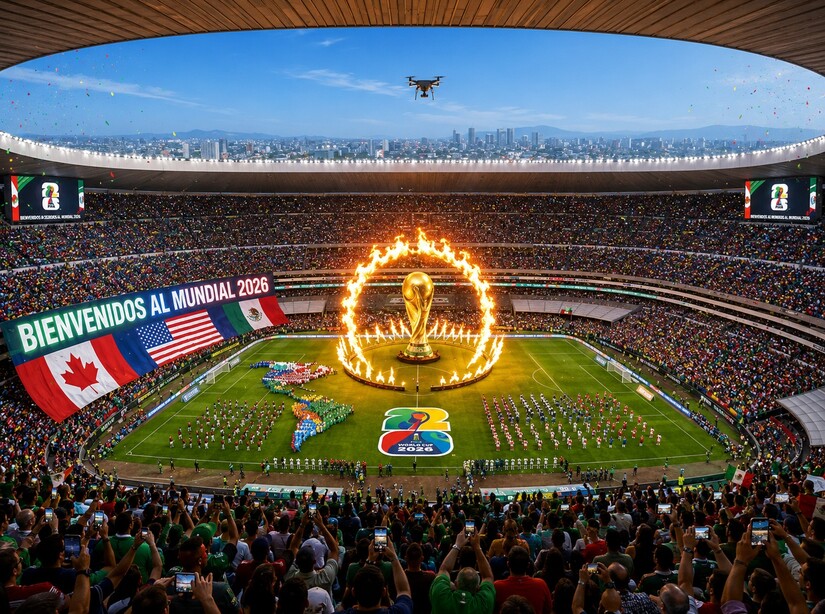
In Mexico City, tens of thousands of supporters will pour into Estadio Azteca, while millions more gather in homes, bars, public squares, and fan festivals stretching from North America to Africa, Europe, Asia, Oceania, and South America. The opening whistle will launch what is already the largest sporting event ever organized on the planet. But World Cup 2026 is more than the beginning of another tournament.
It is the beginning of a different map.
For the first time in history, 48 nations will participate in a FIFA World Cup. The expansion from 32 teams to 48 has added sixteen new places to football's most exclusive stage, transforming a tournament that once belonged primarily to a relatively small collection of established powers into something considerably broader, more representative, and more reflective of the modern world. This change is not simply administrative; it is historical.
For decades, qualification for the World Cup functioned as one of the most punishing achievements in international sport. Entire regions found themselves competing for a claustrophobic number of places, forcing talented national teams to eliminate one another long before the tournament itself began. Countries with burgeoning football cultures frequently discovered that reaching the World Cup required overcoming structural obstacles as much as competitive ones.
The 2026 expansion alters that reality. Asia's allocation nearly doubled. Africa received additional guaranteed places. North and Central America expanded their representation, and Oceania secured a direct qualification berth for the very first time. Across multiple continents, nations that had spent generations watching from the periphery suddenly found a viable pathway into the world's premier sporting event.
Predictably, the expansion has drawn sharp criticism. Purists argue that a 48-team field dilutes the pristine quality of the competition, warning of lopsided scorelines and a bloated group stage designed more for corporate revenue than sporting excellence. That debate will undoubtedly continue throughout the tournament, but it misses a fundamental truth: the expansion has permanently altered who gets to hold space on the global stage.
And participation matters.
For much of its history, the World Cup reflected the traditional geography of football power. Nations such as Brazil, Argentina, Germany, Italy, France, Spain, England, and the Netherlands became familiar fixtures. Their presence was entirely deserved, and their achievements shaped the very soul of the sport. Yet football's growth over the last generation has extended far beyond its traditional Eurocentric and South American centers.
Modern academies now operate in regions that once lacked basic elite infrastructure. International scouting networks reach countries previously overlooked by major clubs. Satellite television, digital media, and global player movement have accelerated football's development in places that, a generation ago, were largely absent from the international conversation. World Cup 2026 is the first tournament designed to fully acknowledge that transformation.
No nation illustrates this better than Uzbekistan. For decades, the White Wolves stood agonizingly on the doorstep of qualification, repeatedly coming within reach of football's biggest stage only to fall short in the cruelest of margins. Since achieving independence, the country invested heavily in youth development, domestic infrastructure, coaching education, and professional league competition. Those investments accumulated over time. The national team arriving in North America is not the product of a fortunate qualifying cycle; it is the result of a deliberate, long-term national project that gradually transformed raw potential into international achievement. When Uzbekistan appears at its first World Cup, the moment will represent far more than ninety minutes of football. It will symbolize the arrival of a footballing nation that spent decades building toward a goal once considered unattainable.
Jordan offers a similarly profound narrative. The Jordanian national team has long competed in one of the world's most challenging football regions, often overshadowed by larger neighbors with deeper resources and longer traditions of international success. Yet recent years have witnessed a remarkable growth in both tactical discipline and public fervor. The country's historic run to the AFC Asian Cup final demonstrated that Jordanian football had entered a mature phase, and qualification for the World Cup confirmed it. When Jordan takes the field in this tournament, millions of supporters across the Middle East will see something that previous generations never experienced: their own flag unfurled on football's biggest stage.
The same can be said for Cape Verde. With a population of roughly half a million people spread across an Atlantic archipelago off the coast of West Africa, Cape Verde has built one of the most remarkable, punching-above-its-weight football programs in the world. Drawing from both domestic talent and a deeply connected global diaspora, the Blue Sharks have consistently outperformed expectations for more than a decade. Their qualification stands as undeniable evidence that football success is no longer determined solely by population size, economic scale, or historical advantage. In an increasingly interconnected world, organization, investment, and vision can accomplish extraordinary things.
That reality may prove to be one of the defining themes of World Cup 2026. The tournament's expanded field includes nations making their first appearance, nations returning after lengthy absences, and nations representing regions that previously struggled to secure meaningful access to the competition. Together, they create a World Cup that looks, sounds, and feels noticeably different from those that came before it. The flags, the languages, the tactics, and the stories are entirely new, and that diversity may ultimately become the tournament's greatest strength.
The coming weeks will undoubtedly belong in part to the traditional powers. Argentina enters as defending champion, Brazil remains an enduring giant, and European heavyweights arrive carrying legitimate ambitions of lifting the trophy in July. The established elite are not disappearing, but they are no longer the only story.
World Cup 2026 arrives at a moment when the world's political, economic, cultural, and demographic centers of gravity are becoming increasingly dispersed. Influence is no longer concentrated in a handful of capitals, and opportunity is no longer confined to a narrow, protected circle. Football, perhaps more than any other cultural force, has become a mirror reflection of that reality. The expansion to 48 teams is not merely a larger tournament; it is an acknowledgment that the game has grown larger than the structures that once contained it.
Many of the new participants will not advance beyond the group stage. Some may struggle against more experienced opponents, and a few may leave without a single victory. Yet success should not be measured solely by standings.
The true significance of this moment lives elsewhere. It lives in the child watching wide-eyed from Tashkent. It lives in the family gathered around a television in Amman. It lives in the supporters filling the streets of Praia with song. For millions of people, seeing their players walk onto a World Cup pitch represents something larger than sport. It represents possibility.
As the first whistle sounds in Mexico City today, that may prove to be the most important story of all. The World Cup has always crowned champions. This year, it also welcomes new dreamers.
MinneapoliMedia | Community. Culture. Civic Life.



Sunny, with a high of 107 and low of 73 degrees. Sunny for the morning, cloudy overnight.