Image
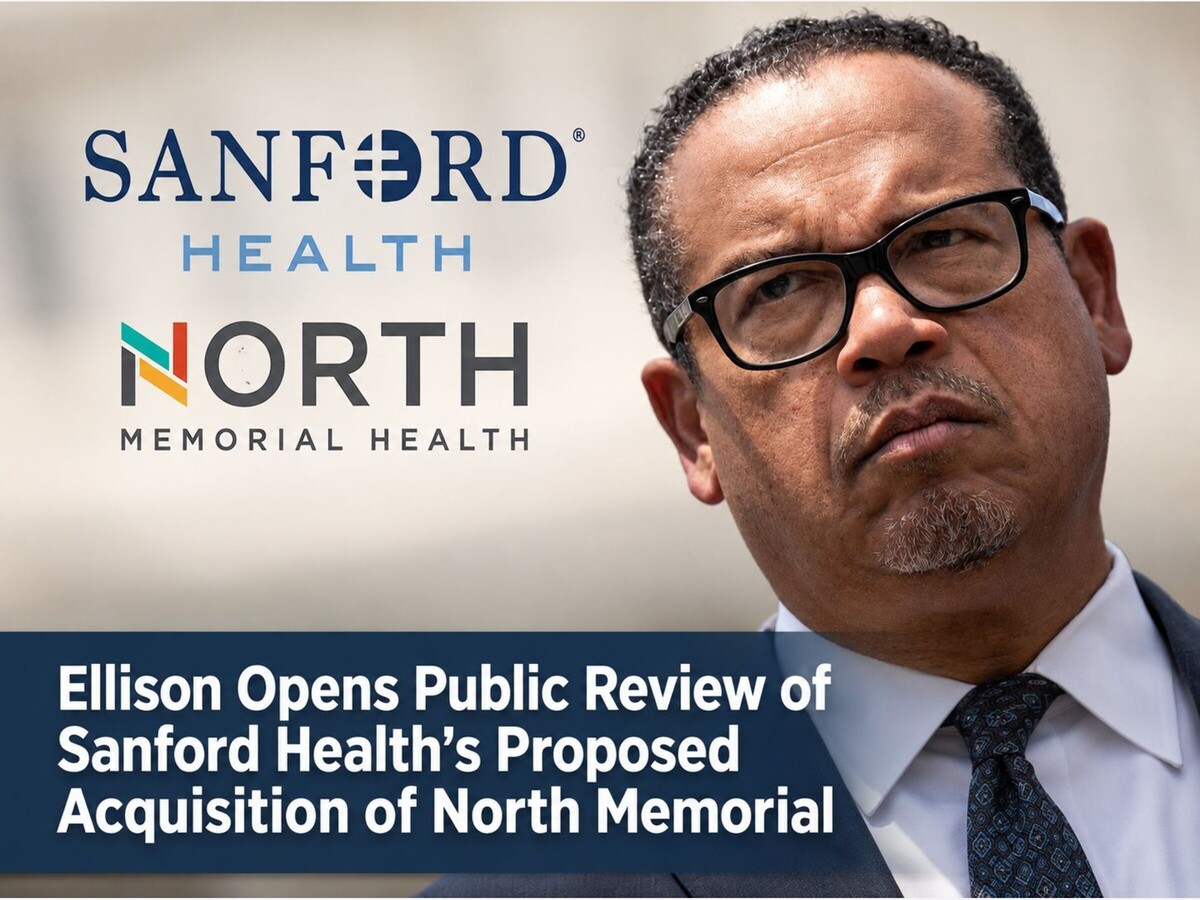



The Minnesota Attorney General's Office will host a public forum on Tuesday, July 7, from 6:00 p.m. to 8:00 p.m. at Fellowship Minneapolis in north Minneapolis as it continues its review of Sanford Health's proposed acquisition of North Memorial Health, a transaction that would reshape the ownership of one of the Twin Cities' largest independent nonprofit health systems.
The meeting represents the second of two public forums scheduled as part of the state's review process. Community members, patients, employees, health care professionals, labor organizations, and other stakeholders are encouraged to attend, ask questions, and provide comments before the Attorney General completes the evaluation.
The proposed affiliation was announced on May 8, when Sanford Health and North Memorial Health signed a letter of intent and affiliation agreement outlining plans for North Memorial to become part of the Sanford Health system.
If completed, North Memorial would continue to exist as a Minnesota nonprofit corporation while operating as a wholly owned subsidiary of Sanford Health. The organization would become Sanford's Twin Cities Region and maintain designated representation on Sanford's governing board.
The transaction would significantly expand Sanford Health's presence in Minnesota.
Headquartered in Sioux Falls, South Dakota, Sanford Health is among the nation's largest integrated nonprofit health systems, employing approximately 55,000 people and serving more than two million patients throughout South Dakota, North Dakota, Minnesota, Iowa, Wisconsin, Wyoming, and Michigan's Upper Peninsula. The organization also provides health insurance coverage to nearly 415,000 members and currently operates hospitals in Bemidji, Canby, Jackson, Luverne, Thief River Falls, and Worthington.
North Memorial Health has long occupied a unique position within Minnesota's health care landscape. The nonprofit system operates Robbinsdale Hospital, a Level I Trauma Center that serves patients from throughout the region, Maple Grove Hospital, more than 20 primary care, specialty care, and urgent care clinics, and one of Minnesota's largest medical transportation divisions. More than 6,500 employees care for approximately 55,000 patients each month.
Sanford Health has pledged to invest approximately $600 million if the transaction proceeds. According to the health systems, the investment would strengthen Robbinsdale Hospital, preserve its Level I Trauma Center, expand Maple Grove Hospital by approximately doubling its capacity, modernize facilities, and support long-term clinical growth across the Twin Cities.
Whether those promised benefits ultimately outweigh potential risks is now the central question before Minnesota regulators.
Unlike many business acquisitions, health care mergers in Minnesota undergo heightened public scrutiny because of their potential impact on patients and communities.
The Attorney General's Office is reviewing the transaction under Minnesota's Health Care Entity Transactions law, charitable trust laws, and state antitrust statutes. Working in consultation with the Minnesota Department of Health, the review examines how the proposed acquisition could affect patient access, affordability, competition, workforce stability, quality of care, and the availability of health care services throughout the state.
Although the Attorney General does not issue an administrative approval or denial, the office has authority to file suit to block a transaction if it concludes the proposal violates Minnesota law or is otherwise contrary to the public interest.
"As we have done and are currently doing with other health care transactions, we are conducting a thorough review of this potential acquisition to ensure it complies with the law and is in the public interest," Attorney General Keith Ellison said when announcing the review.
"Proposed health care consolidation requires careful examination. As long as I am Attorney General, I will use the full range of regulatory tools to protect Minnesotans' access to quality, affordable health care."
The Attorney General's Office has emphasized that community participation is an important part of that review.
Residents may submit comments through the online Community Input Form or by calling the Attorney General's Office at (651) 296-3353 in the Twin Cities metropolitan area or (800) 657-3787 elsewhere in Minnesota. Public submissions are generally treated as nonpublic data under the Minnesota Government Data Practices Act.
Key staff from the Attorney General's Office, along with representatives from Sanford Health and North Memorial Health, are expected to attend the July 7 public forum. Attorney General Ellison will not attend because of a previously scheduled commitment.
The proposed acquisition arrives during a period of accelerating consolidation across the American health care industry, where rising labor costs, inflation, aging infrastructure, reimbursement pressures, and physician shortages have prompted many nonprofit health systems to seek larger regional partners.
Supporters argue that partnerships such as the Sanford-North Memorial proposal provide financial stability, preserve essential services, improve access to specialty care, and generate the capital needed to modernize aging hospitals that independent systems increasingly struggle to finance alone.
Critics, however, caution that health care consolidation has often produced mixed results nationally. Researchers have found that hospital mergers can reduce competition, increase prices, weaken local governance, narrow patient choice, and place additional pressure on health care workers. Labor organizations, including the Minnesota Nurses Association, have already voiced concerns that the proposed acquisition could affect staffing levels, patient care, and community accountability.
For residents across North Minneapolis, Robbinsdale, Maple Grove, and much of the northwest metropolitan area, the outcome carries particular significance. North Memorial's hospitals, trauma services, ambulance operations, birth center, primary care network, and specialty clinics serve as critical components of the region's emergency and everyday health care infrastructure.
Whether Sanford's proposed investment ultimately strengthens that system while preserving affordability, competition, and local accountability is the question Minnesota regulators now face. Over the coming weeks, state officials will weigh financial commitments against potential long-term consequences before determining whether the transaction complies with Minnesota law and serves the broader public interest.
The public forum will be held Tuesday, July 7, from 6:00 p.m. to 8:00 p.m. at Fellowship Minneapolis, 3333 N. 4th Street, Minneapolis, Minnesota 55412. Registration is requested for those planning to attend or provide comments.
MinneapoliMedia | Community. Culture. Civic Life.

Sunny, with a high of 93 and low of 67 degrees. Sunny in the morning, clear overnight.