Image





There is a moment in almost every remarkable life when the path ahead exists only in imagination. No awards have been won. No company has been founded. No recognition has arrived. No one outside a small circle of family and friends knows the person's name. Yet something inside quietly insists that life can become larger than present circumstances.
For Damaris Melo-Gyasi, that journey began thousands of miles from Minnesota, in São Paulo, Brazil, long before anyone would associate her name with award-winning architecture, community-centered design, or one of the state's most respected emerging architectural firms. Before there was Design by Melo, there was simply a young girl learning how to observe the world. That instinct to observe would become one of the defining characteristics of her life.
Today, people often describe Melo-Gyasi by her accomplishments. She is an architect, an entrepreneur, a founder, a community designer, and an advocate for equitable development. She is an immigrant whose work has helped reshape conversations around affordable housing and public space across Minnesota.
Those descriptions are accurate, but they are also incomplete. Spend time listening to her speak, and another picture begins to emerge. She rarely begins with herself. She almost never leads with professional accomplishments. Instead, she talks about people: communities, families, children, neighbors, and belonging. It is an approach that reveals something important about both the architect and the woman behind the profession. For Melo-Gyasi, success has never been measured solely by what she builds; it is measured by what her work allows other people to become.
That philosophy did not develop inside an architecture studio. It began much earlier.
Growing up in São Paulo meant growing up inside one of the world's largest and most dynamic cities, a place of extraordinary opportunity, remarkable creativity, and profound social contrasts. Like many large urban centers, São Paulo presents daily reminders that the places people inhabit often shape the opportunities available to them. Long before she understood the language of urban planning or architectural theory, she understood that environments influence lives.
Her family provided the foundation upon which everything else would eventually rest. Melo-Gyasi speaks with deep appreciation about the values instilled in her from an early age. Education mattered. Character mattered. Faith mattered. Hard work was expected. Resilience was not treated as an extraordinary quality but as a necessary part of daily life. Those lessons would prove invaluable. Years later, when professional obstacles emerged, they would serve as anchors rather than abstract memories.
Many successful professionals speak about confidence as though it arrives fully formed. Melo-Gyasi's story suggests something different. Confidence grows. It is built: sometimes slowly, sometimes painfully, and often one decision at a time. That gradual construction of confidence would become one of the recurring themes throughout her journey.
As a young woman, architecture appealed to her not simply because it combined creativity with technical precision. It appealed because it offered the possibility of improving people's lives in tangible ways. Buildings are permanent. Neighborhoods shape generations. Cities influence how people experience opportunity, safety, education, commerce, recreation, and community. Architecture offered an unusual intersection between creativity and service. It was a profession capable of leaving visible marks on society.
But dreams often become more complicated once they encounter reality. Leaving Brazil required far more than changing addresses; it required rebuilding life itself.
Immigration is frequently described through logistics: passports, visas, employment, and housing. Those realities matter, yet beneath every logistical transition lies a quieter emotional one. Identity must also be rebuilt. Professional confidence must be rebuilt. Community must be rebuilt. For many immigrants, familiar reference points disappear almost overnight. Language changes. Customs change. Professional expectations change. Even accomplishments earned elsewhere sometimes require new validation.
Melo-Gyasi experienced that reconstruction firsthand. The United States offered opportunity, but it also demanded adaptation. Architecture, despite its universal principles, remains deeply connected to local practice. Building codes differ. Regulations differ. Professional expectations differ. Client relationships differ. Learning architecture again in a different country required humility as much as intelligence. Rather than resisting that process, Melo-Gyasi embraced it.
Looking back today, those experiences appear to have expanded rather than narrowed her understanding of people. Living between cultures developed a sensitivity that would later define her design philosophy. Different people experience the same spaces differently. Different communities carry different histories. Different neighborhoods remember different stories. Good architecture cannot assume every community needs the same solution.
That realization eventually became one of the cornerstones of Design by Melo. Before that firm existed, however, there were years of learning.
Like many architects beginning their careers, Melo-Gyasi worked inside larger firms, gaining experience while developing technical expertise. The work was valuable and the projects were important, yet something continued to unsettle her. She began noticing who architecture most frequently served. Too often, investment flowed toward communities already receiving investment. Beautiful buildings appeared where resources already existed. Meanwhile, many neighborhoods facing the greatest challenges continued receiving the least thoughtful design.
The contradiction became increasingly difficult to ignore. She found herself asking questions that reached beyond architecture itself: Who decides what beauty looks like? Who decides which neighborhoods deserve investment? Who decides whose daily experiences matter?
Those questions were not simply professional; they were deeply personal, because every answer carried consequences for real people.
At the same time, another chapter of her life was unfolding: motherhood. Melo-Gyasi never presents motherhood as something separate from leadership or entrepreneurship. Instead, it became part of the same story. Responsibility expanded. Perspective expanded. Purpose expanded. Becoming a mother sharpened her understanding of what families need from the environments they inhabit. Safety became more than a design principle; it became something deeply lived. Opportunity became more than a policy discussion; it became something every parent quietly hopes their child will encounter.
Those experiences would later influence countless design decisions. Years afterward, when speaking with mothers during community engagement meetings, she would discover an immediate connection. Parents, regardless of background, often begin with similar hopes. They want their children safe. They want them to be healthy. They want them surrounded by opportunity. Architecture alone cannot accomplish those goals, but architecture can either support them or quietly undermine them.
That understanding continued growing inside her long before she launched her own firm. Starting Design by Melo eventually became both a professional decision and an act of faith. Entrepreneurship rarely arrives at a convenient moment. There is almost never complete certainty. There is rarely perfect financial security. There are always reasons to wait. Yet waiting would have required ignoring something she increasingly believed: she had something different to contribute. Not because she possessed different technical skills than every other architect, but because she saw communities through experiences that many others had never lived. That perspective mattered. It still does.
When asked about the concept of calling, her answer revealed perhaps the deepest layer of her journey. She recalls a definition describing calling as the work a person would continue doing even if no one paid them, the work that continually returns to the heart, the work impossible to abandon. For Melo-Gyasi, the answer arrived with unusual clarity: design, architecture, creating spaces, and improving lives through the built environment.
Yet even then, another question followed: If architecture truly was her calling, whom was it supposed to serve? That question would shape every chapter that followed, ultimately transforming not only her career but also communities across Minnesota.

Every entrepreneur eventually reaches a moment when experience alone is no longer enough. There comes a point when the spreadsheets cannot guarantee success, professional credentials cannot eliminate uncertainty, and careful planning cannot answer every question. The decision becomes less about certainty and more about conviction.
For Damaris Melo-Gyasi, founding Design by Melo was one of those moments. By then, she had established herself professionally. She understood architecture, had worked on significant projects, and had earned the confidence of colleagues. From the outside, remaining within an established firm would have appeared to be the safer path. Yet the more experience she gained, the more she recognized a growing disconnect between the kind of architect she wanted to become and the work she was being asked to do.
It was not dissatisfaction with architecture itself; quite the opposite. She had become convinced that architecture possessed far greater potential than many projects allowed it to express. The profession had taught her how to design buildings; life was teaching her why those buildings mattered.
Melo-Gyasi does not romanticize entrepreneurship. She speaks honestly about the uncertainty that accompanied starting her own practice. Building a business meant accepting risk. It meant leaving behind the predictability of a paycheck. It meant becoming responsible not only for design decisions but also for payroll, contracts, client relationships, marketing, finances, staffing, and every other responsibility that accompanies ownership. For a mother, those risks carry additional weight. Entrepreneurship is rarely an individual decision; it becomes a family decision. Every uncertainty extends beyond the founder.
Throughout her transition, however, one theme surfaced repeatedly whenever she reflected on difficult moments: faith. Not faith as a slogan, but faith as practice and faith as discipline. It is the quiet willingness to continue moving forward before every answer has arrived.
She describes periods when logic suggested remaining where she was. The established path appeared safer, and the future seemed more predictable. Yet something continued pulling her toward a different future. She believed there was work she had not yet been allowed to do, communities she had not yet been allowed to serve, and conversations she had not yet been invited to lead.
Design by Melo became the vehicle through which those possibilities could finally become reality. In many ways, the company was born less from ambition than from purpose. That distinction matters. Ambition often asks, How far can I go? Purpose asks, Who can I help if I go?
Purpose consistently outweighed prestige. She was not interested in creating architecture that merely looked impressive; she wanted architecture that improved lives. That aspiration sounds simple until one considers the realities of practice. Architects answer to clients. Clients answer to budgets. Budgets answer to lenders. Projects answer to timelines. Within that chain of decisions, opportunities to advocate for communities can become surprisingly limited.
Yet Melo-Gyasi discovered that influence often begins with asking better questions: questions about dignity, questions about belonging, and questions about how people actually experience the places architects create. Those questions gradually became part of her firm's identity. Clients who valued community engagement found their way to Design by Melo. Organizations seeking more collaborative approaches to development found an architect willing to spend time listening before designing.
The reputation did not emerge overnight. It grew project by project, conversation by conversation, and trust by trust. One quality repeatedly distinguishes Melo-Gyasi from many professionals who speak about community engagement: she never describes listening as public relations; she describes it as design work.
That perspective fundamentally changes the architect's role. Community meetings cease becoming obligations and become sources of information. Residents cease becoming audiences and become collaborators. The architect ceases becoming the person with every answer; she becomes the person responsible for translating many different answers into one coherent place.
That translation, she admits, is difficult. Communities rarely speak with one voice. Parents prioritize one concern, business owners another, young people another, developers another, neighborhood organizations another, government agencies another, and funders another. None of those perspectives are automatically wrong, neither are they automatically compatible. The architect's responsibility becomes one of careful interpretation.
"It is messy," she notes, laughing softly when describing this process. She does not attempt to disguise the complexity. Large community engagement efforts often involve dozens of participants, sometimes hundreds. Everyone arrives carrying legitimate hopes, and everyone leaves without receiving everything they wanted. Success, she explained, does not mean unanimous agreement. It means honest participation. It means communities recognizing themselves in the finished work. It means hearing enough voices that the building belongs to many people rather than reflecting only one vision.
That philosophy reflects something much larger than architecture: it reflects leadership. Melo-Gyasi consistently returns to humility. Leadership, in her view, is not measured by visibility; it is measured by responsibility. Sometimes leadership requires speaking, other times it requires listening. Sometimes it means directing, other times it means stepping aside so someone else's experience can shape the conversation.
"I don't have to be the smartest person in the room," she suggests through both her words and her practice. "I have to help the room become smarter."
That perspective has quietly shaped Design by Melo into something more than an architectural practice. It has become a firm whose identity is inseparable from its values. Those values become especially visible in the kinds of projects the firm chooses to pursue: affordable housing, community centers, youth facilities, neighborhood investments, and public-serving developments.
These are not always the projects associated with prestige inside architecture. They are often the projects requiring the greatest patience, the greatest collaboration, and the greatest willingness to balance competing priorities. They are also the projects capable of producing some of the greatest social impact. For Melo-Gyasi, that combination appears intentional.
Architecture was no longer simply professional practice; it became service. That realization also answered an earlier question she had carried for years: How could architecture serve people who had historically received less thoughtful investment? How could beautiful design become something communities experienced rather than merely admired from a distance? How could buildings communicate welcome instead of exclusion?
Those questions would soon find their most visible expression in projects like Opportunity Crossing. But before the awards, before statewide recognition, and before being named Architect of the Year, there was simply one woman choosing faith over certainty, one architect choosing purpose over comfort, and one entrepreneur deciding that the safest path was no longer the most faithful one.
The buildings would come later. First came the decision to believe they were possible.
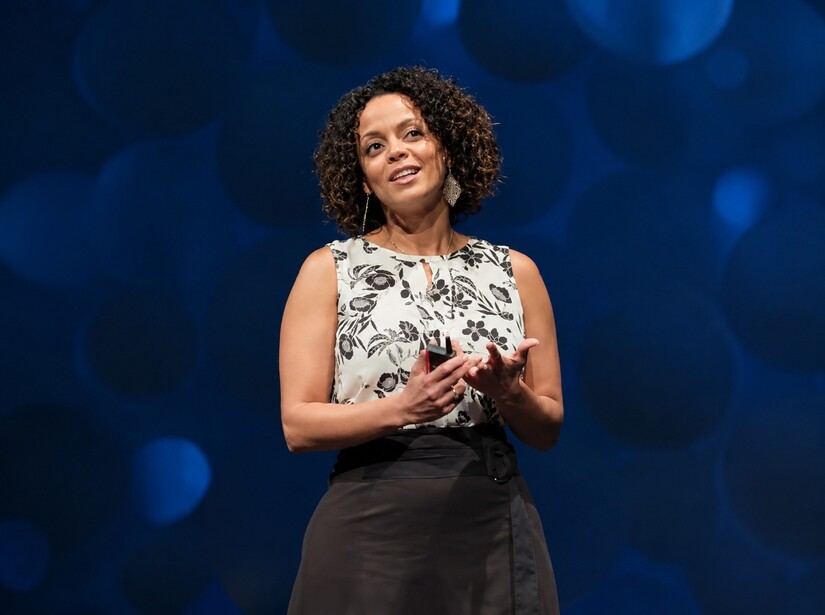
Success has a way of simplifying people's stories. Awards appear in biographies. Completed projects fill résumés. Magazine profiles list accomplishments. Organizations celebrate milestones. From a distance, achievement can appear almost inevitable.
Spend an hour with Damaris Melo-Gyasi, however, and a different picture begins to emerge. She speaks very little about success; she speaks constantly about responsibility. That distinction may be the clearest window into who she has become. Leadership, for Melo-Gyasi, is not primarily about influence; it is about stewardship.
She has reached a point in her career where she leads projects worth tens of millions of dollars. She works alongside nonprofit organizations, public agencies, developers, neighborhood groups, and community leaders, carrying responsibilities that affect thousands of lives. Yet when asked how leadership has changed for her, she did not describe increased authority; she described increased weight.
"I think leadership is quite a humbling thing," she reflected.
Earlier in her career, leadership felt like recognition. It meant being selected, promoted, trusted, or invited into larger responsibilities. Like many professionals, she initially associated leadership with titles and visible positions. Experience changed that understanding. Today she views leadership less as a position and more as a daily discipline.
Some days leadership requires making difficult decisions. Other days it requires asking better questions. Sometimes it means standing in front, other times it means intentionally stepping behind someone else and allowing their voice to shape the direction of the work. Leadership, she believes, is never static because people are never static. Every project introduces different personalities. Every neighborhood carries different histories. Every client arrives with different priorities. Every community deserves to be understood on its own terms.
That philosophy explains why Melo-Gyasi resists the temptation to become the central figure in her own work. Many architects become known for recognizable styles. A building is completed, and someone immediately says, "That looks like one of theirs." Melo-Gyasi hopes people never say that about her work.
At first, that answer seems surprising. Most designers spend careers developing a signature; she deliberately avoids one.
"I don't want people to look at a building and immediately know it is mine," she explains. Instead, she wants people to recognize the community. She wants a neighborhood to see itself reflected in its own buildings. She wants families to recognize their own aspirations, young people to feel ownership, elders to feel respected, and culture to remain visible.
In many ways, she is attempting something unusual in architecture. She is trying to remove herself from the center of her own success. The building should not become a monument to the architect; it should become an expression of the people who will live with it long after the architect has gone. That approach requires an unusual degree of humility. It also requires confidence. Only someone secure in her own identity can willingly surrender the spotlight to others.
Throughout her work, Melo-Gyasi repeatedly describes herself as a translator. Communities speak; architects translate. Residents describe experiences; architects convert those experiences into space. Parents describe fears; architects convert those fears into safer environments. Children describe dreams; architects search for ways to build places where those dreams can grow.
Translation, however, is impossible without listening. Listening may be the most underestimated leadership skill in her profession. Architects receive years of technical education. They learn structures, materials, codes, accessibility standards, environmental systems, and construction administration. Few receive formal instruction in how to earn the trust of a neighborhood. Yet Melo-Gyasi increasingly sees trust as one of the profession's most valuable building materials. Without trust, community engagement becomes performance; with trust, it becomes partnership.
That distinction surfaced repeatedly as she described working with youth. One might assume that a shared racial identity automatically creates connection, but her experience taught something different. Young people often viewed her first through the lens of authority. She was an accomplished architect, a professional, an adult, and someone successful. Those identities sometimes created distance rather than closeness.
She realized she needed help. Instead of insisting on leading every conversation herself, she partnered with youth workers who already possessed authentic relationships. She sat back, observed, and listened. The young people eventually revealed what no survey could have captured: how they joked, how they interacted, how they imagined their spaces, and how they actually lived.
The experience reinforced an important lesson: representation is not simply about who is sitting at the table; it is about who feels comfortable enough to speak honestly once they arrive. That insight extends well beyond architecture. It speaks to leadership itself. Leaders do not merely create opportunities to speak; they create environments where people believe their voices matter.
Perhaps nowhere is that philosophy more visible than in the way Melo-Gyasi talks about dignity. She returns to that word repeatedly: dignity. Not luxury, not prestige, and not status, but dignity. The distinction is significant. Luxury depends on resources; dignity should not.
She refuses to believe that beautiful design should become a privilege reserved only for wealthier communities. She refuses to accept that affordable housing should receive lower expectations simply because budgets are tighter. She refuses to accept that neighborhoods with fewer financial resources deserve less thoughtful architecture.
Those convictions are not political slogans for her; they are professional obligations. When she describes refusing to design bedrooms without windows in affordable housing developments, she is not making an aesthetic argument; she is making a moral one. Natural light becomes more than a design element; it becomes a statement about human worth.
The same philosophy appears in smaller details: community rooms, playgrounds, foot-washing stations, public art, and ownership opportunities for neighborhood entrepreneurs. Each decision communicates something. Every building tells residents whether they were considered, whether they were expected, and whether they belong.
Listening to Melo-Gyasi explain these ideas, it becomes increasingly difficult to separate architecture from humanity. One begins to understand why her work resonates so deeply with nonprofit organizations, community leaders, and residents alike. She is not simply designing buildings; she is asking what those buildings say about the people who inhabit them. That question may ultimately explain why she has become one of Minnesota's most respected emerging voices in community-centered design.
It also explains why her story belongs in this retrospective of leadership. This narrative exists to understand the deeper forces that shape extraordinary lives. What gives someone the courage to leave one country and begin again in another? What convinces a young mother to exchange professional certainty for entrepreneurial uncertainty? What sustains a leader when recognition has not yet arrived? What transforms technical skill into meaningful service?
In Melo-Gyasi's case, the answer cannot be reduced to a single quality. It is faith, resilience, curiosity, humility, discipline, and a profound love for community. Above all else, it is the quiet conviction that every person deserves to feel honored by the places they call home.
Long before Minnesota recognized Damaris Melo-Gyasi as an award-winning architect, she had already become something far more enduring. She had become a woman whose success would always be measured not by how many buildings carried her name, but by how many people walked into those buildings believing they mattered. That may be the most powerful architecture of all.

For all the buildings Damaris Melo-Gyasi has designed, the legacy she hopes to leave has surprisingly little to do with architecture alone. Ask her what she wants people to remember decades from now, and she does not begin by listing projects, awards, or professional milestones. She speaks instead about people.
She wants communities to know they were seen. She wants families to know they mattered. She wants young architects, especially those who may never have imagined themselves entering the profession, to understand that there is room for them too.
That perspective has become one of the defining characteristics of her leadership. Melo-Gyasi never separated professional achievement from personal responsibility; one existed because of the other. Every opportunity carried an obligation. Every accomplishment created another opportunity to open a door for someone else. It is a philosophy shaped as much by gratitude as ambition.
She knows what it means to begin again. She knows what it feels like to learn a profession inside a new country. She knows the quiet uncertainty of wondering whether there will be space for someone with her background, her accent, her perspective, and her experiences. Rather than allowing those memories to become sources of resentment, she has transformed them into sources of empathy.
That empathy now reaches far beyond architecture. She often returns to the importance of creating pathways for others. She wants more young people to discover architecture as a profession, she wants the field to become more accessible, and she wants future architects to come from neighborhoods that historically have not seen themselves represented inside design studios or executive boardrooms. She wants diversity not because it satisfies a statistic, but because different lives produce different questions. Different questions, in turn, produce better buildings. She believes communities deserve that richness of perspective.
It is difficult to spend time with Melo-Gyasi without recognizing that education also occupies a central place in her thinking. Teaching may not appear in her job title, but it is woven into the way she explains architecture. She rarely answers a question with technical language alone. Instead, she invites people into the profession. She explains, she illustrates, and she makes architecture understandable. That generosity reflects a leader who understands that knowledge becomes more valuable when it is shared. It also explains why conversations with her often feel less like interviews and more like thoughtful discussions about how society functions.
Architecture simply becomes the doorway into much larger ideas: ideas about equity, opportunity, family, neighborhoods, and hope.
Those themes naturally carried her beyond architecture and into authorship. During recent reflections on her expanding career, the discussion shifted away from buildings and toward a new chapter in her life: she had recently published a book.
When asked where readers could find the book, she mentioned that it was available online, but then she enthusiastically encouraged a visit to Black Garnet Books instead. She wanted readers to support a local, independent bookstore. It was a simple, community-first recommendation. Then she smiled and added something completely unexpected: she had designed the bookstore.
The moment perfectly captured the interconnected nature of her life. Readers could purchase a book written by Damaris Melo-Gyasi while standing inside a space designed by Damaris Melo-Gyasi. The architect, the author, the entrepreneur, the community advocate, the immigrant, the mother, and the leader were all meeting inside the same room.
There was something quietly symbolic about that moment, not because it had been engineered that way, but because it reflected the absolute consistency of her life's work. Whether she is writing, designing, mentoring, speaking, or listening, the underlying purpose remains remarkably similar: create spaces where people can flourish. Sometimes those spaces are physical, sometimes they are intellectual, sometimes they are emotional, and sometimes they are opportunities. All of them begin with the same question: How can another person's life become better because I was here?
That question may ultimately explain why Melo-Gyasi's work resonates so deeply. She has never viewed architecture as an isolated profession; she sees it as part of a much larger ecosystem of community building. Buildings influence families, families influence neighborhoods, neighborhoods influence cities, cities influence opportunity, and opportunity influences generations. When viewed through that lens, every design decision becomes an investment in the future.
Throughout her journey, one quality remained remarkably consistent: gratitude. Melo-Gyasi speaks with gratitude about the people who invested in her, the colleagues who trusted her, the clients who believed in her, the communities who welcomed her, and the organizations willing to try something different. She rarely presents success as an individual achievement. Instead, she speaks about collaboration, partnership, and shared responsibility.
Perhaps that explains why Opportunity Crossing became such a defining project in her career. It represented much more than a successful building; it represented what becomes possible when architects, nonprofit organizations, community members, artists, entrepreneurs, residents, lenders, public officials, and neighborhood advocates choose to work toward the same goal. This collaborative spirit has become one of the structural signatures of Design by Melo.
Ironically, it is also why Melo-Gyasi resists the idea of having a signature architectural style. She does not want buildings that immediately announce her authorship; she wants buildings that announce their communities. That may sound like a subtle distinction, but it is not. Many professions encourage individuals to build personal brands; Melo-Gyasi appears more interested in building community identity. In an era increasingly focused on individual recognition, there is something refreshingly different about that perspective.
It also provides a fitting conclusion to her story. Documenting a life like this is never intended to be a mere collection of biographical dates; its purpose is to record a legacy that illuminates larger truths about leadership, courage, service, and impact. These are stories that deserve to be preserved, not simply because a subject achieved success, but because of how they achieved it.
Damaris Melo-Gyasi embodies that purpose. Her story is certainly about architecture, but it is equally about immigration, motherhood, entrepreneurship, faith, and resilience. It is about choosing courage when certainty is unavailable, believing that beautiful spaces should never become the exclusive privilege of a fortunate few, and insisting that dignity belongs to everyone.
There is a temptation when writing profiles of accomplished people to conclude with a tally of awards, titles, or public recognition. Melo-Gyasi has earned all of those, yet none of them fully explain why her story matters. Her story matters because it reminds us that leadership is not measured only by the structures we leave behind; it is measured by the people those structures continue serving long after we are gone.

Years from now, thousands of people will live, work, gather, worship, learn, celebrate, and raise families inside spaces touched by Damaris Melo-Gyasi's vision. Many of them will never know her name. They will not know the meetings she attended, the difficult conversations she navigated, or the compromises she refused to make. They will simply experience places that feel welcoming, places that feel thoughtful, and places that quietly communicate, "You belong here."
Perhaps that is the highest compliment any architect could hope to receive. Because long before Damaris Melo-Gyasi became known for designing buildings, she first built a life defined by courage, conviction, compassion, and purpose. Everything else grew from that foundation. That is her legacy, and that is the quiet power she continues to leave behind, one community, one conversation, and one carefully designed space at a time.
MinneapoliMedia | Community. Culture. Civic Life.

Sunny, with a high of 93 and low of 67 degrees. Sunny in the morning, clear overnight.