Image




Day 33 served as the absolute tactical boundary between elite preparation and elimination. France and Spain completed their final closed training sessions in North Texas, optimizing their positional structures before Tuesday’s opening block at Dallas Stadium. Concurrently, England and Argentina spent their remaining hours of stasis managing the severe physical consequences of their grueling extra-time quarterfinal victories ahead of Wednesday’s high-stakes meeting in Atlanta.
The pause carried a hyper-focused character radically distinct from the broad group permutations of the opening month. Forty-eight competing operations have been systematically reduced to an elite four, leaving zero mathematical margin for error or peripheral wildcard calculations. Every major international storyline now points directly toward two monumental single-elimination fixtures. France and Spain will lock horns first in Arlington, followed twenty-four hours later by England and defending world champion Argentina at Atlanta Stadium.
The opening semifinal offers a classic collision between the tournament’s most lethal transition matrix and its most sophisticated possession geometry. France arrives entirely unbeaten, leveraging the vertical acceleration of Kylian Mbappé and Ousmane Dembélé, while Spain counters with extraordinary positional patience and a spectacular string of late knockout interventions from midfielder Mikel Merino.
The second block renews one of international soccer’s most emotionally charged and multi-generational rivalries. England reached the final four via Jude Bellingham’s sensational extra-time brace against Norway, while Argentina survived an exhaustive tactical duel against Switzerland, breaking a ten-man low block deep in the additional period via late strikes from Julián Álvarez and Lautaro Martínez.
Away from the intense tactical camps in the United States, Norway’s national program returned home to one of the largest public celebrations in Scandinavian sporting history. More than 100,000 supporters packed central Oslo for an open-top bus parade, royal tribute, and national festival dedicated to a roster that had stunned five-time world champion Brazil and marched to the final eight before bowing out in extra time. While the stadiums remained briefly silent, the emotional and strategic architecture of the tournament continues moving toward its ultimate conclusion.
|
Match |
Fixture |
Venue |
Kickoff (PST) |
Broadcast |
|
Semifinal 1 |
France vs. Spain |
Dallas Stadium, Arlington, TX |
12:00 PM |
FOX / FOX One |
|
Semifinal 2 |
England vs. Argentina |
Atlanta Stadium, Atlanta, GA |
12:00 PM |
FOX / FOX One |
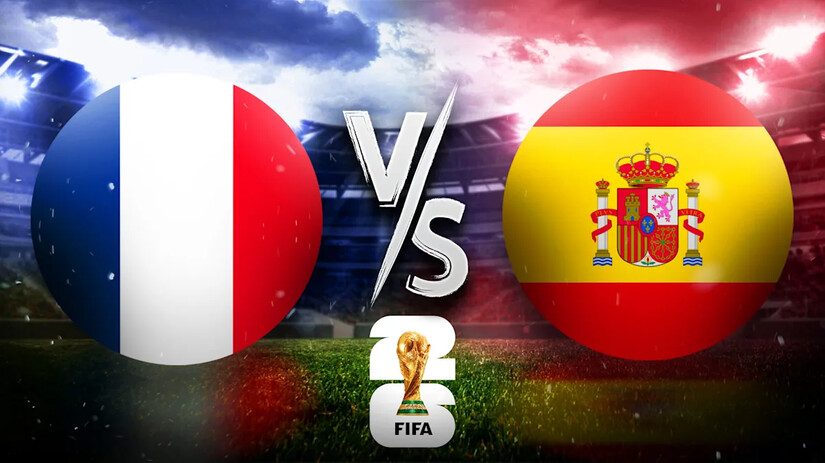
The immediate focus of the international media desk centered on North Texas, where France and Spain finalized their competitive game plans before the opening semifinal kickoff. Neither European giant reached the final four through an identical operational route. France has combined disciplined defensive stasis with explosive horizontal power, topping its group before dispatching Sweden, Paraguay, and Morocco with a professional 2-0 quarterfinal display. Les Bleus remain completely unbeaten, racking up sixteen total goals entering the semifinal phase.
Spain has relied far more heavily upon positional dominance, patient short-passing manipulation, and late-game emotional composure. Luis de la Fuente’s team eliminated Portugal via Merino’s stoppage-time strike before the Real Sociedad midfielder executed an identical late match-winner against Belgium in the quarterfinals.
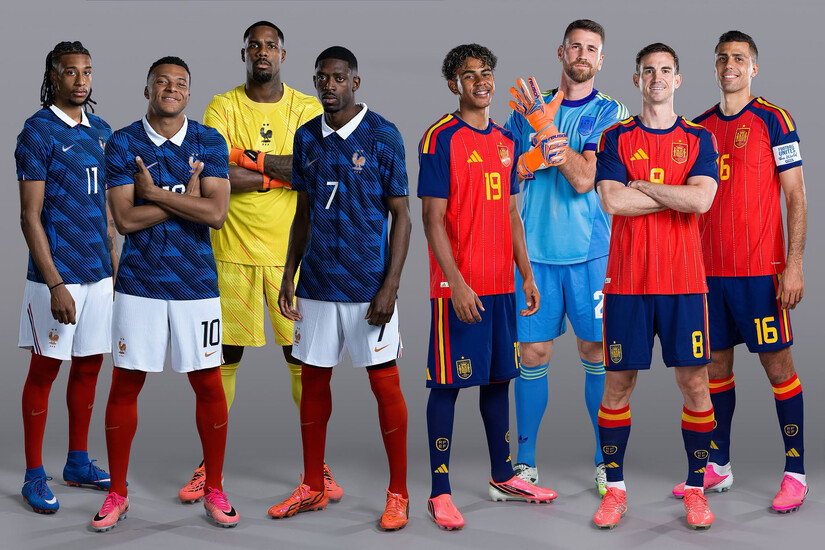
The meeting presents an absolute clash of philosophies. Spain will attempt to dictate match tempo through Rodri, Pedri, and Fabián Ruiz, using short interior triangles to shift France's defensive lines laterally. Teenage phenom Lamine Yamal and Nico Williams provide dynamic width, individual isolation tools, and the explosive acceleration required to attack fullbacks once Spain’s midfield recycling creates a numeric overload out wide.
Deschamps’ team is perfectly comfortable surrendering raw ball possession metrics. France possesses the vertical pace to instantly punish the smallest spatial tracking error. Mbappé operates as the principal threat, but France’s danger extends across a multi-faceted front line; Dembélé can unpick either flank, while the French double pivot has repeatedly demonstrated the capacity to regain possession and release vertical balls before opposing defenses can establish low-block stasis.
The semifinal may therefore be decided entirely by the location of mid-block turnovers. If Spain yields the ball while its fullbacks are advanced, France can immediately exploit the vacant corridors. If France sits too deep for too long, Spain will establish the crushing lateral pressure that eventually disintegrated Belgium. France's medical staff confirmed that Mbappé has completed full rehabilitation for a minor ankle issue, guaranteeing the captain will start at full fitness. Spain enters the match with zero reporting absences, allowing de la Fuente to preserve his preferred technical lineup.
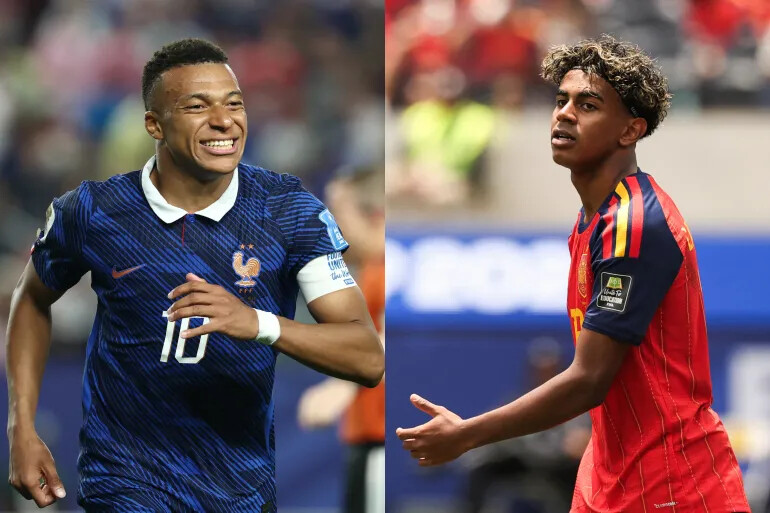
The most critical individual tactical battle will involve Mbappé and Spain’s central defensive pairing. Spain's possession structure depends heavily upon maintaining a highly compact field. The central defenders routinely advance toward the center circle to keep the vertical lines connected and compress the operating space available to the opposition immediately after a turnover.
While this aggressive posture supports Spain’s front-line counterpress, it simultaneously introduces catastrophic structural risk. Mbappé requires only a microscopic passing lane and a sliver of open grass to transform a routine mid-block interception into a direct, point-blank look on goal. Spain must therefore control not only France’s central passing strings but the absolute quality of the French transitional release the moment ball retention is broken.
The Spanish fullbacks cannot afford to retreat prematurely, because conceding early territory would disconnect them from the midfield pivots and undermine the structural compression that makes Spain effective. Conversely, they cannot remain recklessly high, because France will intentionally trigger early long balls behind them. Rodri’s positioning remains the definitive variable: his primary responsibility involves controlling Spain’s horizontal recycling rhythm, while his secondary function will require him to physically obstruct France from launching direct counterattacks through the center circle.
France faces a corresponding structural dilemma out wide. Spain’s wide attackers can ruthlessly punish a narrow defensive shape. If France allocates excessive resources toward protecting the central channel, Yamal and Williams will receive the ball in high-floor one-on-one isolation duels. If the French fullbacks defend too aggressively toward the touchline, spaces will instantly open for Dani Olmo or a late-arriving interior midfielder. The semifinal will therefore require constant defensive compromise, where every micro-adjustment designed to neutralize one threat inevitably exposes another.
Salvadoran referee Iván Barton has been formally appointed by FIFA's technical committee to oversee the France-Spain blockbuster, becoming the first official from El Salvador selected to lead a men’s World Cup semifinal. Barton will be assisted on the lines by David Moran of El Salvador and Antonio Pupiro of Nicaragua, with Swedish referee Glenn Nyberg designated as the Fourth Official.
The structural appointment generated immense discussion across global football circles due to Barton's previous controversial calls during the tournament phase, including his high-profile dismissal of Miguel Almirón during Paraguay’s group-stage match. FIFA has nevertheless entrusted Barton with the most important assignment of his modern career.
The institutional pressure surrounding the officiating crew will be immense. The knockout rounds have already been heavily governed by formal administrative complaints, prolonged VAR monitor reviews, disallowed tracking goals, and volatile public debate concerning the baseline consistency of video interventions. With a place in the World Cup Final hanging in the balance, every penalty appeal, marginal offside trace, disciplinary caution, and video review will receive exhaustive global examination.
While France and Spain finalized immediate match strategies, England and Argentina remained one day farther from competition, focusing their internal resources entirely on physical rehabilitation. Both operations absorbed immense cardiovascular loads during Saturday's quarterfinals, requiring a full 120-minute extra-time block to secure passage forward. England defeated Norway 2-1 after Bellingham secured his late double, while Argentina eliminated Switzerland 3-1 after Álvarez finally unpicked the ten-man Swiss low block in the 112th minute.
The extended matches significantly increased the physical workload for both remaining rosters, severely compressing the medical staff's timetable. England midfielder Declan Rice emerged as a primary fitness anxiety after battling an acute mid-week illness that forced his early removal during the quarterfinals. By Monday evening, Rice was reportedly showing excellent recovery metrics and is fully expected to start against Argentina. Fullback Ezri Konsa has also recovered from severe muscular cramping, while Reece James and Bukayo Saka remain prime candidates to return to Tuchel's starting configuration.
Tuchel faces a critical managerial decision: preserve the rigid structural shape that survived Norway or refresh the lineup with energetic squad depth capable of pressing Argentina's backline more aggressively. Rice’s tactical availability remains paramount. England will require immaculate midfield discipline to manage Messi’s lateral drifting movement and prevent Argentina from engineering rapid numerical overloads through Alexis Mac Allister, Enzo Fernández, and Rodrigo De Paul. Without Rice, the Three Lions surrender their most elite defensive reader and their primary tool for recovering second balls.
Argentina’s technical desk also spent the window evaluating the physical durability of their central defense. Cristian Romero required precise load management after exiting the Switzerland match during extra time due to complete exhaustion, while Lisandro Martínez remains central to Scaloni's preferred central pairing. Scaloni's challenge extends well beyond identifying his starting eleven; he must accurately determine which substitute options can sustain high-velocity pressing intensity should the match drift into a secondary extra-time block.
The international media build-up to Wednesday’s second semifinal has inevitably centered on the gravity of Lionel Messi. England goalkeeper Jordan Pickford emphasized the absolute necessity of maintaining perfect internal composure, directing his squad to focus upon Argentina as a complete operational system rather than allowing Messi's historic reputation to dominate preparation.
That tactical distinction remains vital. Messi operates as Argentina’s most influential playmaker, but the defending world champions no longer depend exclusively upon him for every decisive action. Álvarez delivered the critical quarterfinal winner against Switzerland, Lautaro Martínez added the late insurance goal, Mac Allister opened the scoring, and Enzo Fernández produced the stoppage-time header that eliminated Egypt. England must systematically contain Messi without allowing Argentina’s auxiliary attackers to operate in vacant territory.
Assigning a solitary midfielder to man-mark Messi across horizontal tracks would catastrophically distort England’s defensive spacing. Conversely, allowing him to receive possession between the lines without immediate pressure would be equally fatal. Tuchel will instead implement a strict zone-containment matrix: the nearest English midfielder must instantly close the ball carrier, the defensive line must retain a highly compressed depth, and fullbacks must prevent Argentina from stretching the play wide. The center backs must communicate flawlessly whenever Messi drops into a deep false-nine pocket and another secondary runner exploits the vacated space behind the line.
Argentina faces an identical tracking problem in containing Bellingham. The Real Madrid midfielder has scored repeatedly through late, vertical runs into the penalty area, capitalizing on rebounds, aerial crossings, and moments when opposing lines become hyper-focused on Harry Kane. Bellingham refuses to operate exclusively within a conventional midfield or attacking box; his spatial movement demands constant defensive hand-offs between tracking center backs. Norway failed to track his vertical geometry at the decisive moments, and Argentina cannot afford the identical lapse.
Atlanta Stadium will host its final match of the global summer Wednesday when England and Argentina collide in the second semifinal block. Ticket demand across the Georgia municipality has reached unprecedented metrics, with the official FIFA Fan Festival at Centennial Olympic Park nearing maximum capacity as international supporters arrive for the final World Cup event scheduled in the city.
The high-stakes fixture represents England’s return to the stadium where they defeated DR Congo during the Round of 32. Argentina has already authored one of the defining chapters of their tournament inside the Atlanta venue, overturning a dramatic two-goal deficit against Egypt during the Round of 16. The stadium therefore carries immense tournament weight and history for both remaining rosters. England survived a major tactical scare there; Argentina survived an even greater one. Only one selection will leave Atlanta with a ticket to the World Cup Final.
Day 33 also produced one of the most significant off-field cultural milestones of the global summer. Norway’s national team returned home following their historic quarterfinal run, receiving a monumental public welcome that effectively transformed athletic elimination into a massive national celebration.
More than 100,000 supporters packed central Oslo to receive the squad. The team was greeted with a ceremonial water-cannon salute upon arrival at the airport before traveling through the heart of the capital in an open-top bus parade and attending a formal royal reception. Dense crowds completely filled Karl Johans gate and the perimeter surrounding the Royal Palace before the parade tracking advanced toward City Hall Square.
The sheer scale of the civic reception reflected the immense cultural impact of Norway’s summer campaign. The national team had returned to the World Cup finals for the first time since 1998, advancing through a competitive group stage, defeating five-time champion Brazil in the Round of 16, and pushing England deep into extra time before falling 2-1 in the quarterfinals.
Captain Martin Ødegaard and his teammates were welcomed as national heroes whose international standing has evolved dramatically over the course of a single month. Crown Prince Haakon joined supporters in executing the signature “Viking Row” chant that operated as one of the defining visual features of Norway’s tournament journey. The historic celebration demonstrated that World Cup success is not measured exclusively by lifting the golden trophy; Norway fell short of the semifinals, yet they returned home having permanently redefined what the national program believes possible.
The baseline characteristics of the final preparation window solidified several vital competitive realities:
The final phase of stasis is archived. France and Spain take the pitch this afternoon in Arlington, with England and Argentina waiting tomorrow in Atlanta. Four elite operations remain standing on Earth; by Wednesday evening, only two will retain the right to call themselves contenders for the world championship.
MinneapoliMedia | Community. Culture. Civic Life.



Sunny, with a high of 85 and low of 49 degrees. Sunny for the morning, overcast for the afternoon and evening, clear overnight.