Image
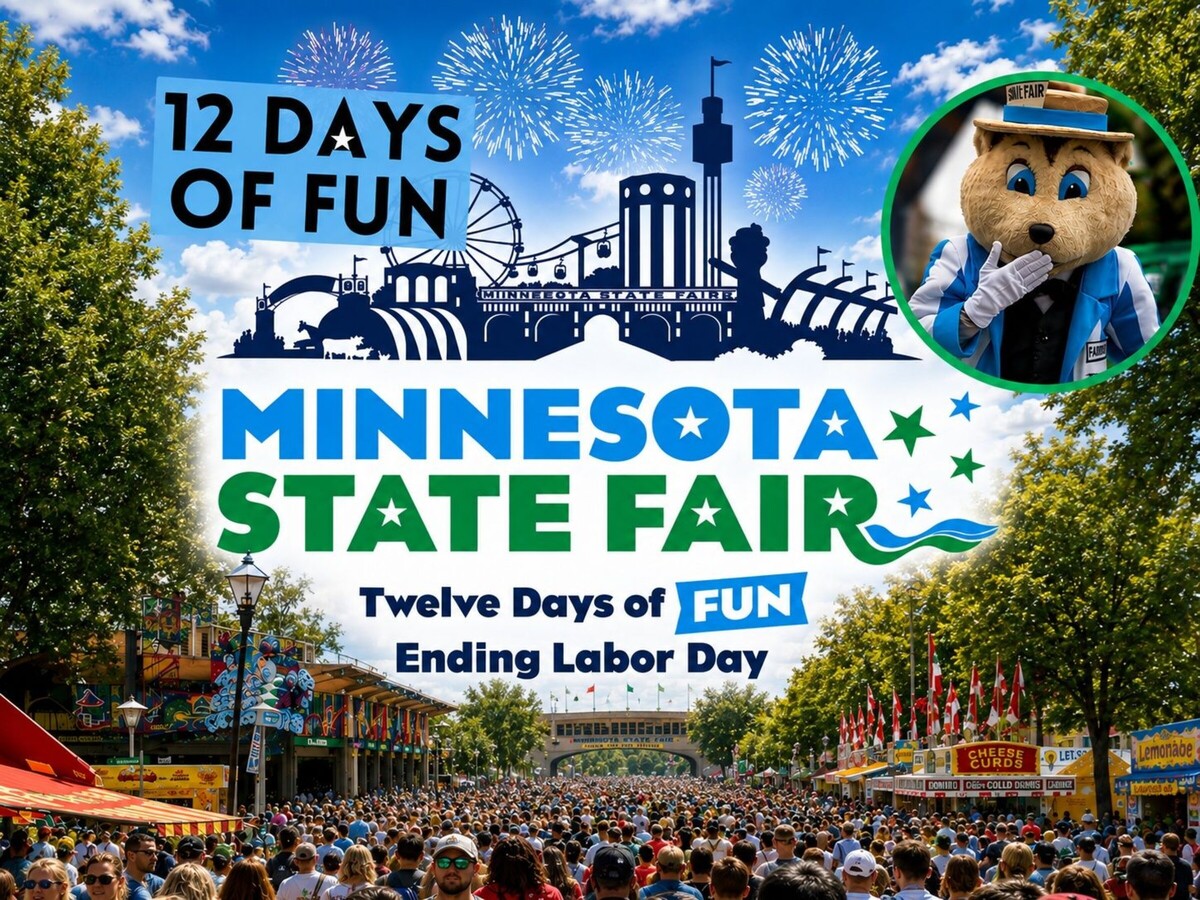



MINNEAPOLIS, MN (August 24, 2026)
On Thursday morning, as the sun clears the horizon over Falcon Heights, the gates of the Minnesota State Fairgrounds open once more. For the next 12 days, a 322-acre expanse midway between Minneapolis and Saint Paul transforms into the epicenter of state life, continuing a ritual whose history reaches back to the 1850s.
People arrive from every corner of our state. Some come from neighborhoods only a few miles away in Saint Paul and Minneapolis. Others drive for hours past sunrise from farms, timberlands, small towns, and river cities across Greater Minnesota. Families push strollers through early morning dew, teenagers map their routes toward the Midway, 4-H members tend livestock in historic brick barns, musicians tune instruments on open-air stages, and vendors slide open service windows. Alongside them, generations of fairgoers move instinctively toward the exact paths, benches, and exhibition halls they visit every summer.
By the time the final turnstiles lock on Labor Day, a living cross-section of Minnesota passes through.
The scale is difficult to overstate. Recent years have recorded near-record attendance approaching two million admissions, anchored by an all-time high of 2,126,551 in 2019 and single-day peaks exceeding 270,000 visitors. Yet those numbers only explain the Fair's massive reach, not why it matters. The Fair stands as one of the few surviving civic institutions capable of gathering people across geography, age, occupation, income, and cultural identity on such a scale. For 12 days, Minnesota practices an art that has become rare in public life: we inhabit the same physical space together.
The Civic Architecture of Proximity
The true significance of the Fair is not found in attendance records, but in what happens when hundreds of thousands of strangers step onto the same pavement.
They share crowded sidewalks. They wait in the same lines. They slide into picnic tables beside families they have never met. They pause together in quiet admiration as a young person exhibits an animal raised through months of disciplined care. They wander halls filled with fine art, crop art, horticulture, and technical innovation. They hear languages they do not speak, listen to music outside their usual routines, encounter organizations doing work in unfamiliar communities, and strike up conversations with neighbors they might otherwise never cross paths with in daily life.
There is no requirement that those who enter the gates think alike, vote alike, or hold the same worldview. There is only an invitation to be present together.
Minnesota has been accepting that invitation since before statehood itself. The Minnesota Agricultural Society was founded in 1854, hosting its first territorial fair in Minneapolis in 1855, three full years before Minnesota became a state in 1858. The first official State Fair followed in 1859. After moving among several communities during its early decades, the Fair established its permanent home in 1885, when Ramsey County donated its 210-acre poor farm to the Agricultural Society, a footprint that eventually expanded to the 322 acres familiar today.
Its longevity is remarkable. Only six times since its inception has the Fair not been held. It was canceled in 1861 and 1862 during the Civil War and U.S.-Dakota War; in 1893 because of scheduling conflicts with the World’s Columbian Exposition in Chicago; in 1945 because of federal wartime travel restrictions; in 1946 because of the polio epidemic; and in 2020 because of the COVID-19 pandemic. After each interruption, the Fair returned. That endurance reflects more than affection for an annual tradition. It proves that physical gathering is not a luxury. It is a fundamental necessity of self-governance.
Protecting the Roots, Expanding the Canopy
Agriculture remains the heart of the Fair's identity, as it must. Created to celebrate and advance agricultural knowledge, the Fair's livestock barns, crop displays, 4-H programs, and FFA competitions remain essential to its soul. For urban and suburban families whose daily routines rarely bring them into contact with production agriculture, those barns provide a direct connection to the labor, animal husbandry, and stewardship behind our food supply. At the Fair, agriculture refuses to become invisible or abstract. The work of farming is honored as a living part of Minnesota’s present and future.
Yet the true strength of the Fair lies in its ability to protect its agricultural roots while continually expanding its cultural canopy.
The Minnesota represented on the fairgrounds today reflects a state whose population, identity, and creative expressions have evolved dramatically. Dedicated daily programming honoring Indigenous, Pan-Latino, Hmong, and diverse community traditions recognizes that our cultural vocabulary is far richer than it was in the 19th century.
That cultural dialogue is visible everywhere, even on the paper trays handed across food counters. When culinary traditions intersect, a local icon like the cheese curd meets a Hmong sausage, Filipino lumpia, or Mexican mole without any tradition losing its identity. It is a playful reminder of a larger truth: new traditions do not need to replace old ones to belong. They can sit side by side, influence one another, and weave a broader common culture.
The same balance between stewardship and growth guides the physical fairgrounds. Major capital investments, including a $23.2 million allocation for infrastructure, modernization of the Lee & Rose Warner Coliseum, and a complete transformation of the 85-year-old 4-H Building, prove that preservation does not mean freezing an institution in amber. True preservation requires identifying what is essential, then equipping it to serve the needs of a new generation.
That responsibility applies equally to human access. The expansion of adult changing facilities, American Sign Language interpretation, human navigational guides for guests who are blind or have low vision, sensory-friendly accommodations, Braille signage, and expanded prayer spaces represents the highest form of civic stewardship. A public gathering becomes greater when more people can participate in it with dignity. Belonging cannot be measured solely by how many people pass through turnstiles; it must be measured by how welcoming and reachable the space remains for every neighbor.
A Remedy for the Isolated Age
We live in an era increasingly designed to eliminate physical contact. We shop without walking into store aisles, work without entering shared office space, communicate through digital screens, and consume media tailored to reinforce our existing biases. Technology delivers efficiency, but efficiency is a poor substitute for community.
Community requires real places. It requires occasions where we step outside our curated routines and encounter one another without controlling every detail of whom we will see.
On the fairgrounds, a grain farmer from the Red River Valley walks the same street as a tech worker from Minneapolis. A family attending for their fifth generation stands in line behind a family attending for the first time. In an era marked by deep political, geographic, and social divides, the Fair offers a powerful counter-narrative. It does not demand uniform agreement; it asks us to practice patience, share space, exercise courtesy, and remember that our state is vast enough to hold many different stories at once.
Maintaining this common ground requires ongoing civic labor and public economic responsibility. The Fair receives no state government appropriations, operating as a self-supporting entity that employs thousands of seasonal workers and generates hundreds of millions in regional economic impact.
As economic pressures impact household budgets, the Fair’s leadership and civic partners must keep a sharp focus on affordability. Standard adult admission, parking fees, and vendor costs can quickly accumulate for a family. If the Fair is to remain Minnesota’s great common table, access must not become cost-prohibitive. Protecting economic accessibility through discount days, advance tickets, and accessible transit is as crucial to the Fair's future as maintaining its historic brick structures.
The Minnesota State Fair is not a static museum piece. It is a living civic habit.
On Thursday morning, the gates open once more. Historic barns fill, vendors serve their first guests, Midway lights come alive, and children begin gathering memories they will carry for decades. The 230-foot America Wheel will tower over the North End to mark the nation's 250th anniversary, offering new perspectives above historic grounds. Longtime visitors return to treasured rituals, while first-time guests begin traditions of their own.
Across those 322 acres, in all our complexity, diversity, and shared hope, Minnesota gathers. We arrive not as a single uniform voice, but as neighbors willing to share the same ground.
In a world that often pulls us apart, the Great Minnesota Get-Together gives us somewhere to meet. Year after year, generation after generation, Minnesota accepts the invitation.
On Thursday, we do it again.

Local stories matter. Subscribe free to MinneapoliMedia and receive independent news, community reporting and important updates from Minneapolis, the North Metro and communities across Minnesota.
SUBSCRIBE FREE: https://minneapolimedia.town.news/subscribe
MinneapoliMedia | Community. Culture. Civic Life


Sunny, with a high of 68 and low of 49 degrees. Patchy rain nearby in the morning, sunny for the afternoon, clear in the evening, overcast overnight.