Image



MORRIS, MN (October 6, 2026). Morris has not seceded from the electrical grid. It does not operate a city-owned electric utility, and it has not powered every home and business entirely with renewable energy since 2021.
Those facts matter because an exaggerated account of the western Minnesota community has circulated online, claiming that Morris defeated large utilities, achieved complete energy independence and began saving residents and businesses millions of dollars every year through a municipally owned system. The story is appealing. It is also unsupported by the public record.
Morris receives electric service from Otter Tail Power Company. Its two prominent wind turbines belong to the University of Minnesota Morris, not to a municipal electric utility. No authoritative financial record supports the widely shared claims of $3 million in annual community energy savings or $500,000 in yearly lease payments to the city. Otter Tail Power’s own service records identify Morris as one of the communities within its western Minnesota territory.
Correcting those claims does not diminish what Morris has accomplished. It reveals a more useful story.
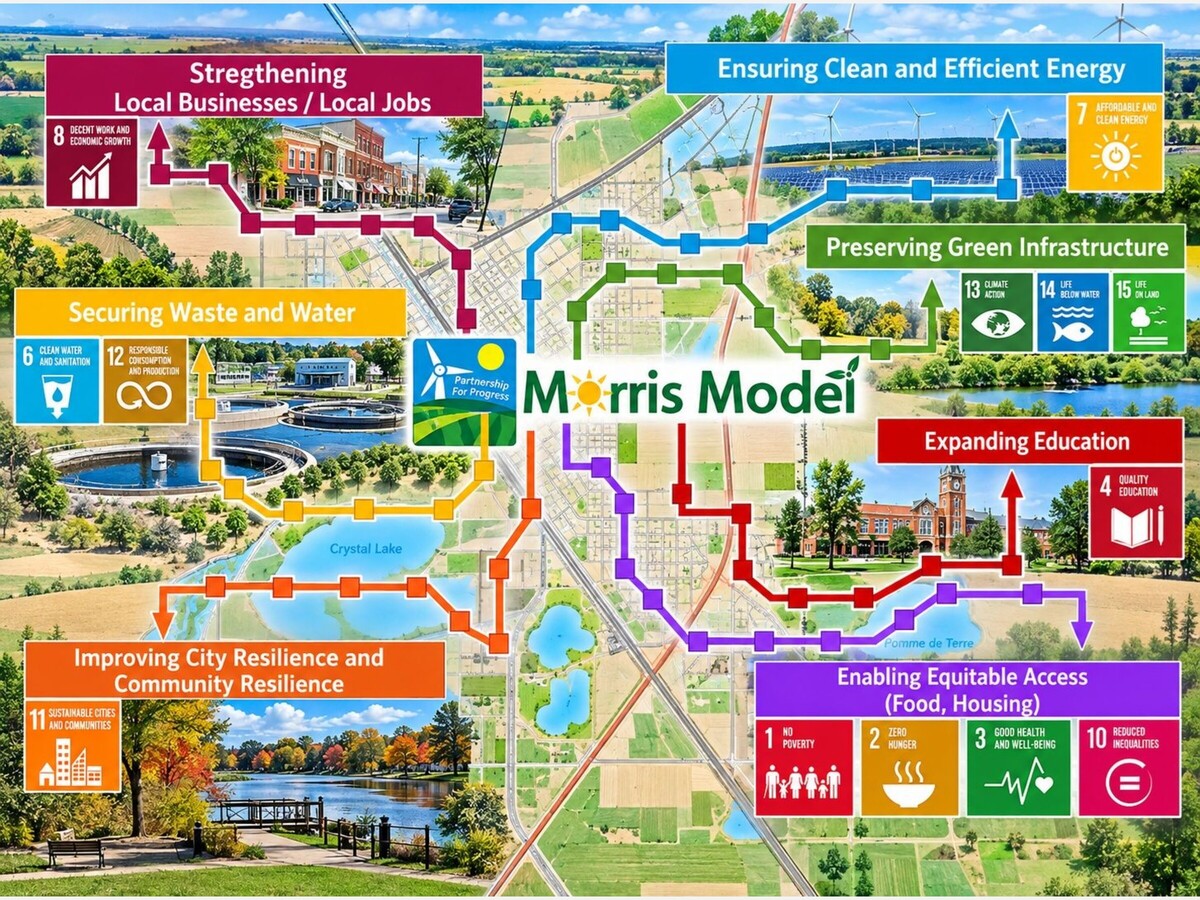
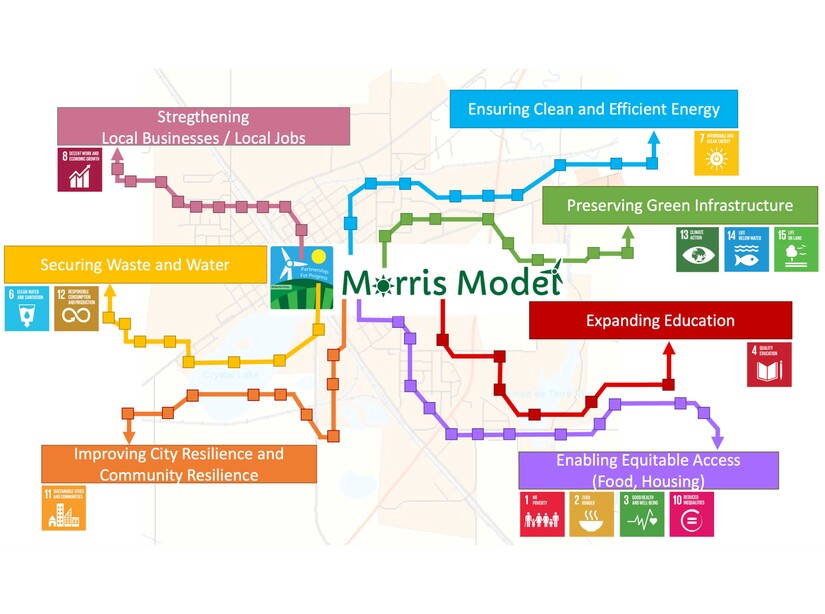
Morris has spent years building a practical system for producing more energy locally, reducing unnecessary consumption and testing technologies that could give rural communities greater influence over how their energy is generated, stored and used. The work has brought together the city, Stevens County, the University of Minnesota Morris, the Morris Area School District, the West Central Research and Outreach Center, Otter Tail Power and other public and private partners.
That partnership, known as the Morris Model, offers Minnesota something more durable than an inspirational social-media post. It demonstrates that a farming community can pursue ambitious clean-energy goals without asking residents to join a political movement, accept questionable claims or abandon concerns about cost and reliability.
Morris has treated energy as an economic and community-development question. Other Minnesota cities should pay attention.
Energy independence is often presented as a dramatic act of separation. A community is imagined cutting its connection to a large utility, erecting a collection of wind turbines and solar panels, and operating entirely on its own.
That image overlooks the physical and financial complexity of a modern electrical system. Electricity must be available when the wind weakens, when clouds reduce solar production, when winter demand rises and when equipment requires maintenance. Generation has to be matched with transmission, distribution, storage and backup capacity. Voltage and frequency must remain stable every second of the day.
For most communities, especially smaller ones, genuine energy independence will not mean withdrawing from the regional grid. It will mean becoming less dependent on distant fuel sources, volatile energy markets and decisions made without meaningful local participation.
That is the more realistic direction Morris is pursuing.
The Morris Model established a goal of producing 80 percent of the energy consumed within Stevens County from local renewable resources by 2030. It also called for a 30 percent reduction in overall energy use. These are goals, not completed achievements, and the distinction should be made clear whenever Morris is presented as a model for other communities.
Still, the targets reveal a sound understanding of energy independence. Morris is not waiting for a single technology or government program to transform the community. It is reducing demand, expanding local generation, improving public buildings, studying storage technologies and connecting energy development with agriculture.
Local control can take several forms. A community can own generation even when a regulated utility continues to operate the distribution system. Public institutions can install solar arrays on their buildings. Schools, farms, businesses and homeowners can participate in cooperative or community-solar arrangements. Cities can use purchasing agreements to secure predictable prices. Counties can support transmission planning and make land-use decisions that preserve local benefits.
Municipal ownership can also be appropriate where it is legally, financially and operationally feasible. Minnesota has a long tradition of public and cooperative utilities. But ownership alone is not a guarantee of affordability, good management or clean generation. The quality of the governing structure, the source of the electricity and the terms under which infrastructure is financed remain decisive.
The lesson from Morris is not that every community must create a municipal utility. It is that communities should stop treating electricity as a service over which they can exercise no influence.
One of the strongest features of the Morris approach is that it began with manageable projects whose results could be measured.
The city’s conversion of the lighting system along Atlantic Avenue to LEDs reduced annual electricity consumption from 64,786 kilowatt-hours to 15,067 kilowatt-hours, a reduction of nearly 50,000 kilowatt-hours each year. Otter Tail Power later replaced its streetlights across the community, making Morris the first Minnesota city to complete a community-wide LED streetlight conversion, according to the city. LED lighting has also been installed in municipal buildings.
No ideological declaration was required. The lights used less electricity, reduced operating costs and demonstrated that conservation could produce measurable benefits.
That sequence is important. Communities discussing energy independence sometimes begin with expensive generation proposals while ignoring aging heating systems, inefficient lighting, poor insulation and buildings that waste electricity. Producing additional power makes little economic sense when a significant share of existing consumption can be eliminated at lower cost.
Conservation also makes local renewable projects more effective. A solar array that supplies a modest share of an inefficient building’s electricity can cover a much larger share after lighting, heating and cooling systems are upgraded.
Morris installed approximately 150 kilowatts of solar capacity across four city properties, including City Hall, the public library and the municipal liquor store. The installations are expected to generate about 176,000 kilowatt-hours annually. The library combines solar generation with a geothermal heating and cooling system, showing how different technologies can be integrated rather than promoted as competing solutions.
These projects do not power the entire community, nor should they be presented as if they do. Their value lies in proving what public institutions can accomplish on property they already control.
Every Minnesota city owns or operates buildings. Many control libraries, public works facilities, fire stations, wastewater plants, community centers and municipal parking areas. School districts maintain large roofs, athletic facilities and bus fleets. Counties operate courthouses, service centers and highway facilities.
The first question should not be whether a city can achieve total energy independence immediately. It should be how much energy its public assets consume, how much is being wasted and which properties can produce electricity economically.
Morris possesses an advantage that cannot be copied exactly by every rural community. The University of Minnesota Morris and the nearby West Central Research and Outreach Center provide research capacity, technical knowledge and infrastructure that would be difficult for a small city to develop independently.
The university’s two 1.65-megawatt wind turbines have become visible symbols of that work. The first began operating in 2005 and was the first large-scale wind turbine installed at a public university in the United States. The second followed in 2011. The campus also maintains solar installations and has conducted research involving biomass, thermal systems, agricultural energy use and renewable fuels.
The turbines should not be mislabeled as city-owned community turbines. They are university assets serving campus generation, education and research. Recent university figures indicate that wind and solar resources produce more than 60 percent of the campus’s daily electricity needs on site. At times, the facilities produce more electricity than the campus can immediately consume.
That surplus points to the next challenge in independent generation: storage.
A community can install enough wind and solar capacity to produce substantial electricity over the course of a year while remaining dependent on the grid during particular hours. Production and consumption do not occur on identical schedules. Summer solar generation may peak when a building needs less electricity. Strong nighttime winds may produce power when demand is low. Winter heating demands can exceed available renewable production.
The university, Otter Tail Power and technology partners are preparing to install a one-megawatt, six-megawatt-hour zinc-based battery on the Morris campus. The system is expected to be commissioned in 2027. Otter Tail Power will operate it as part of the utility’s infrastructure while the university studies how long-duration storage can support campus needs and grid reliability.
The project deserves close attention across Minnesota. Lithium-ion batteries dominate many current storage discussions, but communities need systems suited to harsh winters, repeated cycling, fire-safety requirements and longer discharge periods. A zinc-based installation operating in western Minnesota can provide evidence that laboratory projections cannot.
Morris is not merely purchasing finished technology. It is creating a place where new energy systems can be tested under real rural conditions.
The Morris Model is especially relevant because it does not treat rural Minnesota as empty land waiting to be covered with industrial energy projects.
Western Minnesota is an agricultural economy. Land supports families, food production, local tax bases and businesses connected to farming. Renewable development that ignores those relationships will encounter understandable resistance.
Research in Morris is examining whether energy production and agriculture can support one another. Agrivoltaics, for example, studies how solar installations can be designed to accommodate grazing, crop production, pollinator habitat or other agricultural uses. The West Central Research and Outreach Center has also worked on producing ammonia using renewable electricity.
Ammonia is essential to modern fertilizer production, but conventional manufacturing relies heavily on natural gas and exposes farmers to global energy markets. Producing ammonia with local wind power and water could eventually reduce emissions and create a regional source of fertilizer or fuel. The economics and technical demands remain under study, but the work reflects the kind of independence rural communities should pursue.
Independent energy generation should not mean converting farmland without regard for agricultural value. It should mean finding ways for landowners, farmers and local institutions to share directly in the benefits.
That requires better lease protections, transparent siting rules, decommissioning requirements and serious consideration of local ownership. When outside developers control the project, claim the tax benefits and export the electricity, residents may reasonably question what independence has been achieved.
A locally owned solar cooperative, farm-scale energy system or publicly controlled generation project keeps more of the economic value near the place where the energy is produced. Even when complete local ownership is not feasible, development agreements can secure local construction work, long-term maintenance opportunities, landowner protections and contributions to public infrastructure.
Morris’s emphasis on building community wealth should become a central principle of Minnesota energy policy. Rural communities should not function merely as production zones for metropolitan electricity demand. They should be partners with enforceable financial interests.
Clean-energy policy has become entangled with national political identities that often have little to do with the decisions facing a city council, school board or farm family.
One side sometimes presents every renewable project as an unquestionable environmental good. The other treats clean-energy development as an intrusion driven by urban politicians. Both positions leave too little room for examining whether a particular project is affordable, reliable, locally beneficial and properly located.
Morris followed a more productive course. Its leaders concentrated on energy savings, local resilience, agricultural applications, education and investment. The Morris Model emerged through relationships among institutions that residents already knew. Its projects could be visited, inspected and evaluated. Brookings has identified that practical approach as an important reason Morris advanced sustainability while avoiding much of the partisan division surrounding climate policy elsewhere.
The language matters, but the work matters more.
Residents do not have to agree about every national climate policy to support lower municipal electricity bills. Farmers do not have to join an environmental organization to see value in reducing fertilizer dependence. Utility customers do not have to embrace a political label to support a battery that improves reliability during periods of heavy demand.
This does not mean communities should conceal the environmental purpose of reducing fossil-fuel consumption. Climate change is real, and public officials should not be afraid to discuss it plainly. But durable policy must also answer immediate questions about household costs, grid reliability, land use, agricultural productivity and who owns the resulting assets.
Morris built cooperation by connecting environmental objectives to practical community interests.
The state should develop a clear program to help cities, counties, tribal nations, schools and cooperatives evaluate local generation opportunities.
Many small communities lack the staff required to study building consumption, solar potential, interconnection costs, financing structures and battery systems. Private developers may offer technical expertise, but their recommendations are shaped by their own financial interests. Communities need independent assistance before negotiating contracts that can remain in force for decades.
A serious state program should provide energy audits, engineering support, standardized contract guidance and access to financing. It should help local governments compare direct ownership, power-purchase agreements, cooperative structures and utility partnerships. It should also publish actual project costs and savings so communities can distinguish evidence from promotional claims.
Minnesota should examine whether public buildings can serve as the foundation of community microgrids capable of maintaining critical services during outages. Fire stations, emergency shelters, water plants, health facilities and schools could combine local generation with battery storage and controlled connections to the wider grid.
This is not an argument for every municipality to duplicate Morris. Local wind conditions, solar exposure, utility rates, industrial demand and financing capacity differ significantly. Some communities will benefit from solar. Others may find wind, geothermal systems, biogas or shared storage more appropriate.
The state’s responsibility is to give communities the information and authority needed to make those decisions intelligently.
Utilities must be included, but they cannot possess an automatic veto over locally beneficial generation. Interconnection standards should be transparent, costs should be justified and customers who invest in generation should receive fair compensation for electricity returned to the grid. Regulators must protect other customers from unreasonable cost shifting while preventing utilities from using complicated procedures to discourage competition.
The partnership in Morris shows that utilities and local institutions can work together. It also demonstrates why communities need their own goals rather than simply adopting a utility’s corporate plan.
Supporters of clean energy should resist the temptation to improve the Morris story through exaggeration.
Morris has not completed its transition. Its 2030 targets remain ambitious. The university’s achievements cannot automatically be attributed to every household and business. Some experimental technologies may prove more expensive or less effective than expected. Major questions remain about storage, transmission, winter demand and the financing of wider community adoption.
Acknowledging those limitations does not weaken the case for the Morris Model. It establishes credibility.
The strongest argument for local energy generation is not that it will instantly eliminate every utility bill or make a community completely self-sufficient. It is that conservation and local ownership can reduce exposure to outside costs, keep more money circulating locally and give residents a greater voice in decisions that shape their future.
Morris began with projects it could undertake, institutions it already possessed and resources available across the surrounding prairie. It reduced electricity consumption, placed solar panels on public buildings, developed university wind generation, expanded energy research and created partnerships broad enough to continue after individual officeholders and administrators moved on.
That is how lasting infrastructure is built.
The community has not defeated its utility. It has persuaded the utility, university, city, county, schools and research institutions to work toward goals that none could accomplish alone. It has not escaped the electrical grid. It is learning how to contribute more power to it, draw less from it and store locally produced electricity for times when it is most valuable.
Minnesota communities seeking greater energy independence should begin with that honest definition.
The objective is not isolation. It is leverage. It is the ability to conserve energy, produce a meaningful share locally, protect essential services and ensure that public investment creates public benefit.
Morris has not finished that work. It has shown Minnesota how to begin.

Local stories matter. Subscribe free to MinneapoliMedia and receive independent news, community reporting and important updates from Minneapolis, the North Metro and communities across Minnesota.
SUBSCRIBE FREE: https://minneapolimedia.town.news/subscribe
MinneapoliMedia | Community. Culture. Civic Life



Patchy rain nearby, with a high of 48 and low of 41 degrees. Don't forget your umbrella! Patchy rain nearby in the morning, light drizzle for the afternoon and evening, patchy rain nearby overnight.