40° and Clear
Image
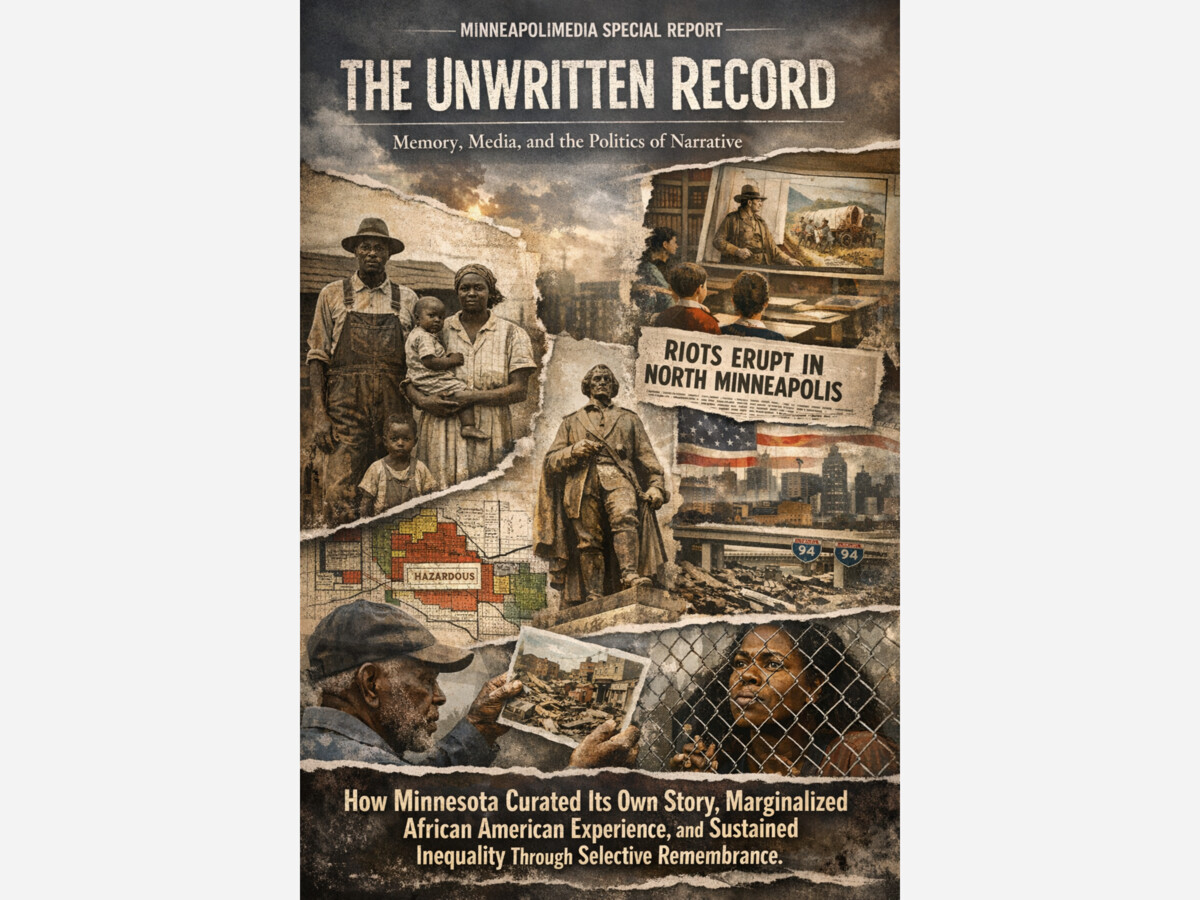



For generations, Minnesota students learned about the flour mills that powered Minneapolis. They learned about the Iron Range, Scandinavian immigration, and Progressive reform. They learned about statehood, civic virtue, and northern moral distinction.
They did not learn, in any sustained way, about African American homesteaders in pre statehood Minnesota. They did not learn about the Coleman family in Anoka confronting brutality in 1886. They did not learn about racially restrictive covenants shaping Minneapolis neighborhoods for decades. They did not learn about the destruction of the Rondo neighborhood as a structural displacement of wealth and community.
The omission was rarely loud.
It was orderly.
It was polite.
It was Midwestern.
And because it was polite, it was rarely challenged.
Erasure in Minnesota was not theatrical.
It was curated.
Historical preservation is not automatic. It is funded, archived, cataloged, and displayed by institutions.
The Minnesota Historical Society has preserved immense documentation of state development. University archives hold political papers, corporate records, and government correspondence.
Yet community records created by African American churches, mutual aid societies, and neighborhood associations were often underfunded, privately held, or vulnerable to loss.
When archives prioritize corporate, legislative, and settler narratives, they do not necessarily destroy other histories. They simply elevate some above others.
What is cataloged becomes citable.
What is citable becomes teachable.
What is teachable becomes official.
African American life in Minnesota was often preserved in church minutes, family records, oral histories, and small community newspapers.
Parallel archives existed.
But parallel is not equal.
When preservation is uneven, legitimacy becomes uneven.
Minnesota’s education standards have evolved over time. Yet for much of the twentieth century, African American history was framed primarily within the context of national civil rights movements, often disconnected from Minnesota specific experience.
Students could learn about Martin Luther King Jr. while remaining unaware of racial covenants in their own neighborhoods.
They could learn about Reconstruction in the South while remaining unaware that Minnesota’s original Constitution restricted suffrage to white men.
This separation creates psychological distance.
If injustice is always elsewhere, reform feels unnecessary here.
Curriculum does not merely transmit facts. It shapes civic identity.
If African American contributions are peripheral in textbooks, they become peripheral in policy urgency.
Media institutions shape how communities interpret events.
When neighborhoods in North Minneapolis were described historically through crime statistics rather than historical disinvestment, public perception followed.
Headlines matter.
Language matters.
Words such as “urban unrest,” “troubled neighborhood,” or “high crime area” do not emerge in a vacuum. They reinforce mental associations between place and pathology.
If labor disparities are framed as individual failure rather than structural exclusion, policy responses narrow.
If housing segregation is framed as market preference rather than engineered policy, reform appears unnecessary.
Narrative influences voting behavior.
Voting behavior shapes law.
Media does not simply report inequality. It influences the moral imagination that determines whether inequality is seen as systemic or behavioral.
Minnesota has long cultivated an identity as progressive, educated, and civically engaged.
The state ranks high in many national measures of well being.
Yet Minnesota also consistently ranks among the highest states for racial disparities in homeownership, income, educational outcomes, and incarceration rates.
This contradiction is rarely centered in public memory.
Exceptionalism functions as insulation.
If a state believes itself fundamentally just, it resists the possibility that its systems are structurally unequal.
The belief in northern innocence once obscured complicity in housing exclusion and economic stratification.
The belief in progressive identity can obscure contemporary disparities.
Self image is powerful.
It shapes what a state is willing to confront.
Marginalization is not only economic. It is narrative.
Consider the psychological effect of building neighborhoods later labeled blighted.
Consider the effect of watching a thriving commercial district like Rondo erased for highway expansion, then seeing its history reduced to a footnote.
Consider working in industries that built state wealth while being absent from commemorative narratives about that wealth.
Consider watching media describe your community primarily through deficit language.
When contribution is unacknowledged, belonging weakens.
When belonging weakens, civic trust erodes.
Intergenerational marginalization is not solely about wages or housing. It is about legitimacy.
If a community’s labor built the state but its story is not central to the state’s story, the moral contract feels incomplete.
Street names, statues, and historical markers communicate who matters.
Public commemoration in Minnesota has historically centered political leaders, industrialists, and settler narratives.
Efforts to diversify public memory have increased in recent years, particularly after 2020.
But the timeline matters.
For decades, African American presence was structurally underrepresented in public space.
Memory is not neutral.
It is curated.
When physical space reflects selective remembrance, inequality feels natural rather than constructed.
When housing exclusion is not widely remembered, housing reform appears radical.
When labor stratification is not publicly documented, wage gaps appear mysterious.
When environmental zoning history is not taught, asthma appears biological rather than infrastructural.
Selective memory functions as a shield.
It protects policy from scrutiny.
It allows inequality to persist under the appearance of neutrality.
The struggle over memory is ongoing.
Curriculum standards continue to evolve.
Diversity initiatives face political debate.
Media framing of protest and crime remains contested.
Memory is not fixed. It is continuously negotiated.
The question is not whether Minnesota will remember African American history.
The question is whether that history will be integrated as foundational or appended as supplemental.
Erasure in Minnesota was rarely loud.
It did not always require burning books or explicit censorship.
It required selection.
It required elevation of certain narratives and quiet marginalization of others.
Land was allocated.
Wages were structured.
Schools were funded.
Votes were counted.
Hospitals were built.
And the story told about those processes shaped how they were defended.
The deepest form of marginalization is not exclusion from a building.
It is exclusion from the story of the building.
If African American history in Minnesota remains peripheral to the state’s self understanding, reform will always feel optional.
But the record built across this series shows otherwise.
Housing was engineered.
Labor was stratified.
Education was geographically funded.
Voting was structured.
Health disparities were measurable.
These were not accidents.
They were design.
And the narrative that minimized that design allowed it to persist.
A state that does not fully remember cannot fully repair.
And until Minnesota’s official story includes the full architecture of marginalization and contribution, the future will continue to rest on partial truth.
The record is no longer partial.
The question is whether the memory will be.



Sunny, with a high of 73 and low of 37 degrees. Sunny in the morning, partly cloudy for the afternoon and evening, clear overnight.