51° and Overcast
Image
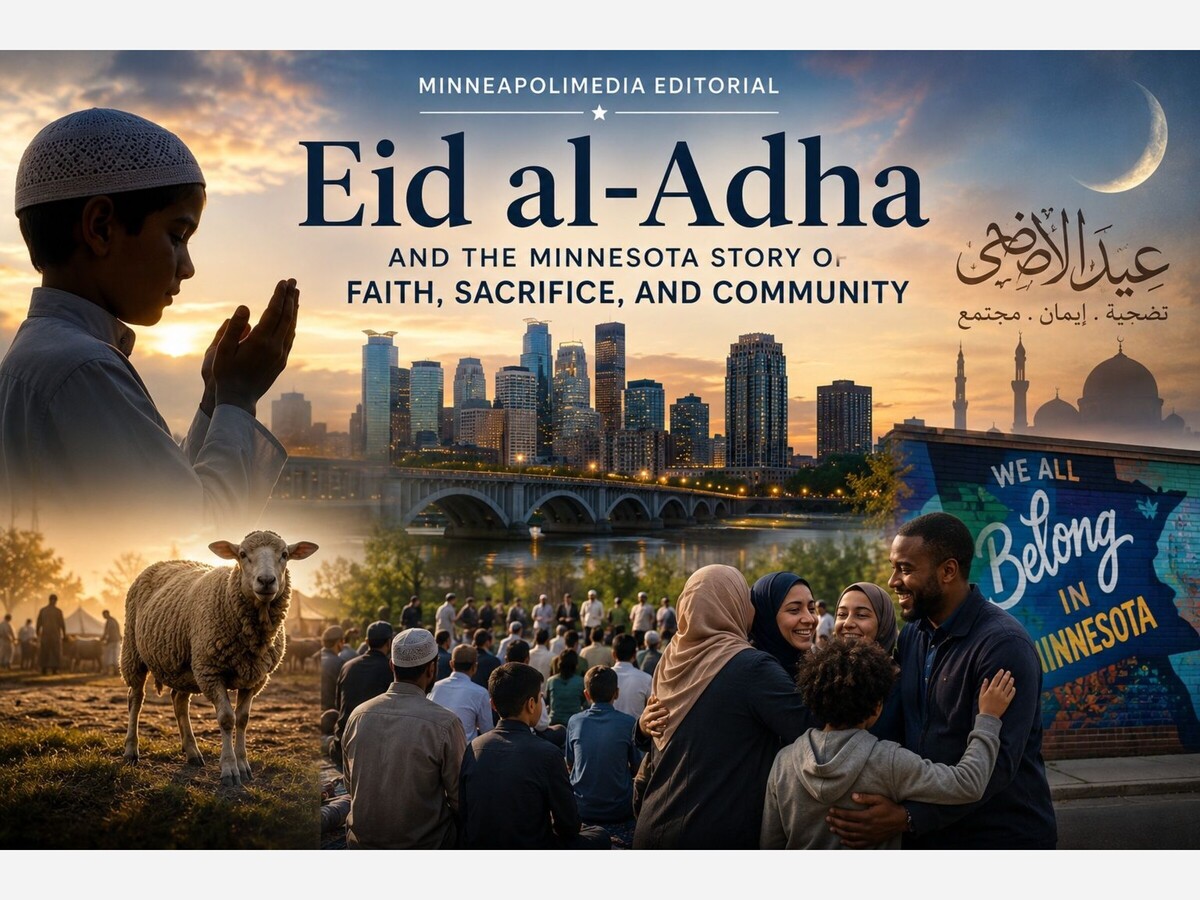



MINNEAPOLIS, MN (May 27, 2026) On Wednesday, May 27, Muslim families across Minnesota will gather before sunrise, prepare children for morning prayers, exchange embraces and greetings of “Eid Mubarak,” and begin observing one of the most sacred holidays in Islam: Eid al-Adha.
Across the Twin Cities and throughout Minnesota, mosques, convention centers, school gymnasiums, and community prayer spaces are expected to fill with worshippers marking the annual observance, which commemorates the faith and obedience of the Prophet Ibrahim, known in the Judeo-Christian tradition as Abraham. According to Islamic tradition, Ibrahim demonstrated his willingness to sacrifice his son in submission to God before God provided a ram in his place. The story remains central to the meaning of Eid al-Adha, often referred to as the “Festival of Sacrifice.”
The holiday, observed according to the Islamic lunar calendar and confirmed through moon sightings in various parts of the world, is among the two holiest celebrations in Islam. For many Muslims, the day begins with congregational prayers followed by family gatherings, acts of charity, food distribution, and the ritual sacrifice known as Qurbani for those financially able to participate. The meat from the sacrifice is traditionally divided among family, relatives, and people in need.
Yet in Minnesota, Eid al-Adha represents more than a religious observance taking place quietly behind mosque walls. It has become part of the broader civic and cultural rhythm of the state itself. The holiday reflects the enduring presence of immigrant and African Muslim communities that have become deeply woven into Minnesota’s economic, educational, healthcare, transportation, entrepreneurial, and public life over several decades.
Minnesota today is home to one of the largest Muslim populations in the Upper Midwest, including substantial Somali, Ethiopian, Oromo, Liberian, Nigerian, Senegalese, and broader West African communities, alongside African-American Muslims, Arab-American Muslims, South Asian Muslims, and multigenerational Muslim families who have lived in the United States for generations. Their presence has reshaped neighborhoods, strengthened local economies, expanded cultural life, and contributed to Minnesota’s civic identity in ways now visible across nearly every sector of public life. That reality becomes especially visible during Eid observances.
Long before many Minnesotans begin their normal workday, Muslim families across the state will already be gathering in prayer. Parents will prepare meals, coordinate family visits, and organize celebrations for children while volunteers and community leaders oversee prayer logistics, parking coordination, charitable food efforts, and community outreach. Businesses owned by Muslim entrepreneurs may close or operate on reduced schedules so employees and families can participate in observances. Some workers will request time away from their jobs, students will miss classes, and families will travel across the metro area and beyond to spend time together. Far from being isolated cultural practices existing outside Minnesota’s public square, these observances are fundamentally part of it.
That distinction matters because immigrant communities are too often discussed primarily during moments of political controversy, demographic debate, or crisis. Public conversations surrounding Muslim communities in America frequently become dominated by national political arguments, security concerns, or cultural misunderstandings that flatten entire populations into abstractions rather than recognizing them as neighbors, workers, parents, students, business owners, and citizens participating in the daily life of the state.
Holidays such as Eid al-Adha help restore that human scale.
They remind the broader public that for Muslim Minnesotans, faith is not simply a theological identity. It is also community structure, family continuity, moral obligation, charitable responsibility, and intergenerational preservation. The values emphasized during Eid, including sacrifice, discipline, generosity, humility, and care for those in need, are recognizable across many religious and cultural traditions. While the observance itself is distinctly Islamic, the broader themes remain deeply familiar within American civic life.
The charitable dimension of Eid al-Adha is particularly important. In Islamic tradition, the distribution of food to others, especially vulnerable families and individuals, is central to the observance. In practice, that spirit often extends far beyond formal religious obligation. Across Minnesota, Muslim-led organizations, mosques, nonprofits, and informal community networks routinely organize food drives, mutual aid efforts, refugee support services, youth mentorship programs, and emergency assistance initiatives that serve both Muslim and non-Muslim residents alike, though those contributions rarely receive sustained public attention proportional to their impact.
The same can be said for the economic and institutional contributions made by Muslim communities throughout Minnesota. Immigrant-owned businesses have helped stabilize commercial corridors in Minneapolis, St. Paul, Brooklyn Park, Burnsville, Rochester, and other cities throughout the state. Muslim healthcare professionals serve in hospitals, clinics, nursing homes, pharmacies, and home healthcare systems across Minnesota. Muslim educators teach in public schools and universities. Muslim entrepreneurs operate logistics companies, restaurants, retail establishments, transportation services, financial firms, technology startups, and community organizations that employ Minnesotans from many backgrounds. This civic participation is no longer peripheral to Minnesota’s development. It has become part of the state’s ongoing economic and civic growth.
At the same time, Muslim communities in the United States continue to navigate persistent misunderstandings, scrutiny, and periods of social suspicion that intensified after the September 11 attacks and have periodically resurfaced during moments of international conflict and domestic political polarization. For many Muslim families, especially immigrants and refugees, maintaining religious identity while building stability in America has required substantial sacrifice extending across generations.
That sacrifice is often economic long before it is symbolic.
Many immigrant families arrived in Minnesota carrying pressures familiar to immigrant communities throughout American history: language barriers, employment instability, credential recognition challenges, housing insecurity, cultural adjustment, and the responsibility of supporting relatives both in the United States and abroad. Parents worked long hours while attempting to preserve faith traditions for children growing up between cultures. Families built religious institutions, community centers, businesses, and social support networks largely through local organizing and collective effort.
In that context, Eid al-Adha acquires an additional layer of meaning beyond formal religious observance. The holiday becomes part of how communities maintain continuity across displacement, migration, and adaptation. It becomes part of how identity survives transition without disappearing into it.
Minnesota’s civic fabric has been shaped repeatedly by communities who arrived carrying traditions that were initially unfamiliar to the broader public. Scandinavian, German, Irish, Hmong, Liberian, Vietnamese, Latino, Ethiopian, Somali, and many other communities have all contributed to the evolving identity of the state. Within the Midwest, the Islamic presence itself forms part of this longer historical lineage, tracing back more than a century to early Syrian, Lebanese, and European Muslim settlers who established roots in the region long before the modern diaspora arrived. Muslim communities today remain part of that same unfolding American story.
Recognizing Eid al-Adha publicly does not require religious agreement or theological participation from non-Muslims. It requires only the civic maturity to understand that pluralistic societies function best when communities are acknowledged with dignity and accuracy rather than reduced to caricature or invisibility.
Public acknowledgment matters because invisibility carries consequences. When communities feel unseen in public life, social trust weakens, and misunderstanding grows more easily in the absence of familiarity. The simple act of recognizing a major religious observance practiced by neighbors, coworkers, classmates, healthcare workers, business owners, and fellow citizens helps strengthen the broader civic culture on which diverse societies depend.
That recognition also reflects the practical reality of modern Minnesota itself. Eid prayers are not taking place somewhere distant from the state’s identity. They are taking place within it.
They will occur in Minneapolis and St. Paul, in suburban convention centers, in local mosques, in community halls, and in neighborhoods that form part of the daily life of Minnesota. They will be observed by people helping shape the future of the state in classrooms, hospitals, small businesses, transportation systems, universities, nonprofits, government offices, and local communities every day.
For many Muslim families, the holiday will be deeply spiritual. For children, it may center around family meals, gifts, and celebration. For elders, it may carry memories of countries left behind decades ago. For immigrants, it may symbolize both continuity and adaptation. For converts and multigenerational American Muslims, it may represent religious devotion rooted fully within the American experience itself.
For Minnesota more broadly, Eid al-Adha offers an opportunity to recognize a reality that already exists: Muslim communities are not peripheral participants in the life of the state. They are already embedded within Minnesota’s civic, economic, cultural, and community life. As families gather in prayer and celebration during Eid al-Adha, that reality deserves acknowledgment not as symbolism, but as an honest reflection of modern Minnesota itself.
MinneapoliMedia | Community. Culture. Civic Life.


Overcast, with a high of 64 and low of 48 degrees. Overcast during the morning,