57° and Clear
Image
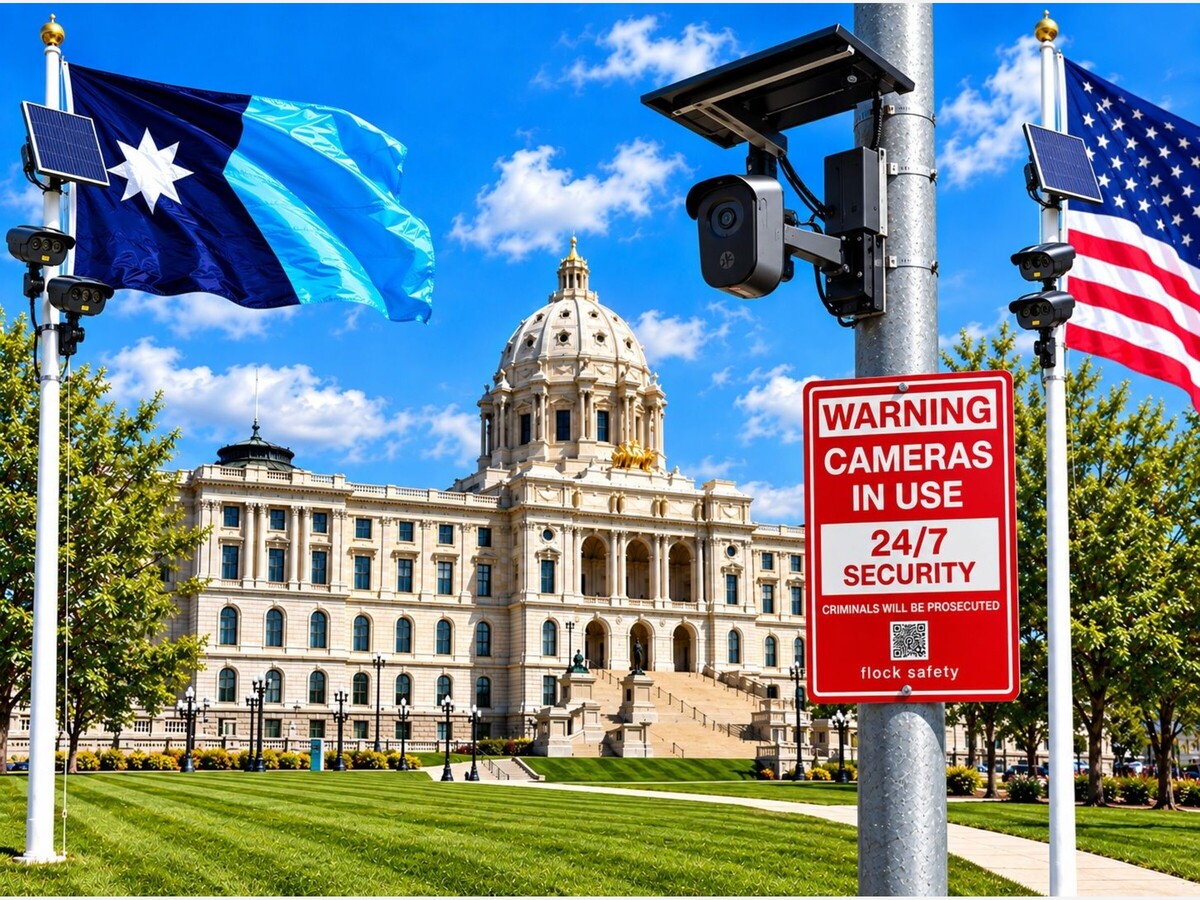



The camera was installed in late August 2026 near the university’s West Bank campus. State Rep. Mohamud Noor, who represents the area, questioned university officials about why the device had been placed off campus and what would happen to the information it collected. Residents raised concerns about privacy, surveillance, and the possibility that vehicle location data could reach federal immigration authorities or other agencies outside the neighborhood.
Cedar-Riverside is home to a vibrant East African immigrant population, including residents whose experiences with government authority necessitate clear, transparent boundaries around security technology. The neighborhood also contains community organizations, houses of worship, small businesses, gathering places, and a rich history of civic activism. A camera that continuously records vehicles in such a location cannot be evaluated merely as a routine piece of police equipment. Its placement affects how residents understand their relationship with public institutions and whether they believe their daily movements are being observed without their knowledge or meaningful consent.
The University of Minnesota emphasizes that its license plate reader systems help police recover stolen vehicles, locate missing persons, make arrests, and identify suspects in violent crimes. Those are legitimate, vital public-safety objectives. Police departments should be able to examine tools that assist in responding to serious offenses, particularly when investigators are searching for a specific vehicle connected to an active threat.
Acknowledging those benefits, however, does not require the public to accept an unrestricted network of cameras that records every passing vehicle before police have identified any reason for suspicion.
The Illusion of "Public Space"
Opponents of license plate reader regulation frequently fall back on traditional Fourth Amendment jurisprudence, arguing that drivers have no reasonable expectation of privacy on public roads and that a camera simply automates what an officer could manually observe with a notepad.
This argument ignores the profound qualitative shift between human observation and automated mass recording. An officer on patrol cannot log millions of license plates every hour, convert them into a searchable geographic database, and store them across interconnected networks. When technology aggregates individual, public moments into a comprehensive map of a citizen’s political rally attendance, religious worship, medical visits, and personal relationships, public observation transforms into pervasive dragnet surveillance.
Automated license plate readers do not merely observe vehicles sought in active investigations. They photograph or record the license plates of all vehicles that pass within their view, along with the date, time, and exact geographic coordinates. The system then converts that information into searchable data. Most of the people whose vehicles are recorded are not suspected of committing crimes. They are traveling to work, taking children to school, attending religious services, visiting relatives, keeping medical appointments, shopping, or returning home. The technology collects first and asks questions later.
That distinction must remain at the center of Minnesota’s debate.
Why Corporate Guardrails Are Not State Law
The University of Minnesota has emphasized that its license plate information is owned exclusively by its police department, that data are shared with other law enforcement agencies only after review, and that departmental policy prohibits use of the technology for immigration enforcement, harassment, intimidation, traffic enforcement, or surveillance based solely on a person’s protected class. The department also notes that it does not provide direct access to agencies with formal partnerships with U.S. Immigration and Customs Enforcement.
Those safeguards matter. They indicate that the university recognizes the sensitivity of the information and has attempted to establish boundaries around its use. Yet an internal policy is only as strong as its enforcement, auditing, and durability. Administrators change. Police leadership changes. State and federal enforcement priorities shift. Agencies enter new information-sharing arrangements. A restriction that appears clear today can easily be interpreted differently under future leadership unless it is supported by enforceable law, independent oversight, and records the public can examine.
Minnesota is not starting from nothing. State law already treats automated license plate reader information as sensitive data. It limits what may be collected, generally requires records unrelated to an active criminal investigation to be destroyed within 60 days, and prohibits the use of the technology to monitor or track a person in an active criminal investigation without a warrant based on probable cause unless exigent circumstances exist. It also requires access to serve a legitimate, specified and documented law enforcement purpose grounded in reasonable suspicion, with a factual basis and an associated case, complaint or incident number.
The law goes further. Agencies must maintain public usage logs, including the aggregate number of plates collected during each period of operation and the databases against which those records were compared. They must keep lists of current and former fixed-camera locations, subject to a limited security-information exception, and arrange independent audits every two years. Audit results are public, and a pattern of substantial noncompliance can lead the commissioner of administration to suspend an agency’s use of the equipment.
Those provisions demonstrate that Minnesota lawmakers recognized the risks of automated plate readers years before the current controversy. They also sharpen the question now facing the state. If the statutory framework is as protective as it appears on paper, why have residents, local elected officials and news organizations still struggled to determine where cameras are located, who can reach the data through connected systems, and whether information can travel beyond the purpose for which a Minnesota agency collected it?
The answer may lie in the difference between regulating a local record and governing a national network. A local department can comply with its written policy while relying on software designed to connect agencies across jurisdictions. A search may originate outside Minnesota. A request may move through an agency with different rules. A private vendor may change how permissions, defaults or sharing relationships operate. The public therefore needs more than assurances about the conduct of the agency that owns a particular camera. It needs a verifiable account of every path through which the resulting information can be searched, transmitted or retained.
In response to growing public backlash across the state, including contract cancellations or camera removals in cities like Crystal, Winona, St. Louis County, and Sherburne County, major technology vendors like Flock Safety have rushed to announce self-imposed guardrails. These include shorter default retention periods, required links between searches and specific case numbers, and software tools intended to identify abnormal search behavior.
These corporate shifts may reduce some opportunities for misuse, but they expose a fundamental flaw in governance: a private, for-profit technology vendor should not establish the practical limits of public surveillance. Those limits must be determined by elected lawmakers, courts, accountable public agencies, and the communities whose movements are being recorded. Internal vendor settings and departmental guidelines can be altered with an executive signature, a software update, or a change in local political leadership.
Furthermore, assurances that local police do not share data with federal immigration authorities ring hollow when license plate databases are connected to broader inter-agency networks. Without statutory firewalls, data shared with a neighboring municipality or county can be accessed by federal agencies or out-of-state entities through secondary data-sharing agreements. Access restrictions must follow the data throughout the entire system.
The Missing Denominator
When law enforcement agencies advocate for camera expansion, they routinely point to success stories, such as a kidnapped child found, a stolen vehicle recovered, or an armed suspect apprehended. Those results are real, and they matter to victims of crime. Evaluation, however, requires a denominator.
Minnesotans need to know how many millions of innocent vehicle plates are photographed to produce those results, how often system alerts are incorrect or outdated, and how many people are stopped because of incorrect information produced by the system. Without that context, the public receives promotional anecdotes rather than a complete performance record.
An annual public report should provide those figures in aggregate form. It should distinguish between stolen-vehicle investigations, missing-person cases, violent-crime investigations, and other uses. It should disclose how many vehicles were recorded, how many plates generated alerts, how many alerts were independently confirmed, and how often information contributed materially to an arrest or recovery.
Minnesota’s existing public-log requirement provides an important foundation, but aggregate collection totals and database comparisons do not by themselves answer whether the system works accurately or proportionately. Residents also need to know how many alerts were false, how many searches involved data from another jurisdiction, how many outside agencies sought Minnesota records, how many requests were approved or denied, and whether an arrest or recovery could be directly attributed to the technology rather than merely associated with an investigation in which it was used.
Error reporting is especially important because a license plate alert can quickly become a police encounter. Plates can be misread. Hot lists can be outdated. A vehicle may have changed hands, been recovered without the database being promptly updated, or be driven by someone other than the registered owner. Officers should be required to confirm an alert through an independent database before initiating a stop whenever circumstances permit, and agencies should disclose how often alerts fail that confirmation. Technology marketed as efficient must not be allowed to conceal the human consequences of an inaccurate match.
Public policy should be capable of recognizing both usefulness and danger. A tool can help locate a missing person and still require strict limits. It can assist in recovering stolen vehicles and still be placed in the wrong neighborhood without adequate consultation. It can produce legitimate evidence and still create an infrastructure capable of documenting political activity, religious attendance, medical visits, or personal relationships. The central question is not whether the technology can be useful. It is whether its usefulness justifies collecting location information from everyone who happens to drive past.
The Path Forward in St. Paul
The problem is not confined to one camera at Cedar and Riverside. That camera was one of at least 10 automated license plate readers operated by the University of Minnesota Police Department. The university has not publicly identified every camera location, citing security considerations. While withholding an exact location may sometimes be justified when disclosure would create a specific operational danger, it should not become a general method of preventing the public from understanding where surveillance has been placed.
Public notice should occur before fixed surveillance equipment is installed in a residential or commercial neighborhood, particularly when the agency installing it is operating beyond the most commonly understood boundaries of its campus or jurisdiction. Residents should not have to discover a camera after installation and then search for the agency responsible for it.
The University of Minnesota has preserved an opportunity to rebuild trust by acknowledging that neighborhood context matters. The police department should now apply that lesson to the rest of its system. It should review each remaining camera, explain why it is necessary, publish an inventory of general operating areas, and determine whether less intrusive measures could accomplish the same purpose. That review should include students, neighborhood residents, immigrant organizations, civil liberties advocates, and victims of crime.
Ultimately, Minnesota cannot continue to manage automated license plate readers one protest at a time. Police departments should not have to invent separate standards without clear statewide direction.
The Minnesota Legislature must take up the issue when it reconvenes. Its task is not to pretend that Minnesota has no law governing automated plate readers. The task is to update the law so that its safeguards remain effective when locally collected information moves through privately operated, interstate networks.
First, lawmakers should shorten the existing 60-day destruction deadline for non-investigative data. When a vendor can make records searchable in seconds, two months is a long time to preserve the movements of people who are not suspected of wrongdoing. Agencies should have to justify any retention beyond a substantially shorter default period by connecting the record to an active investigation and documenting that decision.
Second, Minnesota should make explicit that reconstructing a person’s movements over time requires a warrant based on probable cause, whether the information comes from one agency, several Minnesota agencies or a vendor-enabled national search. The protection cannot depend on which search screen an officer uses or whether the relevant cameras are owned by government, a business or a homeowners association. Minnesota law already brings privately operated readers within its definition when their data are shared with law enforcement. That principle must be enforced throughout the full data chain.
Third, state policy should require advance public notice before any fixed camera is deployed, accompanied by a documented assessment explaining the public-safety need, the proposed location, alternatives considered, the anticipated volume of collection and the agencies expected to receive access. Emergency deployments could receive a narrow exception, but permanent surveillance should not arrive by surprise.
Fourth, the state should strengthen reporting beyond the logs and biennial audits already required. Independent audits should occur annually for agencies participating in interstate or vendor-managed sharing networks. Reports should disclose search volumes, outside-agency requests, approvals and denials, alert accuracy, confirmed errors, disciplinary findings and the number of cases in which plate-reader information materially contributed to an arrest, recovery or location of a missing person. Sensitive investigative details can remain protected without concealing the overall performance and reach of the system.
Fifth, Minnesota needs an enforceable rule governing federal and out-of-state access. A prohibition aimed only at direct access is incomplete if the same data can be obtained through a neighboring department, a national lookup or another intermediary. The collecting agency must remain responsible for how its data travel, and the restriction must follow the record after it is shared. Every outside search should leave an auditable trail identifying the requester, legal basis, investigative purpose, time of access and disposition of the request.
Finally, violations need consequences that do not depend entirely on internal discipline. Unauthorized searches should carry meaningful penalties. People whose movements were improperly accessed should receive notice when doing so would no longer compromise an active investigation, along with a process for seeking a remedy. Contracts should require vendors to preserve audit evidence, submit to state review and disable pathways that cannot comply with Minnesota law. Agencies that repeatedly fail to meet those requirements should lose access to the technology.
None of these reforms would prevent police from searching for a vehicle connected to an abduction, homicide, carjacking or missing-person emergency. They would require the government to distinguish those urgent, legitimate uses from routine collection and open-ended retrospective searching. That is not hostility toward public safety. It is the discipline necessary to keep a useful investigative tool from becoming a permanent map of ordinary life.
Removing the camera at Cedar and Riverside was a responsible local correction, but it is not a complete policy. Cedar-Riverside should not be remembered only as the neighborhood where residents forced one camera to come down. It should be remembered as the place where Minnesota finally began deciding how much surveillance a free community should be expected to accept.

Local stories matter. Subscribe free to MinneapoliMedia and receive independent news, community reporting and important updates from Minneapolis, the North Metro and communities across Minnesota.
SUBSCRIBE FREE: https://minneapolimedia.town.news/subscribe
MinneapoliMedia | Community. Culture. Civic Life



Sunny, with a high of 67 and low of 43 degrees. Sunny in the morning, clear in the afternoon and evening,