Image
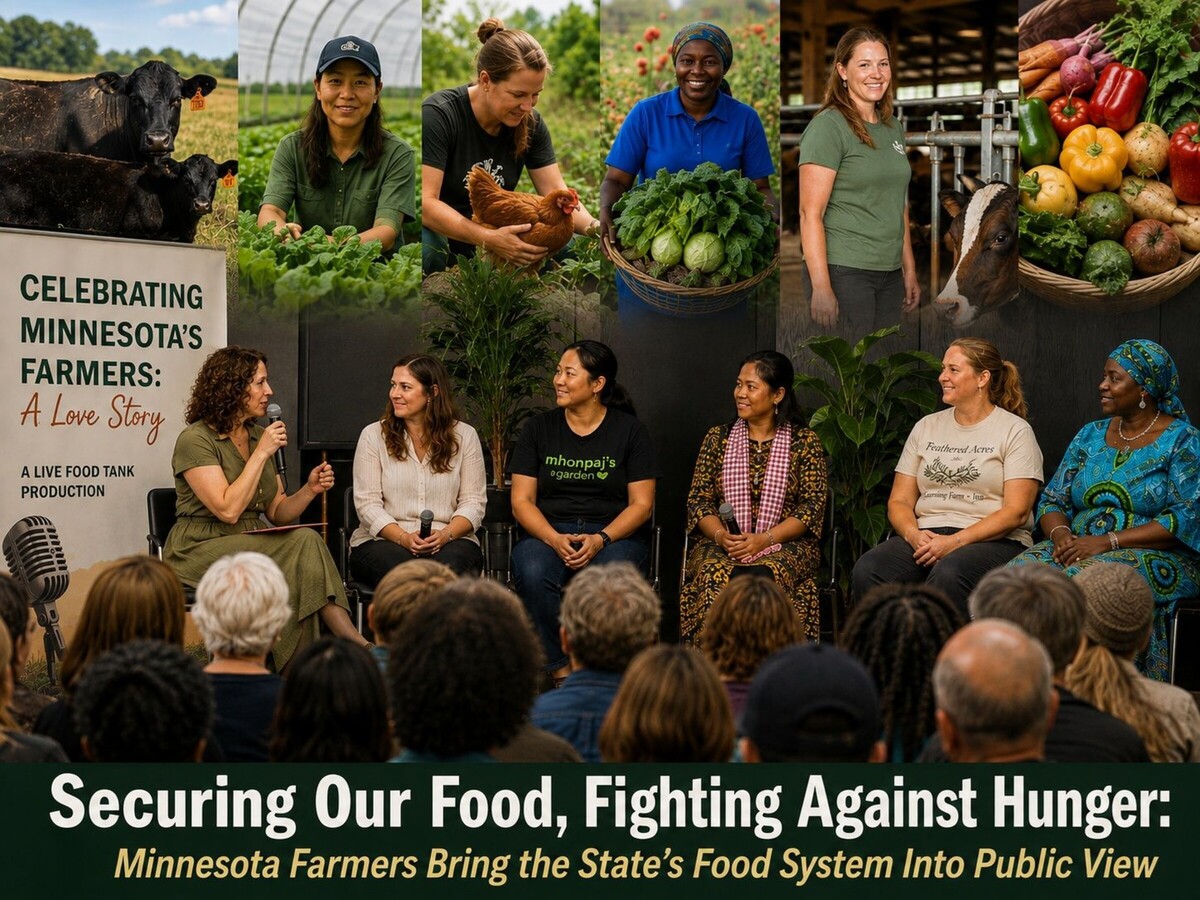



MINNEAPOLIS, MN (August 26, 2026) On Tuesday evening, six Minnesota women stood before an audience at the Minneapolis Central Library and told stories about farming.
They came from different regions, generations and agricultural traditions. Emily Zweber represented a multigenerational organic dairy farm near Elko. Maddie Hokanson brought the experience of a seventh-generation livestock family in southeastern Minnesota. Trisha Zachman described a central Minnesota farm being rebuilt around regenerative agriculture, animal care and public education.
Mhonpaj Lee represented Minnesota’s first certified-organic Hmong-owned farm. Sina War brought Cambodian food traditions into the conversation. Anita Nain Fondikum, who immigrated from Cameroon, represented farmers growing vegetables that many African and immigrant families cannot easily find in conventional grocery stores.
Their stories were presented during “Celebrating Minnesota’s Farmers: A Love Story,” an event organized by Food Tank with the City of Minneapolis, Minnesota Farmers Union and Niman Ranch.
It was an evening designed to honor farmers, and they deserve that honor. But a serious celebration of farmers cannot end with applause.
It must lead us to examine the condition of the food system they sustain.
Minnesota is one of the country’s great agricultural states. Our farms raise livestock, produce dairy products, grow grains, vegetables and specialty crops, support food processors and supply local, national and international markets. Minnesota exports more than $8 billion in agricultural products annually.
Yet in the same state, Minnesotans made more than 9 million visits to food shelves in 2025. It was the fifth consecutive year in which food-shelf use reached a record level, according to the Minnesota Department of Children, Youth and Families.
A statewide study conducted for Second Harvest Heartland found that one in five Minnesota households could not consistently afford the food they needed.
Those two facts should disturb us.
Minnesota does not lack food. Minnesota has a problem getting food from the places where it is produced to the people who need it at a price they can afford, while still paying the people who grow it enough to survive.
That is not a farming problem alone. It is not a hunger-relief problem alone. It is an economic, public-health and community-stability problem.
We cannot secure our food without securing the people who produce it. We cannot claim to support farmers while leaving families unable to purchase what farmers grow. We cannot continue treating record food-shelf demand as an unfortunate but ordinary feature of life.
There is nothing ordinary about 9 million visits to food shelves.
Food shelves are doing essential work. Volunteers, donors, faith communities, businesses, food banks and nonprofit organizations are helping families through moments of genuine hardship. Their work deserves public support and sustained funding.
But food shelves were built to provide emergency assistance. They cannot be expected to function as Minnesota’s permanent answer to inadequate wages, unaffordable housing, rising medical costs, transportation barriers and gaps in public nutrition programs.
A bag of donated groceries may help a family through the weekend. It does not reduce the rent due at the end of the month. It does not lower the cost of child care. It does not repair the car someone needs to reach work. It does not guarantee that the neighborhood grocery store will remain open. It does not give a beginning farmer the money to purchase land.
When families repeatedly have to choose between food, housing, medicine, utilities and transportation, hunger is not an isolated problem. It is evidence that the household economy is failing.
The Food Group surveyed 9,759 customers at 308 Minnesota food shelves and found that 72 percent had been forced to choose between purchasing food and paying another essential expense. The organization also calculated that groceries costing $100 in 2019 cost approximately $131 in 2025.
People are not visiting food shelves in record numbers because they have suddenly forgotten how to budget. They are going because their earnings cannot absorb the combined cost of groceries, rent, health care, child care, transportation and utilities.
Minnesota’s response must begin by acknowledging that reality.
Protecting Federal and State Nutrition Assistance
The Supplemental Nutrition Assistance Program remains the country’s largest and most effective defense against hunger.
SNAP allows eligible families to buy groceries from authorized retailers. It gives households some ability to select food appropriate for their health, culture and family circumstances. It also supports grocery stores, farmers markets, food producers and the broader economy.
The Minnesota Department of Children, Youth and Families has warned that food banks and food shelves cannot replace SNAP. For every meal supplied by the charitable hunger-relief system, SNAP provides many more.
That scale matters. If public officials reduce nutrition assistance and expect nonprofit organizations to absorb the difference, they are not solving hunger. They are transferring a government responsibility to food shelves that are already operating under record demand.
Minnesota’s congressional delegation should defend SNAP against reductions that would remove eligible households, reduce benefits or impose administrative barriers that prevent families from receiving assistance.
State officials must also make enrollment easier for eligible Minnesotans. Application systems should be understandable, available in multiple languages and accessible to people with disabilities. Counties should have enough staff to process cases accurately and without unnecessary delays.
Families should not lose food assistance because they could not navigate a complicated form, obtain a document quickly enough or reach an overburdened county worker.
The same commitment must extend to the Special Supplemental Nutrition Program for Women, Infants and Children. WIC supports pregnant women, new parents, infants and young children during stages of life when nutrition can have lasting health consequences.
Minnesota WIC participants purchased approximately $98.9 million in eligible food from local grocery stores during federal fiscal year 2025. That spending nourished families while supporting retailers and the food economy.
Nutrition assistance is not money disappearing from the economy. It moves through grocery stores, markets, distributors, processors and farms.
USDA research has estimated that during a slowing economy, every additional dollar in SNAP benefits can generate more than a dollar in broader economic activity. The precise effect changes with economic conditions, but the central point remains: helping families buy food also supports jobs and commerce.
Preserving Universal Free School Meals
Minnesota made an important decision when it established free school breakfast and lunch for students at participating schools.
During the first two years of the Minnesota Free School Meals Program, schools served more than 302 million meals. The Minnesota Department of Education estimates that the program saved participating families an average of approximately $1,000 per student each year.
That is money families can use for rent, transportation, clothing, medicine and other necessities.
Free school meals also remove the distinction between children whose families can pay and children whose families qualify for assistance. Students can eat without carrying the social label that once accompanied reduced-price or free meals.
Minnesota should protect this program, and the Minnesota Legislature must ensure state funding benchmarks adjust for grocery inflation so school districts are not forced to cover rising meal costs out of instructional budgets.
School meals should not be treated as a luxury that can be discarded when budgets tighten. A child who is hungry cannot be expected to concentrate, behave, learn and participate at the same level as a child who has eaten.
We should also continue strengthening summer and after-school meal programs. Hunger does not follow the academic calendar. When school closes for summer, the need for breakfast and lunch does not disappear.
Families need clear, timely and multilingual information about where meals are available. Transportation must also be considered, especially in rural areas and neighborhoods where families may live far from participating sites.
Expanding Municipal and Institutional Purchasing
The state should make greater use of the food already produced here.
Minnesota’s Farm to Kids programs help schools and early-childhood providers purchase food grown or raised by Minnesota farmers. As of April 2026, those programs had awarded $5.62 million in grants and cost-sharing assistance to more than 600 schools, districts, early-care centers and family child-care providers.
That is a promising foundation, but it should grow.
When schools, hospitals, colleges, senior facilities and other public institutions purchase from Minnesota producers, public dollars accomplish several goals at once. They feed people, create reliable markets for farmers, shorten parts of the supply chain and keep more economic activity within the state.
Local purchasing will not replace the national food-distribution system, nor should it. Minnesota depends on food from other states and countries, particularly during winter and for crops that cannot be grown here.
But public institutions can make local procurement a larger and more dependable part of their purchasing.
Small and emerging farmers frequently cannot compete for institutional contracts designed around large suppliers. Contracts may require quantities, insurance, packaging, delivery schedules and administrative capacity that a smaller operation cannot provide alone.
The state can help producers form cooperatives, share mid-scale cold-storage and processing facilities, meet food-safety requirements and aggregate products for larger buyers. It can also divide state contracts into smaller, regional allotments that emerging operations can realistically pursue.
Farm-to-food-shelf initiatives deserve similar support. Minnesota’s Farm to Food Security grants help farmers provide agricultural products to food shelves and other hunger-relief organizations.
These programs should pay farmers fairly. Hunger relief should not depend on asking farmers who are already operating on narrow margins to donate more of their labor and production.
A sound program purchases food from farmers and distributes it to families. It does not force us to choose between feeding the hungry and paying the farmer.
Removing Barriers for Next-Generation Farmers
Minnesota cannot secure its future food supply if new farmers cannot enter agriculture.
Farmland is expensive. Equipment is expensive. Credit can be difficult to obtain. Beginning farmers may have agricultural knowledge and a viable business plan but lack the family land, inherited machinery or financial history that established operations possess.
The Minnesota Down Payment Assistance Grant offers qualified beginning farmers as much as $20,000 toward purchasing their first farm. The state made $1.64 million available for the 2026 round and reported that the program had helped 130 farmers purchase their first farms during its first five years.
That is worthwhile, but the numbers also reveal the scale of the challenge. Helping 130 farmers over five years is meaningful to those families. It is not enough to resolve a statewide land-access problem.
Minnesota should expand down-payment assistance, beginning-farmer loans, tax incentives for landowners who sell or rent to new farmers, and grants for equipment and infrastructure. Lawmakers should also establish a statewide land-link registry to directly connect retiring producers with incoming farmers.
The state must also examine who can access these programs.
A grant exists on paper but remains inaccessible if the applicant needs substantial cash in advance, cannot obtain matching financing or does not receive help completing a technical application.
That challenge is particularly significant for immigrant farmers, farmers of color, tribal producers and others who may possess extensive agricultural experience but have less access to inherited land, conventional credit and professional grant-writing support.
Programs should be available in multiple languages. Technical assistance should be provided before application deadlines. Agencies should evaluate whether reimbursement requirements and matching funds unintentionally exclude the very farmers the programs were created to assist.
Support must also extend to farm succession.
Minnesota has families whose agricultural knowledge has developed over several generations. When a farmer retires without a successor who can afford the operation, the state can lose more than acreage. It can lose practical knowledge, community relationships, local spending and food-producing capacity.
Succession planning, affordable credit and tax policies that facilitate responsible farm transfers should be treated as parts of food-security policy.
Investing in Cultural Food Systems
The farmers featured Tuesday also demonstrated that food security is not simply a calculation of calories.
A household may receive enough food to avoid an empty stomach and still lack access to foods that are culturally familiar, medically appropriate or suitable for the family’s cooking traditions.
Mhonpaj’s Garden grows produce connected with Hmong and Southeast Asian foodways. Twin Tiger Farm & Gardens draws from Cambodian agriculture and cooking. Shining Lights Farm grows African vegetables such as bitter leaf, waterleaf, njama njama and garden eggs.
These farms are not operating at the margins of Minnesota agriculture. They are part of its future.
Minnesota’s population has changed, and the state’s agricultural identity is changing with it. Our food policies should recognize producers who bring farming knowledge from Africa, Asia, Latin America and other parts of the world.
Supporting culturally important crops can improve access for immigrant families, create new agricultural markets and reduce dependence on products transported over long distances.
State grants, extension services, farmers markets and public institutions should include these growers in their planning. Food shelves should build relationships with the communities they serve so that donated and purchased food reflects actual household needs.
People deserve more than whatever food happens to be available. They deserve food they can prepare, recognize and use with dignity.
Addressing Market Power and Producer Pricing
Consumers often assume that higher grocery prices mean farmers are receiving more money. That is not necessarily true.
Farmers face their own rising costs for seed, feed, fuel, fertilizer, land, machinery, labor, insurance and credit. Many sell into markets where they have limited control over the price of their products.
A family may pay more at the grocery store while the farmer who produced the food continues operating on a narrow or negative margin.
Minnesota must pay attention to both sides of that equation.
Farmers need fair and competitive markets, access to processing facilities, reliable infrastructure, affordable credit, risk-management tools and protection against unfair business practices. Consumers need adequate income and nutrition assistance to purchase food.
Supporting one without the other leaves the food system unstable.
We should reject the idea that the interests of farmers and low-income families are in conflict. Both are harmed by a system in which too much power can be concentrated between the farm and the household.
Farmers need enough compensation to continue producing. Families need prices they can afford. Public policy must confront the processing, distribution and market structures that determine what happens between those two points.
Measuring Hunger as a Core Economic Metric
Minnesota tracks employment, economic growth, school performance, health outcomes and many other indicators. Hunger should receive the same sustained attention.
State leaders should publish clear annual goals for reducing food insecurity and food-shelf dependence. Those goals should be measurable by region, race, age, disability status and household composition.
The state should identify where grocery stores are closing, where transportation limits food access, where nutrition-program participation is below eligibility and where emergency food organizations lack sufficient storage, refrigeration or delivery capacity.
Data should lead to action.
If one region has few grocery stores, the solution may include transportation, mobile markets or support for rural retailers. If eligible families are not enrolled in SNAP or WIC, the response may require outreach and simpler administration. If farmers cannot reach institutional buyers, the state may need aggregation, processing or distribution infrastructure.
A statewide hunger strategy cannot consist of one program or one appropriation. It must connect agriculture, health, housing, wages, education, transportation and economic development.
Turning Celebration into Policy Action
Tuesday’s event at the Minneapolis Central Library was described as a love story about Minnesota farmers.
Love, if it is to mean anything in public life, must be expressed through what we are willing to protect.
We cannot say we love farmers while allowing farmland, agricultural knowledge and the next generation of producers to slip away.
We cannot say we care about children while treating their meals as negotiable.
We cannot praise food-shelf volunteers while asking them to carry a burden that belongs to the entire state.
We cannot celebrate immigrant farmers on a stage while leaving them outside the systems that distribute land, credit, grants and institutional contracts.
We cannot boast about Minnesota’s agricultural production while one in five households struggles to afford enough food.
The farmers who gathered Tuesday reminded us where food begins. The record lines at Minnesota food shelves remind us where the system is failing.
Our response must connect those realities.
Protect SNAP and WIC. Preserve free school meals and index their funding to inflation. Strengthen food shelves without turning them into a permanent substitute for economic security. Purchase more Minnesota food for schools and public institutions while building shared processing hubs. Pay farmers fairly when their products are used for hunger relief. Help beginning farmers obtain land through expanded down-payment grants and land-link networks. Include immigrant, tribal and culturally diverse producers. Support rural grocery stores and food-distribution infrastructure. Measure hunger honestly and hold government accountable for reducing it.
Minnesota has the land, knowledge, institutions and agricultural capacity to do better.
No child should struggle to learn because there was no breakfast at home. No older adult should divide medication to save enough money for groceries. No working parent should have to decide whether food or rent receives the final dollars in a paycheck. No farmer should be driven from agriculture because producing food no longer produces a living.
Securing our food and fighting hunger are not separate causes.
They are the same responsibility.

Local stories matter. Subscribe free to MinneapoliMedia and receive independent news, community reporting and important updates from Minneapolis, the North Metro and communities across Minnesota.
SUBSCRIBE FREE: https://minneapolimedia.town.news/subscribe
MinneapoliMedia | Community. Culture. Civic Life



Sunny, with a high of 73 and low of 49 degrees. Sunny in the morning, clear during the afternoon and evening, smoky haze overnight.