Image



For more than a decade, the Twin Cities dining conversation revolved around concentration. Prestige clustered in a relatively small geography. Minneapolis’ North Loop became the symbolic capital of culinary ambition, while parts of downtown Minneapolis and St. Paul absorbed the majority of the region’s nationally recognized restaurant investment, chef-driven experimentation, and food media attention.
The logic behind that concentration was straightforward. Dense office traffic, destination tourism, convention activity, entertainment venues, and affluent apartment development created an ecosystem capable of supporting elevated restaurant concepts with high labor costs, premium ingredients, and ambitious service models. The urban core became both a marketplace and marketing machine. If a chef wanted visibility, credibility, and proximity to the region’s cultural conversation, downtown adjacency often felt necessary.
That geography is beginning to change.
Across the Twin Cities, elite culinary talent is increasingly moving outward, not necessarily into distant exurbs, but into neighborhood corridors and first-ring suburban environments that historically operated outside the center of the region’s fine dining identity. The shift is visible in places like Northeast Minneapolis, Bryn Mawr, St. Louis Park, Robbinsdale, Linden Hills, and portions of suburban Saint Paul, where chef-driven restaurants are opening in spaces once occupied by neighborhood taverns, bakeries, family diners, or modest storefront retail.
This movement is not accidental. It is structural.
High commercial rents, changing office patterns, reduced downtown commuter density, evolving customer behavior, and post-pandemic operating realities are forcing a recalibration of where sophisticated restaurants can realistically survive and where chefs themselves actually want to build sustainable businesses.
What is emerging is not merely a restaurant trend. It is a redistribution of cultural capital.
The Twin Cities food scene is undergoing a quiet decentralization, one that may ultimately redefine how Minnesotans experience fine dining, neighborhood identity, and local economic development.
For years, the North Loop represented the aspirational model.
Former warehouses became polished hospitality corridors. National publications elevated the district into a culinary destination. Chef-driven restaurants, cocktail programs, boutique hotels, and luxury residential development fed one another in a tightly interconnected ecosystem.
But prestige came with escalating costs.
Commercial lease rates climbed. Buildout expenses increased dramatically. Parking frustrations intensified. Staffing shortages worsened operating margins. At the same time, the daily office-worker population that once sustained lunch and happy-hour business patterns never fully returned to pre-pandemic levels.
The economic equation changed.
Restaurants that once depended on a blend of destination diners, corporate spending, event traffic, and downtown residential density suddenly faced a far less predictable customer base. Even successful operators began confronting a difficult question: does visibility in a prestige district still justify the financial strain attached to it?
Increasingly, many chefs appear to be answering no.
Instead of competing for expensive urban corridors saturated with hospitality concepts, operators are finding opportunity in communities where rent is lower, customer loyalty is stronger, and neighborhood identity still carries underdeveloped economic potential.
The result is a growing migration outward.
Not away from quality, but away from concentration.
One of the most important aspects of this shift is that it changes the relationship between restaurants and the communities around them.
Destination dining traditionally functions through intentional travel. Customers drive into a district, dine, spend, and leave. The surrounding neighborhood often benefits economically, but the restaurant itself may not become deeply embedded in everyday community rhythms.
Neighborhood-centric dining works differently.
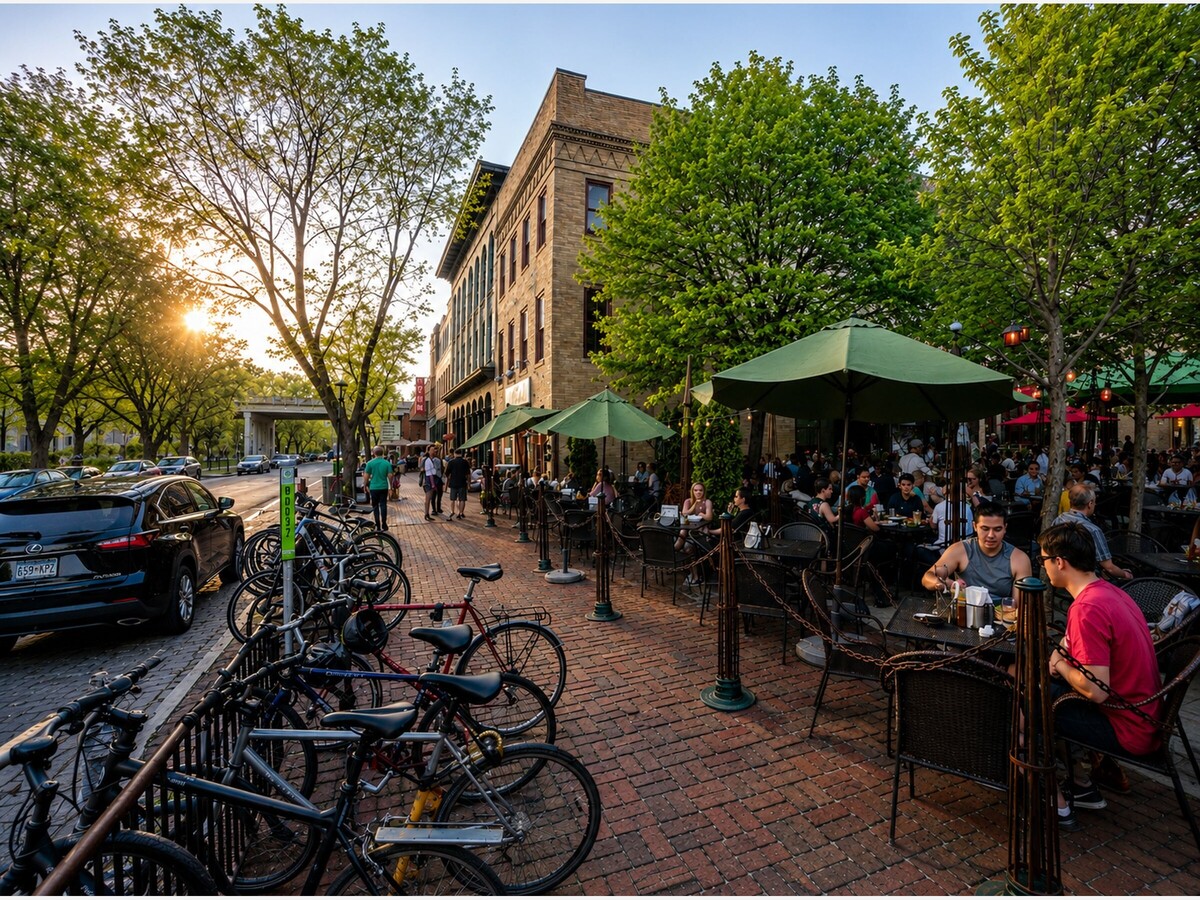
A restaurant operating in Bryn Mawr, Northeast Minneapolis, or Robbinsdale is more likely to develop repeat relationships with residents living within minutes of the establishment. Families return weekly. Local residents celebrate birthdays there. Nearby businesses cross-promote. Word-of-mouth travels through schools, parks, parent networks, and community organizations rather than solely through food media and influencer ecosystems.
This creates a different type of hospitality economy.
The restaurant becomes infrastructure.
That distinction matters because neighborhood restaurants often stabilize commercial corridors in ways that destination districts cannot always replicate. Strong restaurants increase evening foot traffic, support adjacent retail, improve perceptions of safety and vibrancy, and encourage additional investment nearby.
In practical terms, one successful chef-driven restaurant can alter how residents experience an entire neighborhood corridor.
The decentralization of the food scene therefore carries implications far beyond dining itself. It affects local commerce, real estate confidence, transportation patterns, and civic identity.
Another notable dimension of this transition is cultural rather than economic.
For years, portions of the American fine dining industry became heavily performative. Restaurants increasingly emphasized exclusivity, aesthetic branding, reservation scarcity, luxury signaling, and social media visibility. Dining became not only about food, but about status communication.
Neighborhood-centered culinary models soften some of that dynamic.
A chef operating in a residential corridor often encounters different customer expectations than one operating inside a highly branded downtown entertainment district. Residents may still want exceptional food and thoughtful hospitality, but they are less interested in ritualized exclusivity and more interested in consistency, warmth, accessibility, and community connection.
This does not necessarily lower standards.
In many cases, it may actually improve the long-term sustainability of ambitious restaurants.
A chef no longer needs to build an experience around spectacle alone. The emphasis can shift toward craftsmanship, neighborhood trust, and repeatability. Restaurants become places people integrate into their lives rather than occasional luxury performances detached from ordinary routines.
That evolution may ultimately strengthen the Twin Cities dining culture.
The most resilient restaurant ecosystems are often those rooted in habit, not hype.
Few places illustrate this transition more clearly than Northeast Minneapolis.
Long known for its industrial history, artist communities, breweries, and independent business culture, Northeast has steadily transformed into one of the region’s most important food corridors. What distinguishes the area is not simply the quantity of restaurants, but the diversity of concepts capable of surviving there.
High-end tasting menus now exist alongside bakeries, immigrant-owned establishments, cocktail bars, casual neighborhood cafes, butcher shops, and brewery kitchens. The area supports experimentation while retaining a distinctly local identity.
Importantly, Northeast’s culinary growth did not emerge from corporate master-planning in the way some entertainment districts evolve. It grew incrementally through independent operators willing to test whether neighborhood density and local loyalty could sustain ambitious concepts.
Increasingly, the answer appears to be yes.
That success is likely influencing chefs elsewhere in the metro area. It demonstrates that prestige no longer requires geographic centralization.
A restaurant can be nationally respected without sitting inside a luxury district.
Bryn Mawr represents another fascinating case study.
Historically viewed primarily as a residential enclave rather than a culinary destination, Bryn Mawr increasingly reflects a broader shift occurring across urban-adjacent neighborhoods nationwide. Affluent consumers are seeking high-quality experiences closer to home, particularly as hybrid work reduces daily commuting patterns.
This changes the economics of proximity.
If professionals no longer travel downtown five days a week, they are more likely to spend discretionary dining dollars inside their own neighborhoods. Restaurants no longer need to follow office towers as aggressively as they once did. Instead, they can follow residential stability.
That redistribution of spending power benefits neighborhoods capable of supporting sophisticated hospitality ecosystems.
It also alters the meaning of suburban and neighborhood commercial development. Food becomes a leading indicator of demographic confidence. Once chef-driven restaurants arrive, additional investment often follows.
The central question underlying this entire trend is sustainability.
Can neighborhood-based dining ecosystems consistently support high-end culinary operations without relying on commuter density, tourism concentration, or entertainment district traffic?
The answer remains uncertain.
Chef-driven restaurants still operate on notoriously thin margins. Labor costs remain elevated. Ingredient volatility continues to pressure operators. Consumer spending is increasingly unpredictable. Even affluent diners have become more selective about frequency and value.
Neighborhood support alone may not always be enough.
There is also the risk of overexpansion. Once a neighborhood gains culinary attention, commercial rents can rise quickly, eventually recreating the same pressures that pushed operators away from downtown cores in the first place.
In other words, decentralization can eventually reproduce its own contradictions.
Still, the Twin Cities may possess several structural advantages.
The metro area has long maintained strong neighborhood identities, relatively engaged local communities, and consumers willing to support independent establishments. Minnesota diners also historically demonstrate loyalty toward locally rooted businesses in ways that can benefit chef-driven operators seeking stability over spectacle.
That loyalty may become one of the defining economic forces shaping the next era of Twin Cities dining.
What is ultimately happening is larger than restaurants.
Prestige itself is dispersing.
For decades, urban America concentrated cultural legitimacy into a small number of highly visible districts. The best restaurants, galleries, nightlife venues, and cultural experiences clustered together geographically. Visibility depended heavily on proximity.
The Twin Cities food scene increasingly suggests a different model.
Recognition can emerge from neighborhood embeddedness rather than district branding. Culinary excellence no longer needs a downtown zip code to achieve legitimacy. A nationally respected dining experience can exist beside residential streets, bike paths, corner stores, and elementary schools.
That redistribution changes who gets access to high-quality dining experiences and how communities define themselves.
Fine dining becomes less isolated from ordinary civic life.
In many ways, that may be healthier for the region itself.
A city’s cultural identity becomes more durable when excellence is distributed rather than concentrated.
There is a democratic dimension to this transition that deserves attention.
When elite dining concentrates heavily in expensive entertainment districts, access narrows. Parking costs rise. Reservation systems become more competitive. Dining begins to feel geographically and culturally exclusive.
Neighborhood-based culinary ecosystems reduce some of those barriers.
Residents encounter sophisticated restaurants as part of daily life rather than as occasional destination events. Young chefs may find more affordable entry points outside premium districts. Smaller commercial corridors gain relevance. Communities historically overlooked by regional food conversations become viable spaces for innovation.
This does not eliminate inequality inside the hospitality industry. But it does redistribute opportunity.
The Twin Cities food scene may ultimately become stronger precisely because it is becoming less centralized.
The long-term implications of this shift are still unfolding.
Downtown Minneapolis and the North Loop are not disappearing as culinary centers. They remain enormously influential and continue to house many of the region’s most recognizable establishments.
But they are no longer the uncontested center of gravity.
The future Twin Cities dining map is likely to look more distributed, more neighborhood-oriented, and more interconnected across municipal boundaries than at any point in recent memory.
That evolution reflects broader changes in American urban life itself: hybrid work, localized spending patterns, skepticism toward exclusivity culture, and renewed interest in community-scale experiences.
Restaurants are simply revealing those changes earlier than many other industries.
The decentralization of the food scene is therefore not a side story within Twin Cities culture. It is a window into how the region itself is reorganizing economically, socially, and geographically after the disruptions of the last several years.
And if the trend continues, the next defining restaurant in Minnesota may not open in the most fashionable downtown corridor.
It may open a few blocks from somebody’s home.
MinneapoliMedia | Community. Culture. Civic Life.



Sunny, with a high of 85 and low of 60 degrees. Sunny in the morning, clear overnight.